

MSO8604HD | Lab-Grade 6 GHz 4-Channel 12-Bit Mixed Signal Oscilloscope
Overview
The MSO8604HD is a lab-grade 6 GHz 4-channel mixed signal oscilloscope on UNI-T’s MSO8000HD platform, with a native 12-bit ADC, 20 GSa/s real-time sample rate in half-channel mode, 1 Gpts of standard memory per channel at half channels and a rise time of ≤ 73 ps. Sustained waveform capture is ≥ 1,000,000 wfms/s, and the 12-bit resolution is native across the acquisition rather than an averaging mode you switch on and pay for in update rate.
It is the MSO8000HD for benches where signal integrity and power integrity meet. High-speed serial links run on the 50 Ω inputs at up to 6 GHz; power-delivery rails, regulators and control loops run on the 1 MΩ input path, specified to 500 MHz, with the optional MSO8000HD-PWR power analysis suite. One instrument, one timebase, both halves of the board.
It sits between the MSO8504HD at 5 GHz and the MSO8804HD at 8 GHz. All three share the chassis, the 20 GSa/s digitiser, the 15.6-inch FHD touch display and the analysis stack. The MSO8604HD and MSO8504HD add the 1 MΩ path and ship with four UT-P07 500 MHz high-impedance passive probes alongside the 50 Ω kit; the 8 GHz MSO8804HD is 50 Ω only.
Key Features
- 6 GHz Analog Bandwidth at 50 Ω — Half-channel operation, rise time ≤ 73 ps; 4 GHz in full-channel mode.
- 500 MHz 1 MΩ Input Path — High-impedance probing and power measurement on the same instrument. Not available on the MSO8804HD.
- Power Analysis (Optional) — MSO8000HD-PWR: ripple, PSRR, control-loop response, sequencing, switching loss, efficiency and more.
- Native 12-Bit Resolution — 12-bit ADC with an ERes mode to 16-bit, not an 8-bit front end with averaging bolted on.
- 20 GSa/s Sample Rate — 20 GSa/s on half channels, 10 GSa/s with all four analog channels active.
- 1 Gpts Standard Memory — 500 Mpts/CH full-channel and 1 Gpts/CH half-channel as standard, upgradable to 1 Gpts and 2 Gpts with MSO8000HD-MD2G.
- ≥ 1,000,000 wfms/s — Sustained capture rate for rare-event hunting, with segmented Sequence mode.
- 4 Analog + 16 Digital Channels — Mixed-signal ready; the 16 digital channels require MSO8000HD-LA.
- ≤ 150 fs RMS Inherent Jitter — Platform figure, with ≥ 50 dBc typical SFDR.
- Eight Instruments in One — Oscilloscope, spectrum analyzer, digital voltmeter, frequency counter and limit-template testing as standard; waveform generator, logic analyzer, protocol and power analysis as options.
- 15.6-Inch FHD Touch Display — Multi-window touch UI, with WebServer and mobile access over the network.
Detailed Features
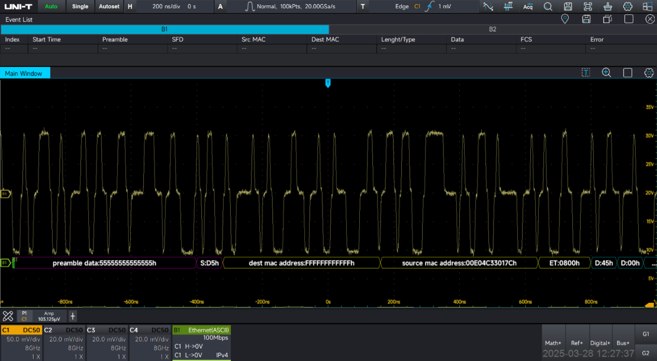
Protocol Analysis — Five Standard, Sixteen Optional
RS-232/422/485/UART, I²C, SPI, CAN and LIN decode as standard. The optional set covers CAN-FD, FlexRay, SENT, I3C, PSI5, USB 1.0/2.0, PCIe 1.0/2.0, 10/100 Mb/s Ethernet, NRZ, Manchester, 8b/10b, SMBus, SPMI, AudioBus (I2S, LJ, RJ, TDM), MIL-STD-1553 and ARINC 429 — individually or as MSO8000HD-BND.
Decoded packets sit on the analog trace, so a CRC error is read against the edge that caused it. Protocol search indexes every matching packet in deep memory and the event list steps between hits, which is the difference between finding a fault and scrolling past it.
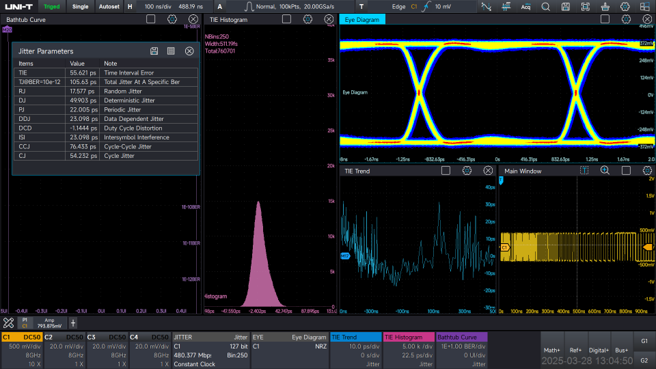
Jitter Analysis and Eye Diagram (Optional)
MSO8000HD-JITTER decomposes random and deterministic jitter and builds real-time eye diagrams for high-speed serial validation. The platform's ≤ 150 fs RMS inherent jitter is what makes the measurement meaningful — an instrument contributing more jitter than the link under test measures itself.
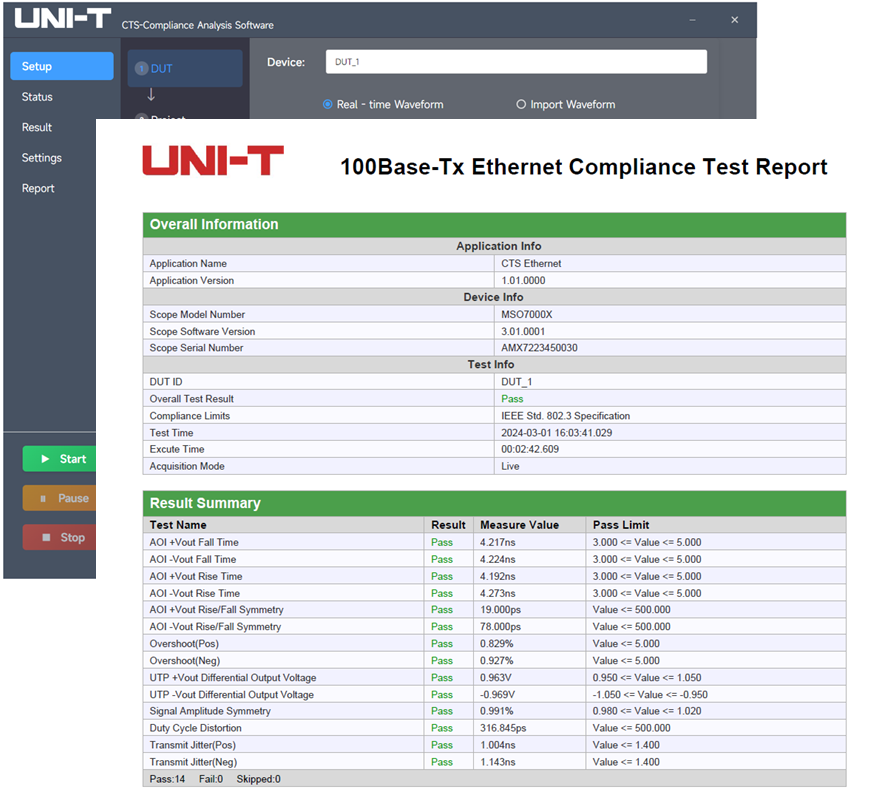
Conformance Test Packages (Optional)
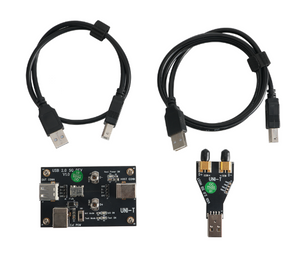
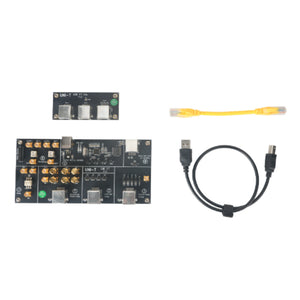
Compliance packages cover MSO8000HD-CTSUSB20 for USB 2.0, MSO8000HD-CTS100 for 100BASE-TX, MSO8000HD-CTS1000 for 1000BASE-T, MSO8000HD-CTS100T1 and MSO8000HD-CTS1000T1 for 100BASE-T1 and 1000BASE-T1 automotive Ethernet, and MSO8000HD-CTSDPHY12 for MIPI D-PHY v1.2. Each runs the standard test set automatically and produces a pass/fail report, which is the part that takes the time when it is done by hand. Test fixtures: UT-USB20-SQ-HD for USB 2.0 and UT-GBE-FT for 100/1000 Mbps Ethernet.
Power Analysis (Optional)
Modern power delivery runs at low voltage and high current, so a rail has to be clean as well as correct. The MSO8604HD reads it on the 1 MΩ path with 12-bit resolution, which keeps millivolt ripple and the DC level it rides on readable in the same view, while the 50 Ω channels watch the high-speed lines that rail is feeding.
MSO8000HD-PWR adds automated power quality, inrush current, harmonics, switching loss, safe operating area (SOA), start-up and shut-down timing, modulation, ripple, efficiency, Rds(on), power-supply sequencing, slew rate (dv/dt and di/dt), control-loop response (Bode plot) and power-supply rejection ratio (PSRR). Results are repeatable from one run to the next, which is what turns a bench check into a validation record.
Power probes connect on the 1 MΩ path: UT-P4150 (12 MHz, 150 A), UT-P4030D (100 MHz, 30 A) and UT-P4500 (5 MHz, 500 A) DC/AC current probes; UT-P30 through UT-P36 high-voltage differential probes; and the UT-PR2060 power rail probe (1 GHz, ±60 V offset) for ripple on low-voltage rails.
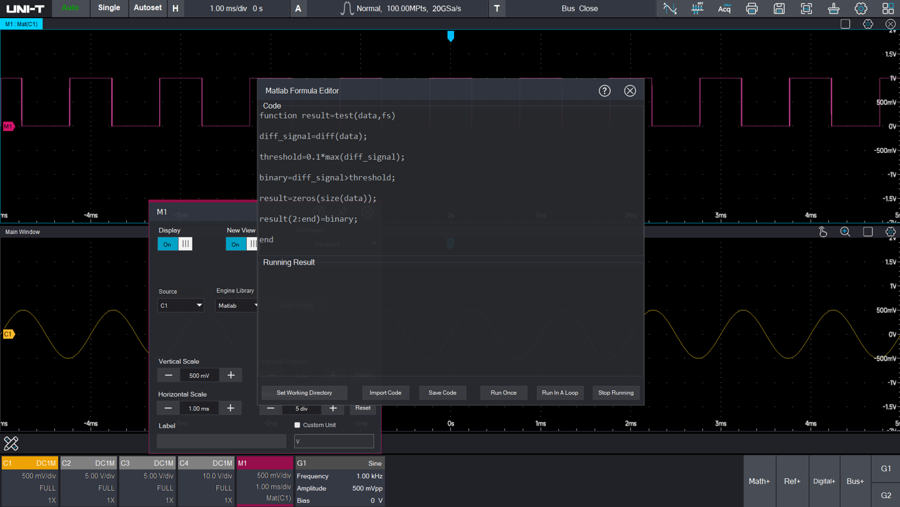
Embedded MATLAB Programming (Optional)
MSO8000HD-MAT embeds a MATLAB compiler in the instrument. Scripts execute against the acquired waveform and their results render as math waveforms on screen, so a custom analysis runs where the data already is instead of being exported to a PC first. A valid MathWorks MATLAB license is required and is not included.
Native 12-Bit Across the Acquisition
The MSO8000HD platform digitises at 12 bits natively — sixteen times the vertical resolution of an 8-bit oscilloscope at the same gain setting. That matters most when a small signal has to be read in the presence of a large one: ripple on a rail, a low-level reflection riding on a clean edge, the difference between two nominally identical lanes. An 8-bit instrument recovers that detail by changing the gain, which is only possible when the large signal is not also on screen. ERes mode extends resolution to a maximum of 16 bits where bandwidth can be traded for it.
Channel Architecture — 6 GHz Half-Channel, 4 GHz Full-Channel
The MSO8604HD interleaves its digitisers. Using half the channels gives the full 6 GHz of bandwidth and 20 GSa/s; using all four analog channels gives 4 GHz and 10 GSa/s. Memory follows the same split, at 1 Gpts/CH and 500 Mpts/CH respectively. Plan the channel count around the fastest edge in the measurement, not the other way round.
Deep Memory and Sequence Mode
Standard memory is 500 Mpts per channel in full-channel mode and 1 Gpts per channel on half channels; MSO8000HD-MD2G doubles both. Deep memory is what lets a long window be captured without dropping sample rate — the usual trade that hides the glitch you were looking for. Sequence mode segments that memory across many triggers, storing event after event with minimal dead time between them, which is where the ≥ 1,000,000 wfms/s figure earns its keep.
Integrated Instruments
Spectrum analyzer, 4-digit digital voltmeter, 8-digit frequency counter and the limit-template testing kit are standard. MSO8000HD-AWG adds a dual-channel function and arbitrary waveform generator with 60 MHz maximum output at 625 MSa/s, including modulation and sweep. MSO8000HD-LA enables the 16 digital channels.
Measurement and Automation
74 automated parameter measurements with quick-measure, statistical analysis, histograms, trend charts and trace analysis. The instrument is driven over SCPI for rack automation, and the built-in WebServer puts the display and controls in a browser — useful when the scope lives in a screened room or a test cell rather than on the desk in front of you.
Applications
Signal Integrity and Power Integrity on One Bench
Processors, FPGAs and SerDes devices fail at the boundary between their data lanes and the power that feeds them. The MSO8604HD measures both: 6 GHz on the 50 Ω inputs for eye diagrams and jitter, and the 1 MΩ path with MSO8000HD-PWR (Optional) for rail ripple, power-supply sequencing, PSRR and control-loop response. A rail droop and the bit error it causes are read in one acquisition rather than inferred across two instruments.
High-Speed Digital Design
6 GHz and ≤ 73 ps rise time cover PCIe Gen2, USB 2.0, Gigabit Ethernet and most embedded SerDes bring-up, with optional jitter, eye-diagram and PAM-N analysis. The UT-PD6000 active differential probe matches it at 6 GHz and ≤ 73 ps. Combined with 12-bit resolution, small crosstalk and reflection terms resolve without gain juggling.
Mixed Analog and Digital Bring-Up
With the logic analyzer option the instrument correlates 16 digital channels against four analog ones on the same timebase, so a bus transaction and the power rail sagging underneath it are captured together.
In the Box
- 2 × UT-P6150 low-impedance passive probe, 1.5 GHz
- 4 × UT-P07 high-impedance passive probe, 500 MHz
- 2 × UT-JLC12 SMA cable, 12 GHz, 1 m
- 2 × UT-KJG12 SMA adapter, BNC to SMA, 50 Ω
- 2 × UT-L45 BNC-to-BNC straight-through cable, 1 m
- 1 × UT-D30 USB 3.0 data cable, 1 m
- 1 × region-specific power cord
- 1 × front-panel protective cover
- Calibration certificate
Instrument dimensions 445 × 311.3 × 189.7 mm (W × H × D), under 12.5 kg. Ships one unit per carton.
Recommended Add-Ons
- MSO8000HD-LA — enables the 16 digital channels.
- MSO8000HD-MD2G — doubles memory to 1 Gpts/CH full-channel and 2 Gpts/CH half-channel.
- MSO8000HD-BND — all optional serial protocol decoders in one license.
- MSO8000HD-PWR — advanced power analysis.
- UT-PR2060 — 1 GHz power rail probe, ±60 V offset.
- MSO8000HD-JITTER — jitter analysis and eye diagram.
- UT-PD6000 — 6 GHz active differential probe, ≤ 73 ps.
- MSO8000HD-AWG — dual-channel 60 MHz function and arbitrary waveform generator.
Frequently Asked Questions
How does the MSO8604HD differ from the MSO8804HD and MSO8504HD?
Bandwidth and input paths. All three share the chassis, the 20 GSa/s digitiser, 12-bit resolution, memory options, display and analysis stack. The MSO8804HD reaches 8 GHz and is built for signal-integrity work, 50 Ω only. The MSO8604HD (6 GHz) and MSO8504HD (5 GHz) add a 1 MΩ input path specified to 500 MHz, ship with four UT-P07 high-impedance probes, and support MSO8000HD-PWR power analysis.
Does the MSO8604HD support power analysis?
Yes, with the MSO8000HD-PWR option (Optional) on the 1 MΩ input path. It adds power quality, inrush current, harmonics, switching loss, safe operating area (SOA), start-up and shut-down timing, modulation, ripple, efficiency, Rds(on), power-supply sequencing, slew rate (dv/dt and di/dt), control-loop response (Bode plot) and power-supply rejection ratio (PSRR).
What is the rise time?
≤ 73 ps, at 50 Ω.
Do I get 6 GHz on all four channels?
No. 6 GHz and 20 GSa/s are available in half-channel mode. With all four analog channels active the instrument runs at 4 GHz and 10 GSa/s. This is the standard interleaving trade across the series.
Is the 12-bit resolution real, or an averaging mode?
It is a native 12-bit ADC — the resolution is present in every acquisition at full waveform capture rate, with no averaging step and no reduction in update rate. ERes mode extends it to a maximum of 16 bits where you can trade bandwidth for resolution.
Are the 16 digital channels included?
The 16-channel logic analyzer hardware is built into every MSO8000HD. It is enabled by the MSO8000HD-LA license (Optional) and connected through the UT-M15 16-channel logic probe (Optional), which UNI-T lists as a separate item.
| Analog Bandwidth | 6GHz | ||||||||||||
|---|---|---|---|---|---|---|---|---|---|---|---|---|---|
| Channels | 4Ch+16D (opt) | ||||||||||||
| Sample Rate | 20GSa/s | ||||||||||||
| Memory Depth |
|
||||||||||||
| Vertical Resolution | 12 bits | ||||||||||||
| Built-in Signal Generator | Optional | ||||||||||||
| Digital Channels | Optional | ||||||||||||
| Touch Screen | ✓ | ||||||||||||
| Instrument Type | HD Mixed Signal Oscilloscope | ||||||||||||
Features
- Frequency Counter
- Digital Voltmeter
Full specifications (22)
| Details | |||||
|---|---|---|---|---|---|
| Waveform Capture Rate |
|
||||
| Input Impedance | 1 MΩ | 50 Ω | ||||
| Vertical Scale (1 MΩ) | 1mV/div to 10V/div | ||||
| Vertical Scale (50 Ω) | 1mV/div to 1V/div | ||||
| Automated Measurements | 74 | ||||
| Bus Protocols (Standard) | RS232|UART|RS422|RS485|I2C|SPI|CAN|LIN | ||||
| Bus Protocols (Optional) | CAN-FD|FlexRay|SENT|Audio|MIL-STD-1553B|ARINC429|SMBus|SPMI|I3C|PSI5|USB2.0|PCIe2.0|Ethernet|NRZ|Manchester|8B/10B | ||||
| Protocol Decoders | 21 | ||||
| Measurement Parameters | 74 | ||||
| FFT Points | 1Mpts | ||||
| ENOB | >7 bits (full system bandwidth, 50Ω, 50mV/div, -3dBFS) | ||||
| Features | |||||
| Frequency Counter Bits | 8-digit | ||||
| DVM Resolution | 4-digit | ||||
| AWG Channels | 2 | ||||
| AWG Frequency | 60 MHz | ||||
| General Information | |||||
| Display Size | 15.6in | ||||
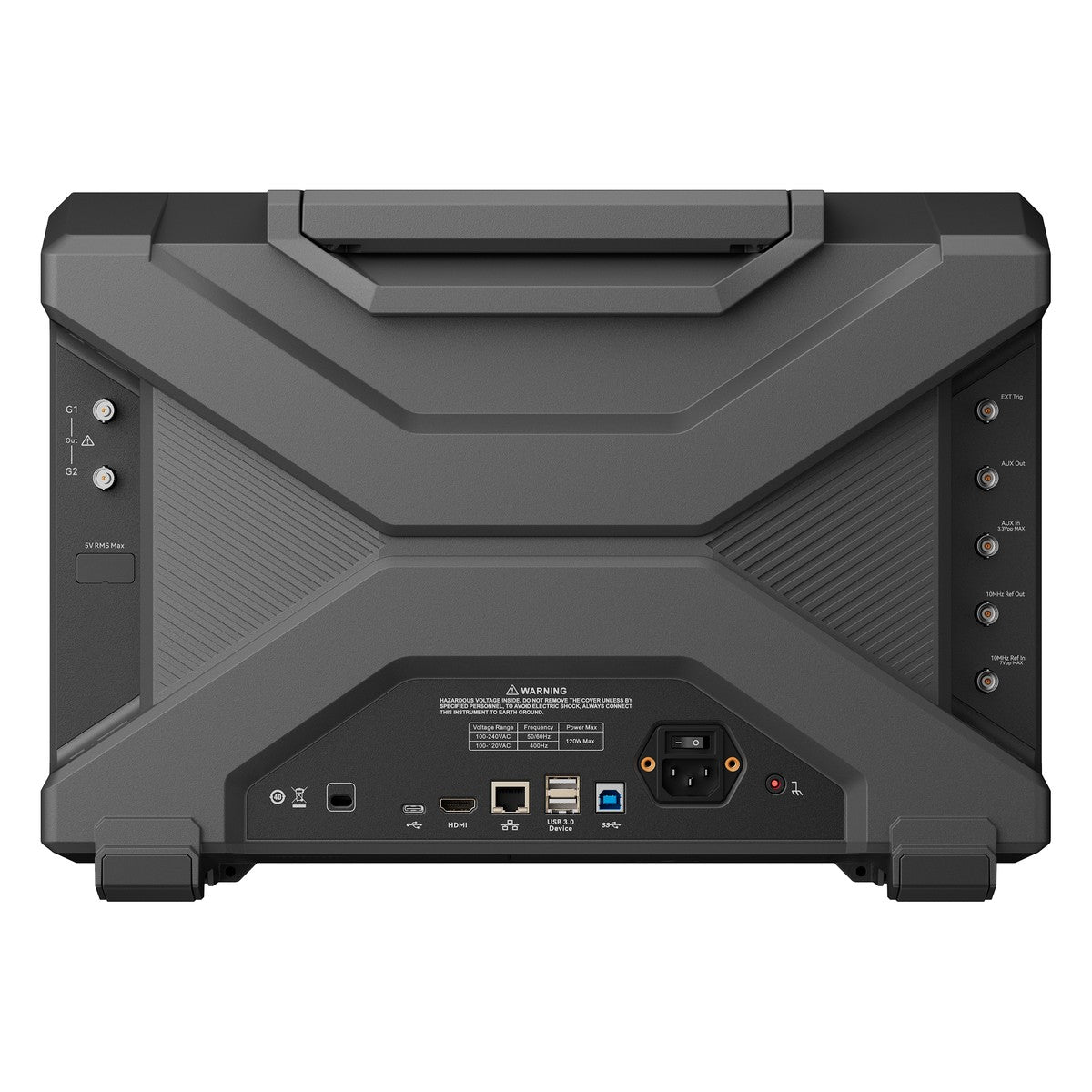
| Interface | USB Host x4 Type-A|USB Host x1 Type-C|USB Device|LAN|HDMI|AUX In|AUX Out|10MHz Ref In/Out | ||||
| Operating Temperature | 0 °C to +40 °C | ||||
| Dimensions (W×H×D) | 445 × 311 × 190 mm | ||||
| Weight | <12.5 kg | ||||
| Warranty | 3+2 years | ||||
| Certifications | CE|cETLus | ||||
Data Sheets and Manuals
Check your instrument’s hardware revision before updating firmware — different hardware revisions take different builds.
Authentic UNI-T accessories are an affordable way to extend the functionality of your instrument.
MSO8000HD Options 27
Need to add specific functionality to your UNI-T instrument? Here are our options for specific applications and measurement types. Have a question? Contact us at 888-668-UniT (8648).
MSO8000HD-8B10B 8b/10b Signal Analysis Option
$999.00
MSO8000HD-AERO Aerospace Serial Bus Trigger Package Option
$999.00
MSO8000HD-AUDIO Audio Serial Bus Option
$999.00
MSO8000HD-AWG Arbitrary Waveform Generator Option
$699.00
MSO8000HD-BND Protocol Analysis and Jitter Suite
$5,399.00
MSO8000HD-CANFD Automotive CAN-FD Serial Bus Option
$999.00
MSO8000HD-CTS100 100MBASE-Tx Ethernet Compliance Test Option
$2,999.00
MSO8000HD-CTS1000 1000 BASE-T Ethernet Compliance Test Option
$3,999.00
MSO8000HD-CTSDPHY12 MIPI D-PHY v1.2 Compliance Test Option
$7,399.00
MSO8000HD-CTSUSB20 USB 2.0 Compliance Test Option
$1,399.00
MSO8000HD-FILTER Advanced Filter Designer Option
$1,299.00
MSO8000HD-FLEX Automotive FlexRay Serial Bus Option
$999.00
MSO8000HD-I3C Embedded I3C Option
$999.00
MSO8000HD-JITTER Advanced Jitter Analysis and Eye Diagram Option
$2,999.00
MSO8000HD-LA 16-Channel Logic Analyzer Option
$399.00
MSO8000HD-MANCH Serial Bus Manchester Option
$999.00
MSO8000HD-MAT MATLAB Embedded Programming Option
$1,299.00
MSO8000HD-MD2G Double the MSO8000HD Memory to 2Gpts
$5,399.00
MSO8000HD-NET 10BASE-T, 100BASE-TX Ethernet Bus Analysis Option
$2,999.00
MSO8000HD-NRZ NRZ Signal Analysis Option
$999.00
MSO8000HD-PCIe2 PCIe Bus Trigger and Analysis Option
$2,999.00
MSO8000HD-PSI5 Automotive PSI5 Serial Bus Option
$999.00
MSO8000HD-PWR Advanced Power Analysis Option
$2,999.00
MSO8000HD-SENT Automotive SENT Serial Bus Option
$999.00
MSO8000HD-SMBUS Embedded Serial Bus SMBus Option
$999.00
MSO8000HD-SPMI Power Management Serial Option
$999.00
MSO8000HD-USB2 USB2.0 Analysis Option
$2,999.00Active Probes 2

Differential Probes 8

UT-PD2500 2.5 GHz Active Differential Probe
$3,779.00UT-PD1500 1.5 GHz Active Differential Probe
$2,845.00
UT-P30 100 MHz 10:1/100:1 Differential Oscilloscope Probe
$399.00
UT-P31 100 MHz 100:1/1000:1 Differential Oscilloscope Probe
$699.00
UT-P32 50 MHz 100:1/1000:1 Differential Oscilloscope Probe
$860.00
UT-P33 120 MHz 100:1/1000:1 Differential Oscilloscope Probe
$1,465.00
UT-P35 50 MHz 50:1/500:1 Differential Oscilloscope Probe
$395.00
UT-P36 100 MHz 200:1/2000:1 Differential Oscilloscope Probe
$459.00Power Rail Probes 1
Passive Probes 4


Current Probes 6

UT-P4150 12 MHz High-Frequency DC/AC Current Probe
$2,529.00
UT-P40 DC-100 kHz 60A AC/DC Current Probe
$452.00
UT-P41 DC-100 kHz 100A AC/DC Current Probe
$595.00
UT-P42 150 kHz 200A AC/DC Current Probe
$459.00
UT-P43 DC-25 MHz 20A 100mV/A Current Probe
$956.00