

MSO8804HD | Lab-Grade 8 GHz 4-Channel 12-Bit Mixed Signal Oscilloscope
Overview
The MSO8804HD is a lab-grade 8 GHz 4-channel mixed signal oscilloscope built on UNI-T’s R12™ native 12-bit ADC architecture, with a 20 GSa/s real-time sample rate (half-channel mode), 500 Mpts standard memory depth (expandable to 2 Gpts), and a calculated rise time of ≤55 ps. The 12-bit resolution holds across the full 8 GHz bandwidth with no ERES averaging step or sample-rate trade-off, and the front-end’s effective number of bits stays >7 bits at full system bandwidth. Sustained capture rate is ≥1,000,000 wfms/s, with segmented Sequential Mode storing up to 520,000 frames of hardware real-time waveform history.
The MSO8804HD is the signal-integrity model of the MSO8000HD series. Its 8 GHz front end and ≤55 ps rise time are aimed at high-speed serial work: jitter decomposition and eye diagrams, PAM-3 through PAM-8 multi-level signaling, and automated compliance testing for USB 2.0, 100/1000BASE-T Ethernet, 100/1000BASE-T1 automotive Ethernet and MIPI D-PHY v1.2 (Optional). The same edge fidelity makes it the series choice for semiconductor and device characterization, where the transition itself is the measurement. Built on UNI-T’s self-developed AFE ASIC and seventh-generation oscilloscope platform.
Key Features
- 8 GHz Bandwidth, 4 Analog Channels — 8 GHz / 20 GSa/s in half-channel mode (C1 or C3 alone, or both simultaneously); 4 GHz / 10 GSa/s in full-channel mode.
- R12™ Native 12-Bit ADC, Up to 16-Bit ERES — 4,096 quantization levels at full bandwidth, sixteen times the resolution of a conventional 8-bit oscilloscope.
- >7 Bits ENOB at Full Bandwidth — Effective number of bits stays above 7 at 50 Ω, 50 mV/div, −3 dBFS — the spec that makes 12-bit resolution actually visible on screen.
- 500 Mpts Standard / 2 Gpts Optional Memory — Deep memory for extended captures and Sequential Mode segmentation.
- ≥1,000,000 wfms/s Capture Rate — UltraAcq® up to 300,000 wfms/s standard; ≥1,000,000 wfms/s with Sequential Mode enabled; up to 520,000 frames of hardware real-time recording.
- 21+ Protocol Decoders — Embedded, automotive and computer/communications buses; RS-232/422/485/UART, I²C, SPI, CAN and LIN included standard.
- Optional Jitter Analysis and Eye Diagram — MSO8000HD-JITTER package decomposes random/deterministic jitter and generates real-time eye diagrams for high-speed serial validation.
- PAM-N Analysis — PAM-3 through PAM-8 multi-level signaling for Ethernet, optical communications and emerging high-speed interfaces.
- Compliance Test Packages (Optional) — USB 2.0, 100BASE-TX, 1000BASE-T, 100BASE-T1, 1000BASE-T1 and MIPI D-PHY v1.2, with automated pass/fail reporting.
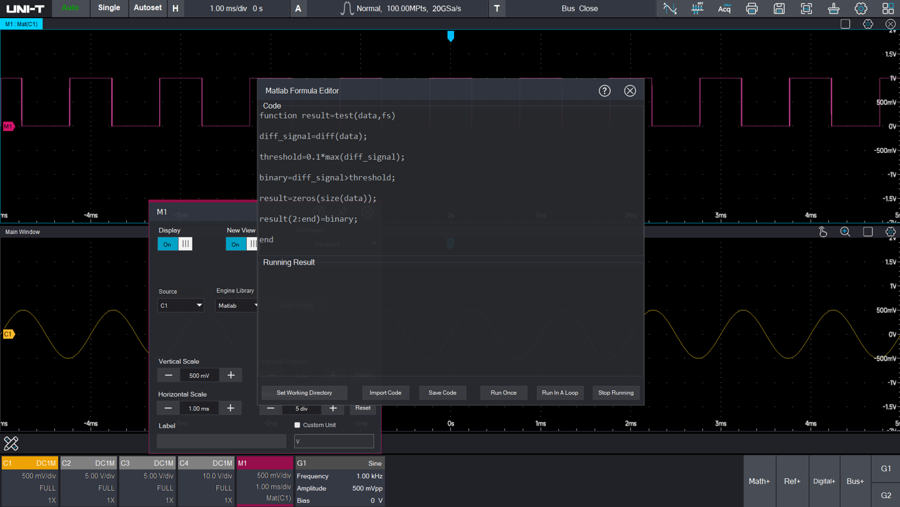
- Embedded MATLAB Programming (Optional) — Run your own MATLAB scripts on-instrument; a valid MathWorks MATLAB license is required and is not included.
- Full SCPI Automation — SCPI over LAN, USB Device, and built-in WebServer.
- 15.6-Inch FHD Multi-Window Touch UI — 1920×1080 capacitive multi-touch with dynamic multi-window operation.
Detailed Features
R12™ — Native 12-Bit at the Full 8 GHz Bandwidth
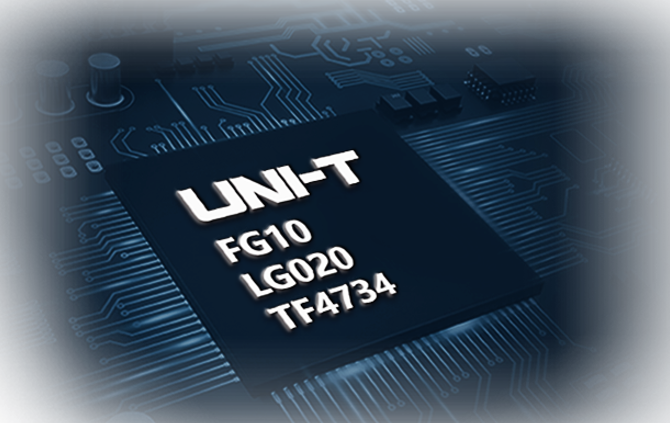
R12™ is UNI-T’s native 12-bit ADC architecture: 4,096 vertical quantization levels — sixteen times the resolution of a conventional 8-bit oscilloscope — held at the full 8 GHz analog bandwidth and 20 GSa/s sample rate (half-channel mode), with no ERES averaging step or sample-rate trade-off. ERES extends effective vertical resolution to 16-bit when bandwidth headroom is available; the baseline 12-bit performance is the front-end’s native behavior, not a software multiplier.
At full 8 GHz bandwidth, ENOB stays >7 bits (Typ., 50 Ω, 50 mV/div, −3 dBFS), inherent jitter ≤150 fs RMS, and SFDR ≥50 dBc — the combination that makes 12-bit resolution actually visible on screen instead of buried under noise. Background noise reaches as low as 390 µVrms on the 1–10 mV/div ranges, and stays ≤800 µVrms (Typ.) at 50 mV/div across the full bandwidth.
R12™ native 12-bit ADC: 4,096 quantization levels held across the full 8 GHz bandwidth, with >7 bits ENOB at 50 Ω and 50 mV/div.
UltraAcq® and Sequential Mode — ≥1,000,000 wfms/s for Rare-Event Hunting
The MSO8804HD captures up to 300,000 wfms/s in UltraAcq® standard acquisition mode, climbing to ≥1,000,000 wfms/s with Sequential Mode enabled. Sequential Mode segments deep memory (500 Mpts standard, 2 Gpts optional) into trigger-conditioned acquisition windows, minimizing dead time between captures and recording up to 520,000 frames of hardware real-time waveform history.
After acquisition, captured frames replay individually, animate as a sequence, or display up to 40 segments simultaneously (45° perspective, overlap, superimpose, or stitch) — turning rare-event hunting on a live serial bus from a watch-and-wait debug session into an analysis-after-capture exercise.
Optimized Channel Architecture — 8 GHz Half-Channel, 4 GHz Full-Channel
The MSO8804HD’s analog front end delivers the full 8 GHz bandwidth and 20 GSa/s sample rate in half-channel mode (C1 alone, C3 alone, or C1+C3 simultaneously); in full four-channel mode, the bandwidth is 4 GHz and the sample rate is 10 GSa/s. Channel-to-channel isolation is ≥600:1 from DC–4 GHz across any combination, and ≥500:1 above 4 GHz with C1 and C3 simultaneously enabled. Both modes operate on the same instrument without a configuration license or front-end module change.
21+ Protocol Decoders
The MSO8804HD decodes more than 21 serial-bus protocols. Embedded: RS-232/422/485/UART, I²C, SPI, SMBus, SPMI, AudioBus (I²S, LJ, RJ, TDM). Automotive: CAN, CAN-FD, LIN, FlexRay, SENT, I3C, PSI5. Computers/Communications: USB 2.0, PCIe 2.0, 10/100 Mbps Ethernet, NRZ, Manchester, 8b/10b. Other: MIL-STD-1553B, ARINC 429.
RS-232/422/485/UART, I²C, SPI, CAN, and LIN are included standard. The remaining protocols are available as separately licensed options — activated on the same instrument with no firmware reflash. The decoder runs on dedicated hardware-accelerated paths, and the tooling supports packet-parameter triggering, packet-decode views, event lists, protocol search, and exportable analysis reports.
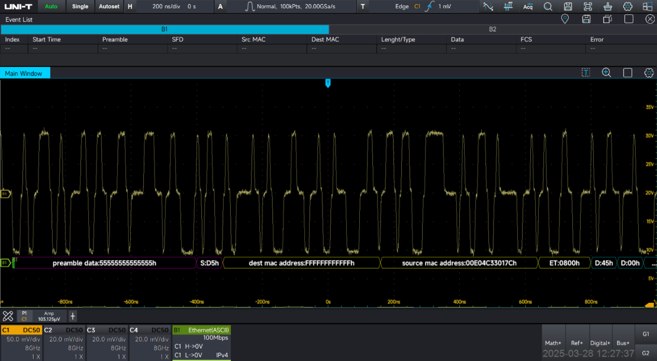 21+ protocol decoders covering embedded, automotive and computer/communications buses.
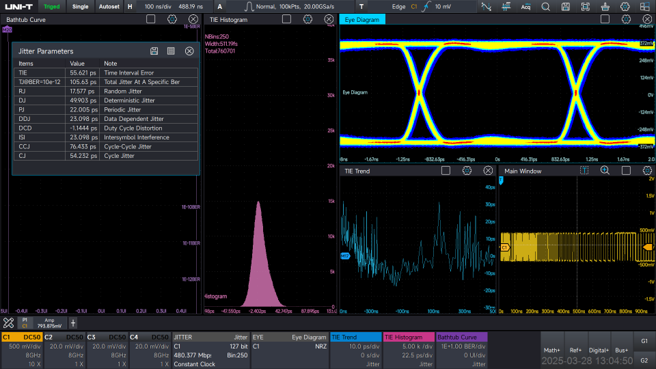
Jitter Analysis and Eye Diagram (Optional)
The MSO8000HD-JITTER option adds a comprehensive jitter measurement suite for high-speed serial validation: random/deterministic jitter decomposition, real-time eye diagrams, clock-recovery and data-recovery measurement, and transmission-quality assessment on PCIe, USB, Ethernet, and custom high-speed interfaces. With the 12-bit native ADC and >7 bits ENOB at full bandwidth, the eye-diagram measurement reaches the front-end’s noise floor — not the ADC quantization limit.
Multiple analysis views support detailed signal evaluation: eye-opening measurement, jitter histogram, clock recovery, and jitter spectrum — replacing a separate signal-integrity analyzer for the measurement-and-debug portion of high-speed serial validation workflows.
Jitter analysis: random/deterministic decomposition, eye-diagram measurement, signal-integrity validation across high-speed serial links.
PAM-N Analysis — PAM-3 through PAM-8
Pulse Amplitude Modulation (PAM) encodes multiple bits per symbol across discrete amplitude levels, increasing throughput at the same baud rate. PAM-4 (the most common variant) uses four levels representing 2 bits each — widely used in Ethernet, optical communications, and emerging high-speed digital interfaces.
The MSO8804HD’s PAM analysis package supports PAM-3, PAM-4, PAM-5, PAM-6, PAM-7 and PAM-8 validation: as the number of amplitude levels increases, level-to-level separation shrinks and signal-to-noise margin tightens — which is where the 12-bit ADC and >7 bits of ENOB at full bandwidth earn their place. The package recovers clocks from small-amplitude-difference PAM-N signals and performs per-level eye-diagram, jitter, and noise measurement.
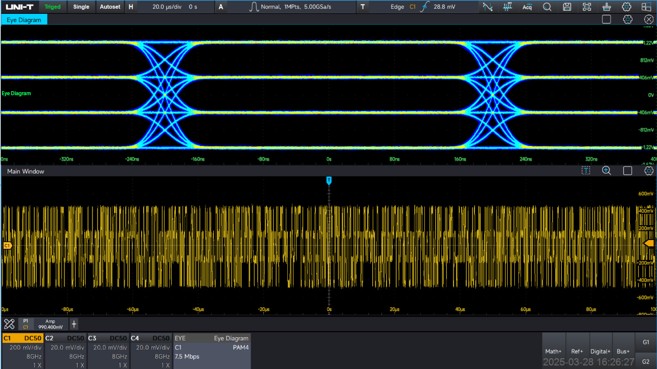 PAM-N analysis: PAM-3 through PAM-8 multi-level signaling for Ethernet and optical communications.
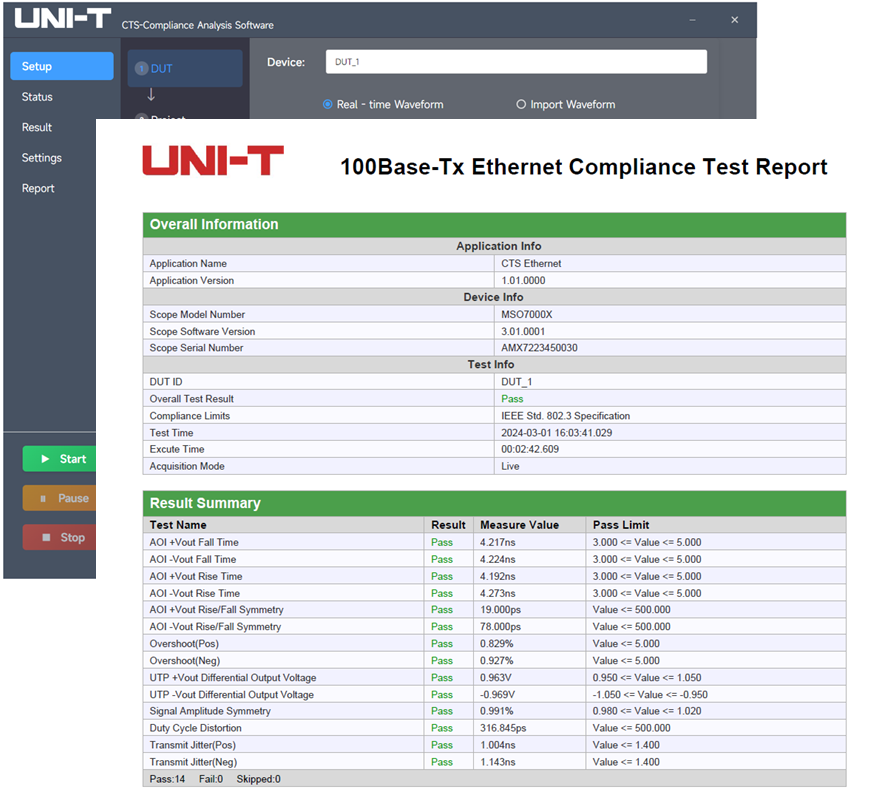
Compliance Testing — USB 2.0, Ethernet, Automotive Ethernet, MIPI D-PHY (Optional)
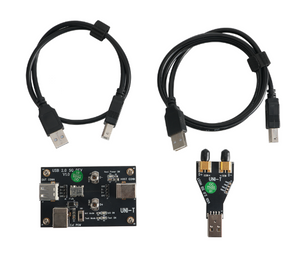
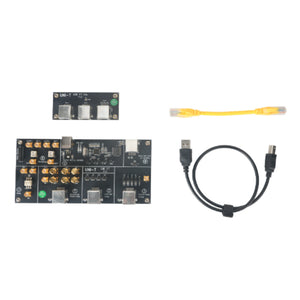
Six compliance packages run on the same instrument: MSO8000HD-CTSUSB20 for USB 2.0, MSO8000HD-CTS100 for 100BASE-TX, MSO8000HD-CTS1000 for 1000BASE-T, MSO8000HD-CTS100T1 and MSO8000HD-CTS1000T1 for 100BASE-T1 and 1000BASE-T1 automotive Ethernet, and MSO8000HD-CTSDPHY12 for MIPI D-PHY v1.2. Predefined test plans guide fixture connection and oscilloscope configuration, execute the measurement sequence, and generate pass/fail reports with margins, parameter results, and waveform snapshots. Test fixtures: UT-USB20-SQ-HD for USB 2.0 and UT-GBE-FT for 100/1000 Mbps Ethernet.
For test labs and consulting practices that document compliance and pre-compliance characterization for customer-supplied DUTs, the packages collapse multi-day manual measurement sequences into single-button automation runs. Multi-round validation supports iterative testing across design revisions; customizable test standards accept both association-defined criteria (USB-IF, IEEE 802.3) and user-defined tolerance windows.
Automated compliance testing for USB 2.0, Ethernet, automotive Ethernet and MIPI D-PHY, with pass/fail reports and waveform snapshots.
MATLAB Embedded Programming (Optional)
The MSO8804HD runs your own MATLAB scripts directly on the instrument, with results rendered as mathematical waveforms in the display window. Useful when built-in math functions and standard formulas are insufficient for the analysis at hand — scripts save, recall, and reuse across measurement sessions for reproducible workflows across design iterations. This option provides the on-instrument execution capability only: a valid MathWorks MATLAB license is required and is not included, and without your own license no scripts will run.
On-instrument MATLAB execution keeps analysis on the oscilloscope, reducing data-export round-trips during interactive analysis.
SCPI Automation
Included as standard, the MSO8804HD speaks full SCPI over LAN, USB Device, and the built-in WebServer interface — LabVIEW, Python, and any SCPI-aware framework can drive the instrument for automated test sequences and unattended regression runs.
Runs MATLAB scripts directly on-instrument; SCPI over LAN/USB integrates with LabVIEW, Python, and custom test frameworks.
74 Automated Measurements with Histogram, Trend, and Statistical Analysis
74 automated measurement types cover voltage, time, frequency-domain, and area-under-curve calculations, with quick-Meas single-channel parameter snapshots and trace-based visualization for measurement evolution over long capture windows. Histogram and trend-chart displays surface measurement statistics over time — useful for signal-integrity work where the parameter distribution matters as much as a single instantaneous value (jitter on a long-running clock line, rise-time consistency across temperature corners). Burst-region measurement localizes the window to a specific event rather than averaging across the full capture, supporting non-stationary signals where the measurement has to be conditioned on a trigger.
16 Digital Channels with the UT-M15 Probe Pod (Optional)
The 16-digital-channel logic-analyzer front end is built into every MSO8000HD chassis as hardware-standard. The optional UT-M15 logic probe pod activates it — separate high/low 8-bit connectors, direct attachment to 8×2 square-pin headers (2.54 mm pitch), 1.25 GSa/s digital sample rate, 3.2 ns minimum detectable pulse width, 101 kΩ ±1% input impedance.
Digital and analog channels share the same time base, trigger system, and display, so a falling SPI clock edge and the analog-domain crosstalk it causes show up in the same time-correlated frame — mixed-signal capture in one instrument eliminates the time-correlation problem of separate-instrument workflows.
15.6-Inch FHD Multi-Window Touch UI and WebServer
A 15.6-inch FHD (1920×1080) capacitive multi-touch display anchors the front-panel experience. Touch, drag, pinch-to-zoom, and gesture controls handle common waveform operations, while traditional knobs and shortcut keys provide the fine-control surface bench engineers expect; Bluetooth keyboard and mouse are supported as a third modality.
Dynamic multi-window operation is the differentiator at the screen-size tier: drag and rearrange windows, resize by dragging edges, pin pop-up windows, extend windows beyond screen edges for multi-monitor setups, and run cursor-based measurements in separate windows from the primary waveform view. The built-in WebServer adds browser-based remote control over LAN (SCPI commands, waveform export, screen capture) from any PC, tablet, or mobile device on the network.
Applications
High-Speed Serial and Signal Integrity
The MSO8804HD is built for the measurements where edge fidelity decides the answer. With 8 GHz on C1 and C3, ≤55 ps rise time and ≤150 fs RMS inherent jitter, the optional MSO8000HD-JITTER package separates random and deterministic jitter and builds real-time eye diagrams on PCIe Gen2, USB 2.0, Gigabit Ethernet and custom SerDes links. PAM-N analysis extends the same work to PAM-3 through PAM-8 signaling, where 12-bit resolution and >7 bits ENOB keep closely spaced levels apart. Pair it with the UT-PD6000 (6 GHz) or UT-PD4000 (4 GHz) active differential probe for differential lanes.
Compliance and Pre-Compliance Testing
For design teams checking a board before it goes to a test house, and for labs running compliance on customer DUTs, the optional packages automate USB 2.0, 100BASE-TX, 1000BASE-T, 100BASE-T1, 1000BASE-T1 and MIPI D-PHY v1.2 physical-layer tests. Reports carry pass/fail status, margins, parameter results and waveform snapshots, and multi-round validation tracks a fix across design revisions. With full SCPI automation the same instrument covers interactive characterization by day and unattended regression runs overnight.
Semiconductor and Device Characterization
Rise time, overshoot, settling and timing margins on fast devices need an instrument whose own edge is faster than the one being measured. The MSO8804HD’s ≤55 ps rise time, 20 GSa/s sampling and 74 automated measurements with histogram and trend statistics turn device characterization into a repeatable, scriptable measurement rather than a cursor exercise.
Wideband Communications Debug
8 GHz of real-time bandwidth and the standard enhanced FFT reach the sub-7 GHz bands used by 5G NR FR1 and current Wi-Fi, so RF bursts and the baseband or control signals around them are captured on one timebase for debug and validation.
Recommended Add-Ons
- UT-M15 Logic Probe Pod — adds 16 digital channels; 1.25 GSa/s, 101 kΩ ±1% input impedance, 8×2 square-pin attachment.
- Active probes — UT-PD6000 (6 GHz, ≤73 ps) and UT-PD4000 (4 GHz) active differential probes for high-speed differential lanes; UT-PD2500 (2.5 GHz differential) and UT-PA2000 (2 GHz single-ended).
- MSO8000HD-AWG — activates the dual-channel 60 MHz AWG (625 MSa/s, 200+ built-in waveforms).
- MSO8000HD-LA — logic analyzer license (paired with UT-M15).
- MSO8000HD-JITTER — jitter and eye-diagram measurement suite.
- Compliance test packages — MSO8000HD-CTSUSB20 for USB 2.0, MSO8000HD-CTS100 for 100BASE-TX, MSO8000HD-CTS1000 for 1000BASE-T, MSO8000HD-CTS100T1 and MSO8000HD-CTS1000T1 for 100BASE-T1 and 1000BASE-T1 automotive Ethernet, and MSO8000HD-CTSDPHY12 for MIPI D-PHY v1.2; fixtures UT-USB20-SQ-HD and UT-GBE-FT.
- Protocol decoder licenses — CAN-FD, FlexRay, SENT, AudioBus, MIL-STD-1553B, ARINC 429, I3C, PSI5, USB 2.0, PCIe 2.0, Ethernet, NRZ, Manchester, 8b/10b, SMBus, SPMI — individually or bundled in the MSO8000HD-BND upgrade kit.
- UT-M13X — signal demonstration board for training and evaluation.
In the Box
- 2 × UT-P6150 low-impedance passive probe, 1.5 GHz
- 2 × UT-JLC12 SMA cable, 12 GHz, 1 m
- 2 × UT-KJG12 SMA adapter, BNC to SMA, 50 Ω
- 2 × UT-L45 BNC-to-BNC straight-through cable, 1 m
- 1 × UT-D30 USB 3.0 data cable, 1 m
- 1 × region-specific power cord
- 1 × front-panel protective cover
- Calibration certificate
Frequently Asked Questions
What protocols are included with the MSO8804HD as standard?
RS-232/422/485, UART, I²C, SPI, CAN, and LIN are decoded standard with no additional license required. The remaining 16 protocols — CAN-FD, FlexRay, SENT, AudioBus (I²S/LJ/RJ/TDM), MIL-STD-1553B, ARINC 429, SMBus, SPMI, I3C, PSI5, USB 2.0, PCIe 2.0, 10/100 Mbps Ethernet, NRZ, Manchester, and 8b/10b — are available as separately licensed options or bundled in the MSO8000HD-BND upgrade kit. Each option activates on the same instrument with no firmware reflash or hardware swap.
What is the practical advantage of native 12-bit resolution over 8-bit on a high-bandwidth oscilloscope?
A 12-bit ADC provides 4,096 vertical quantization levels versus 256 for an 8-bit scope — sixteen times the resolution. At 8 GHz of bandwidth, the measurements that matter most (eye diagrams, jitter, return-loss artifacts) typically involve amplitudes much smaller than the channel’s full-scale range. On an 8-bit scope, low-amplitude artifacts get buried in quantization steps; on the MSO8804HD, 12-bit resolution combined with >7 bits of ENOB at full bandwidth keeps those artifacts above the noise floor and below the quantization grid.
Which MSO8000HD model should I choose for power analysis?
The MSO8604HD or MSO8504HD. Both have a 1 MΩ input path specified to 500 MHz, which is what current probes and high-voltage differential probes connect to, and both support the MSO8000HD-PWR power analysis option. The MSO8804HD’s inputs are 50 Ω only, and it is configured for high-speed signal-integrity work — jitter, eye diagrams, PAM-N and compliance testing.
How do I add 16 digital channels for mixed-signal work?
The 16-digital-channel logic-analyzer front end is built into every MSO8804HD chassis as hardware-standard. Add the optional UT-M15 logic probe pod to use it — separate high/low 8-bit connectors, direct attachment to 2.54 mm 8×2 square-pin headers, 1.25 GSa/s digital sample rate, 3.2 ns minimum pulse width, 101 kΩ ±1% input impedance. The MSO8000HD-LA license activates the logic-analyzer feature.
Can I run my own MATLAB analysis scripts directly on the instrument?
Yes. The MSO8804HD runs MATLAB scripts directly on the oscilloscope, with results rendered as mathematical waveforms in the display window. Scripts save, recall, and reuse across sessions, and full SCPI automation over LAN, USB, and the WebServer lets LabVIEW, Python, and other SCPI-aware tools drive the instrument alongside on-instrument analysis. A valid MathWorks MATLAB license is required; the MATLAB runtime is not included.
Which channel-pair combinations support the full 8 GHz bandwidth?
The full 8 GHz / 20 GSa/s spec is available with only C1 enabled, only C3 enabled, or C1 and C3 enabled simultaneously. Any other combination — C1+C2, C2+C4, all four channels — runs in full-channel mode at 4 GHz / 10 GSa/s. Channel-to-channel isolation reflects this: ≥600:1 from DC–4 GHz applies to any combination, while ≥500:1 above 4 GHz is specified for the C1+C3 simultaneous case where high-frequency dual-channel work is most common.
Part of the MSO8000HD series. Browse the UNI-T oscilloscope catalog to compare bandwidth tiers across the HD, X-Force, and UPO families.
Warranty
This instrument is backed by UNI-T's 3+2 Year Warranty — 3 years of standard coverage, plus 2 additional years free when you register your product. That's 5 years of total protection at no extra cost.
The warranty covers manufacturing defects and component failures under normal use conditions. UNI-T instruments are built for professional daily use, and our warranty reflects that commitment to long-term reliability.
| Analog Bandwidth | 8GHz | ||||||||||||
|---|---|---|---|---|---|---|---|---|---|---|---|---|---|
| Channels | 4Ch+16D (opt) | ||||||||||||
| Sample Rate | 20GSa/s | ||||||||||||
| Memory Depth |
|
||||||||||||
| Vertical Resolution | 12 bits | ||||||||||||
| Built-in Signal Generator | Optional | ||||||||||||
| Digital Channels | Optional | ||||||||||||
| Touch Screen | ✓ | ||||||||||||
| Instrument Type | HD Mixed Signal Oscilloscope | ||||||||||||
Features
- Frequency Counter
- Digital Voltmeter
Full specifications (22)
| Details | |||||
|---|---|---|---|---|---|
| Waveform Capture Rate |
|
||||
| Input Impedance | 50 Ω | ||||
| Vertical Scale (50 Ω) | 1mV/div to 1V/div | ||||
| Automated Measurements | 74 | ||||
| Bus Protocols (Standard) | RS232|UART|RS422|RS485|I2C|SPI|CAN|LIN | ||||
| Bus Protocols (Optional) | CAN-FD|FlexRay|SENT|Audio|MIL-STD-1553B|ARINC429|SMBus|SPMI|I3C|PSI5|USB2.0|PCIe2.0|Ethernet|NRZ|Manchester|8B/10B | ||||
| Protocol Decoders | 21 | ||||
| Measurement Parameters | 74 | ||||
| FFT Points | 1Mpts | ||||
| ENOB | >7 bits (full system bandwidth, 50Ω, 50mV/div, -3dBFS) | ||||
| Features | |||||
| Frequency Counter Bits | 8-digit | ||||
| DVM Resolution | 4-digit | ||||
| AWG Channels | 2 | ||||
| AWG Frequency | 60 MHz | ||||
| General Information | |||||
| Display Size | 15.6in | ||||
| Display Type | TFT LCD | ||||
| Interface | USB Host x4 Type-A|USB Host x1 Type-C|USB Device|LAN|HDMI|AUX In|AUX Out|10MHz Ref In/Out | ||||
| Operating Temperature | 0 °C to +40 °C | ||||
| Dimensions (W×H×D) | 445 × 311 × 190 mm | ||||
| Weight | <12.5 kg | ||||
| Warranty | 3+2 years | ||||
| Certifications | CE|cETLus | ||||
Data Sheets and Manuals
Check your instrument’s hardware revision before updating firmware — different hardware revisions take different builds.
Authentic UNI-T accessories are an affordable way to extend the functionality of your instrument.
MSO8804HD Options 26
Need to add specific functionality to your UNI-T instrument? Here are our options for specific applications and measurement types. Have a question? Contact us at 888-668-UniT (8648).
MSO8000HD-8B10B 8b/10b Signal Analysis Option
$999.00
MSO8000HD-AERO Aerospace Serial Bus Trigger Package Option
$999.00
MSO8000HD-AUDIO Audio Serial Bus Option
$999.00
MSO8000HD-AWG Arbitrary Waveform Generator Option
$699.00
MSO8000HD-BND Protocol Analysis and Jitter Suite
$5,399.00
MSO8000HD-CANFD Automotive CAN-FD Serial Bus Option
$999.00
MSO8000HD-CTS100 100MBASE-Tx Ethernet Compliance Test Option
$2,999.00
MSO8000HD-CTS1000 1000 BASE-T Ethernet Compliance Test Option
$3,999.00
MSO8000HD-CTSDPHY12 MIPI D-PHY v1.2 Compliance Test Option
$7,399.00
MSO8000HD-CTSUSB20 USB 2.0 Compliance Test Option
$1,399.00
MSO8000HD-FILTER Advanced Filter Designer Option
$1,299.00
MSO8000HD-FLEX Automotive FlexRay Serial Bus Option
$999.00
MSO8000HD-I3C Embedded I3C Option
$999.00
MSO8000HD-JITTER Advanced Jitter Analysis and Eye Diagram Option
$2,999.00
MSO8000HD-LA 16-Channel Logic Analyzer Option
$399.00
MSO8000HD-MANCH Serial Bus Manchester Option
$999.00
MSO8000HD-MAT MATLAB Embedded Programming Option
$1,299.00
MSO8000HD-MD2G Double the MSO8000HD Memory to 2Gpts
$5,399.00
MSO8000HD-NET 10BASE-T, 100BASE-TX Ethernet Bus Analysis Option
$2,999.00
MSO8000HD-NRZ NRZ Signal Analysis Option
$999.00
MSO8000HD-PCIe2 PCIe Bus Trigger and Analysis Option
$2,999.00
MSO8000HD-PSI5 Automotive PSI5 Serial Bus Option
$999.00
MSO8000HD-SENT Automotive SENT Serial Bus Option
$999.00
MSO8000HD-SMBUS Embedded Serial Bus SMBus Option
$999.00
MSO8000HD-SPMI Power Management Serial Option
$999.00