


UPO1202
200 MHz 2Ch Digital Storage Oscilloscope
200 MHz 2-channel digital storage oscilloscope with 1 GSa/s sample rate, 56 Mpts memory depth. Versatile bench oscilloscope for automotive engineers.



UNI-T UPO1202 200 MHz 2Ch Digital Storage Oscilloscope: 200 MHz 2-Channel Value-Tier Bench Oscilloscope
Overview
The UNI-T UPO1202 is a 200 MHz, two-channel digital storage oscilloscope with 1 GSa/s real-time sample rate, 56 Mpts memory depth, and a 100,000 wfms/s waveform capture rate. Ultra Phosphor 2.0 display technology drives 256-level intensity grading on a 7-inch WVGA TFT LCD, making it straightforward to distinguish frequent signal behavior from rare anomalies at a glance.
Two channels, 56 Mpts of memory, an independent DVM module, an enhanced 1 Mpts FFT, and three serial bus protocols decoded as standard — features that typically appear at the mid-tier. The UPO1202 keeps them on a two-channel value-tier bench, which makes it the per-station scope for teaching labs running multiple benches and the second scope for engineers who need capability without the price premium.
Key Features
- 200 MHz bandwidth, 2 channels — 1 GSa/s real-time sample rate (1 GSa/s on a single channel; 500 MSa/s with both channels active), ≤ 1.8 ns calculated rise time.
- 56 Mpts memory depth — capture full switching cycles and long protocol sequences without trading sample rate for record length.
- 100,000 wfms/s waveform capture rate — Ultra Phosphor 2.0 with 256-level intensity grading. Fast enough to surface intermittent events that slower scopes miss in normal scan modes.
- 1 Mpts enhanced FFT — frequency-domain analysis with frequency setting, demodulation mode, waterfall display, and marker measurement.
- Independent DVM module — dedicated AC/DC True RMS digital voltmeter, operating in parallel with scope acquisition.
- 6-digit hardware frequency counter — hardware-accelerated counter alongside the scope channels.
- 3 serial bus decoders standard — RS-232/UART, I²C, and SPI trigger and decode included; full-memory hardware decoding turns multi-second decode times into milliseconds.
- 36 automated measurements — time, voltage, frequency, and statistical measurements with cursor-area scoping.
- Multiple trigger types — edge, pulse width, video, slope, runt, over-amplitude, delay, timeout, duration, setup/hold, Nth edge, and pattern triggers.
- Web remote control — browser-based access from any PC or mobile device on the LAN; no driver software, no host application.
- SCPI + LAN automation — Standard Command for Programmable Instruments over LAN for scripted test sequences.
UNI-T UPO1202 Details
Ultra Phosphor 2.0
Ultra Phosphor 2.0 is UNI-T's intensity-graded display technology. Waveforms paint with 256-level brightness, where signals that recur often appear bright and rare anomalies show as faint streaks against the baseline trace — the kind of detail a flat-color display paints over.
The UPO1202 sustains 100,000 wfms/s in standard acquisition. Combined with continuous waveform recording at up to 65,000 frames, the scope surfaces glitches, runt pulses, and other transient events that the lower capture rates of entry scopes routinely miss.
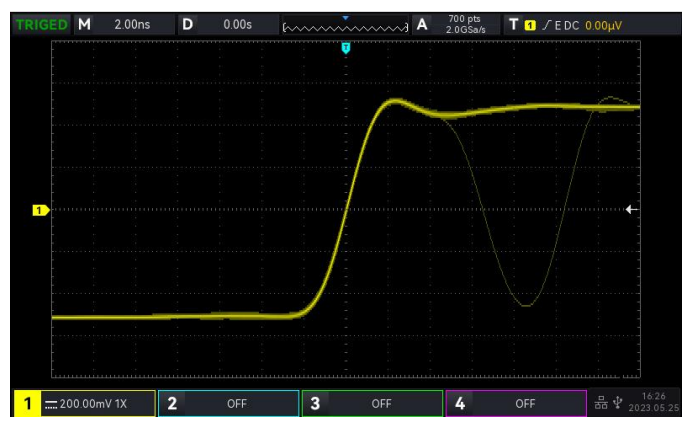 UNI-T UPO1202 Ultra Phosphor 2.0 Waveform Capture
Independent DVM Module
The UPO1202 includes a built-in 4-digit digital voltmeter that operates in parallel with the scope channels, displaying AC/DC True RMS values continuously while the oscilloscope captures waveforms. The DVM has its own display readout and a configurable warning when measurements exceed the specified range — a separate instrument's worth of capability without a separate instrument's bench space, useful for steady-state DC monitoring alongside dynamic AC measurement and for double-checking power-supply rails without breaking the trigger setup.
1 Mpts Enhanced FFT
The 1 Mpts FFT converts time-domain waveforms to the frequency domain at resolution that matches mid-tier oscilloscopes. Frequency setting, demodulation mode, waterfall display, and automatic peak marking are all standard, supporting EMI troubleshooting, switching-supply harmonic characterization, audio-band analysis, and clock-spur identification. Five window functions (Rectangle, Hanning, Blackman, Hamming, FlatTop) cover the common analysis trade-offs between frequency resolution and amplitude accuracy.
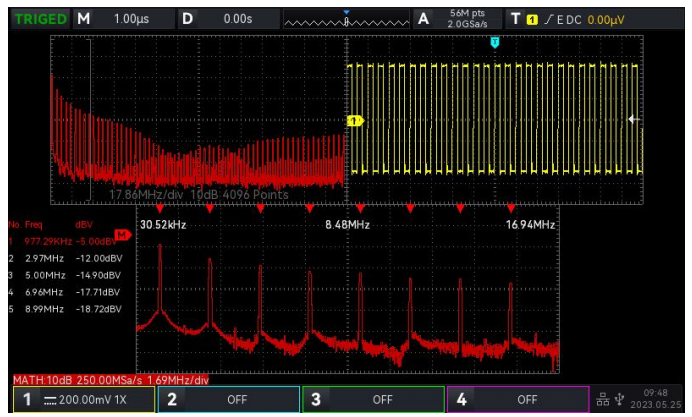 UNI-T UPO1202 1 Mpts Enhanced FFT View
Standard Bus Decoding — RS-232/UART, I²C, SPI
RS-232/UART, I²C, and SPI trigger and decode are standard — no protocol licenses, no add-on packages. Decoded bus traffic overlays the waveform with field-level annotation, and the event list view shows decoded packets alongside the time stamps. Hardware decoding running across the full 56 Mpts memory turns what would be a tens-of-seconds software decode into a sub-second operation, making the UPO1002 a usable embedded-debug instrument rather than a strictly time-domain scope.
No optional protocol licenses are available on the UPO1202: CAN, CAN-FD, LIN, and FlexRay are not supported on this platform. Buyers who need automotive bus decoding should look at the UPO1000HD or MSO/UPO2000 series, which support those protocols as paid options.
6-digit Hardware Frequency Counter
A 6-digit hardware-accelerated counter runs alongside the scope's standard automated measurements. The counter reads independently from the channel measurement engine, which gives stable, high-resolution frequency readings on stable signals without the jitter that software counters can exhibit on the lower-density end of the rate range. Useful for verifying oscillator frequencies, clock-recovery loops, and PWM duty cycles where a stable frequency number matters more than time-domain detail.
Multiple Trigger Types
Beyond standard edge triggering, the scope offers pulse width, video, slope, runt, over-amplitude, delay, timeout, duration, setup/hold, Nth edge, and pattern triggers. Runt and over-amplitude triggers isolate signal-integrity violations that an edge-only trigger would never catch; setup/hold and Nth edge triggers isolate specific cycles in long protocol captures. The full set is standard, with no trigger-package upgrades to license.
36 Automated Measurements with Cursor-Area Scoping
Thirty-six automated measurement parameters cover time, voltage, frequency, and statistical categories: rise/fall time, pulse width, duty cycle, frequency, period, amplitude, RMS, peak-peak, mean, standard deviation, and others. Each measurement supports cursor-area scoping — the measurement runs only within the cursor window rather than across the full record — useful for measuring a specific burst within a long capture without rezooming. Statistics (min, max, mean, std-dev) accumulate over time for characterization of measurement drift.
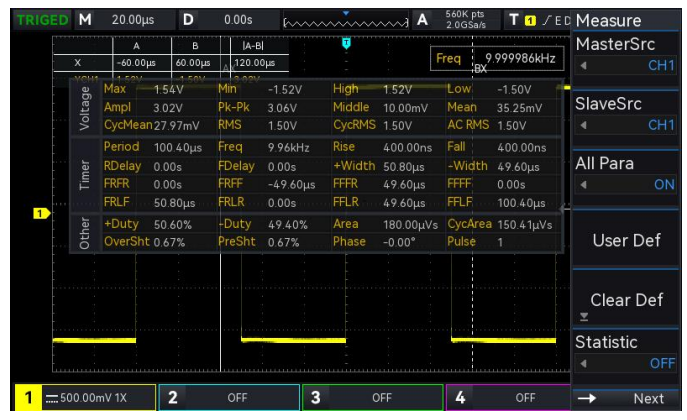 UNI-T UPO1202 Cursor-Area Measurement Mode
Web Remote Control and SCPI Automation
Connect the UPO1202 to the LAN and access the full instrument from any web browser — PC, Mac, or mobile — with no driver installation, no host application, no setup. Capture screenshots, change settings, transfer waveform data, and run SCPI commands from any device on the network. Useful for shared lab instruments, rack-mounted teaching benches with cable runs across the room, and Python or LabVIEW automation scripts that drive the scope through standard SCPI over LAN.
Connectivity (USB, LAN, AUX)
Standard interfaces include USB-Host (front and rear) for thumb-drive screenshot capture and firmware updates, USB-Device (rear) for SCPI over USB to a PC, Gigabit LAN for SCPI and web remote, and AUX output for triggered signal handoff. RS-232 is not present on this platform; SCPI runs over USB and LAN. The LAN connection supports both DHCP and static IP configuration for fixed-IP rack deployments.
Applications
Teaching Lab and Trade-School Curriculum (Education)
- Multi-station deployment at value-tier prices: a real 2 channels scope on every bench, with the same Ultra Phosphor 2.0 UI that students will see in industry on the UPO1000HD and MSO1000HD families.
- 56 Mpts memory and 1 Mpts FFT cover the full spectrum-and-time-domain undergraduate curriculum without the memory-vs-sample-rate trade-offs that entry scopes normally impose.
- 36 automated measurements with statistics let students focus on circuit behavior rather than measurement methodology, while the cursor-area mode supports manual measurement teaching.
- Web-based remote control mirrors the screen for classroom demonstration without USB capture cables or projector adapters; SCPI over LAN supports Python and LabVIEW lab exercises.
Embedded Systems Development (R&D)
- Three serial bus decoders standard (RS-232/UART, I²C, SPI) cover most low-speed embedded debug workflows without protocol-license fees.
- 56 Mpts memory captures full firmware-boot and protocol sequences in a single trigger, with full-memory hardware decoding for sub-second decode of long captures.
- Independent DVM module reads supply rails alongside scope traces — useful for verifying brownout, monitoring switching ripple, or validating reference-voltage stability during prototype bring-up.
- SCPI over LAN runs Python regression scripts on the same instrument that the bench engineer uses interactively — automation without a separate automation-class scope.
Electronics Service, Repair, and Maintenance
- Bench-portable form factor: AC-line bench scope sized for the typical service workshop without the depth or weight of a flagship instrument.
- Ultra Phosphor 2.0 with 256-level intensity grading reveals signal-integrity violations (runt pulses, glitches) that flat-color displays paint over — the difference between fixing the root cause and replacing the symptom.
- Hardware frequency counter gives stable rate readings for verifying oscillator and clock-recovery behavior during board-level repair.
- AC/DC True RMS DVM module replaces the bench multimeter for steady-state checks while keeping the scope trigger configuration intact.
Switching-Mode Power Supply Validation
- Bandwidth selection from 200 MHz matches the switching frequency range of low-frequency LLC and PFC stages through high-frequency GaN/SiC designs, with 56 Mpts memory for capturing long startup transients without losing sample rate.
- 1 Mpts FFT characterizes ripple harmonics and switching-noise spectral content for EMI pre-compliance investigation alongside time-domain switching analysis.
- Multiple trigger types (runt, over-amplitude, pulse-width) isolate switching faults, current spikes during startup, and protection-circuit activations.
- Independent DVM module monitors output-rail DC value while scope captures dynamic AC load-step behavior — both halves of the supply characterization on one instrument.
Production Test and Quality Control
- SCPI over LAN supports rack-mounted production-line deployment with Python or LabVIEW test scripts; the web remote interface gives line operators a familiar browser-based view without driver installation on each test station.
- 36 automated measurements with statistics support go/no-go testing of board-level signal-integrity specs; the cursor-area mode isolates specific cycles for measurement without re-zooming the full capture.
- Continuous waveform recording into the memory depth supports historical archiving of production-line captures for later analysis when a batch shows yield-tail issues.
EMI Pre-Compliance Investigation
- 1 Mpts FFT with five window functions, demodulation mode, and waterfall display supports time-correlated EMI investigation against the time-domain switching waveform — useful for tracking down which switching event produces which emission peak.
- Marker measurement on the FFT supports quick peak frequency and amplitude readout during emission-hunt work on a prototype board.
- Combined with a near-field probe set and a Faraday-cage cardboard tent, the FFT view supports pre-compliance investigation that catches the obvious failures before the expensive compliance-lab booking.
Accessories and Family Options
Included with Every Unit
- UPO1202 digital storage oscilloscope
- Power cord (national standard)
- USB 2.0 data cable
- 2 × passive probes — UT-P07A (500 MHz, one per channel)
- Quick start guide
- Factory calibration certificate
Recommended Accessories
- High-voltage passive probes — UT-P20 (100:1, 250 MHz), UT-V23 (100:1), UT-P21 (1000:1, DC 10 kV / AC 7 kVrms) for line-voltage and HV switching work.
- Differential probes — UT-P30, UT-P31, UT-P32, UT-P33, UT-P35, UT-P36 for floating measurements where ground reference can't be tied to scope chassis.
- Current probes — UT-P40, UT-P41, UT-P42, UT-P43, UT-P44; UT-P4150 for high-current AC/DC measurement on switching and motor-drive applications.
- Isolation transformer — UT-ISOT for line-powered DUTs that require galvanic isolation between scope ground and DUT ground.
Family Members
- UPO1102 — 100 MHz, 2 channels, 1 GSa/s
- UPO1202 — 200 MHz, 2 channels, 1 GSa/s (this product)
Step Up — UPO1000HD (2-channel, 12-Bit Vertical)
If your application needs higher vertical resolution or deeper memory than the UPO1202 provides, the UPO1000HD family offers 12-bit vertical resolution and the same Ultra Phosphor 2.0 display engine in the same cabinet footprint.
Frequently Asked Questions
Which serial bus protocols are decoded as standard, and which require a license?
The UPO1202 decodes RS-232/UART, I²C, and SPI as standard — trigger and decode functions for all three are included with the scope, with no license fees and no protocol-option purchase required. No optional protocol decoders are available on this platform. CAN, CAN-FD, LIN, and FlexRay are not supported on the UPO1002 platform. If your application requires automotive bus decoding, the UPO1000HD or MSO/UPO2000 series support those protocols as paid options.
Does the UPO1102/UPO1202 have Fast Acquire mode like the 4-channel UPO1000 family?
No. The UPO1002 platform sustains 100,000 wfms/s in standard acquisition without a separate Fast Acquire mode. The 4-channel UPO1000 family (UPO1054/1104/1204) has a Fast Acquire mode that pushes capture rate to 500,000 wfms/s, but this mode is not implemented on the 2-channel UPO1002 chassis. The 100,000 wfms/s standard rate is still substantially faster than most entry-tier scopes, surfacing most intermittent events without resorting to a separate acquisition mode.
Does the DVM module share input channels with the scope, or is it truly independent?
The DVM is truly independent: it has its own 4-digit measurement input and operates in parallel with the four (or two) scope channels. You can run a continuous AC/DC True RMS reading on a supply rail while the scope captures dynamic switching behavior on another channel, without any time-sharing between the two functions. The DVM readout appears on a dedicated portion of the screen and persists across scope-channel configuration changes.
What does the web remote control look like in practice, and how does SCPI automation work?
Connect the UPO1202 to your LAN, point any browser at the scope's IP, and you get a full-screen replica of the front panel that you can drive from your desk or a mobile device — no driver installation, no host application. Useful for shared lab instruments and projection during teaching demos. For automation, the scope responds to SCPI commands over LAN (Standard Commands for Programmable Instruments), which means Python (pyvisa), MATLAB Instrument Control Toolbox, LabVIEW, and any other VISA-aware tool can drive the scope through scripts. SCPI also runs over USB-Device for PC-tethered automation when LAN isn't available.
Warranty
This instrument is backed by UNI-T's 3+2 Year Warranty — 3 years of standard coverage, plus 2 additional years free when you register your product. That's 5 years of total protection at no extra cost.
The warranty covers manufacturing defects and component failures under normal use conditions. UNI-T instruments are built for professional daily use, and our warranty reflects that commitment to long-term reliability.
Product Status: Discontinued Replaced By: UPO1152HD 150 MHz 2Ch 12-Bit Digital Storage Oscilloscope
| Analog Bandwidth | 200MHz |
|---|---|
| Channels | 2Ch |
| Sample Rate | 1GSa/s |
| Memory Depth | 56Mpts |
| Vertical Resolution | 8 bits |
| Built-in Signal Generator | Not Available |
| Digital Channels | Not Available |
| Touch Screen | ✗ |
| Instrument Type | DSO |
Features
- Frequency Counter
- Digital Voltmeter
Full specifications (18)
| Details | |||||
|---|---|---|---|---|---|
| Waveform Capture Rate |
|
||||
| Input Impedance | 1 MΩ | ||||
| Vertical Scale (1 MΩ) | 500μV/div to 20V/div | ||||
| Automated Measurements | 36 | ||||
| Bus Protocols (Standard) | RS232|UART|I2C|SPI | ||||
| Protocol Decoders | 3 | ||||
| Measurement Parameters | 36 | ||||
| Fft Points | 1Mpts | ||||
| Features | |||||
| Frequency Counter Bits | 6-digit | ||||
| Dvm Bits | 4-digit | ||||
| General Information | |||||
| Display Size | 7in | ||||
| Display Type | TFT LCD | ||||
| Interface | USB-Host|USB-Device|LAN|EXT Trig|AUX | ||||
| Operating Temperature | 0°C - 40°C | ||||
| Dimensions (W×H×D) | 336 × 164 × 105 mm | ||||
| Weight | 2.5 kg | ||||
| Warranty | 3+2 years | ||||
| Certifications | CE | ||||
Data Sheets and Manuals
Check your instrument’s hardware revision before updating firmware — different hardware revisions take different builds.
Authentic UNI-T accessories are an affordable way to extend the functionality of your instrument.
UPO1000 Options 3
Need to add specific functionality to your UNI-T instrument? Here are our options for specific applications and measurement types. Have a question? Contact us at 888-668-UniT (8648).

Passive Probes 11

UT-P01 25 MHz 10:1 General Purpose Oscilloscope Probe
$15.99
UT-P03 60 MHz 10:1 General Purpose Oscilloscope Probe
$18.99
UT-P04 100 MHz 10:1 General Purpose Oscilloscope Probe
$15.99
UT-P05 200 MHz 10:1 General Purpose Oscilloscope Probe
$20.99
UT-P06 300 MHz 10:1 General Purpose Oscilloscope Probe
$37.99
UT-P07A 500 MHz 10:1 General Purpose Oscilloscope Probe
$51.99UT-P07B 500 MHz 10:1 General Purpose Oscilloscope Probe
$119.00
UT-P08A 350 MHz 10:1 General Purpose Oscilloscope Probe
$51.99
UT-P20 250 MHz 100:1 High Voltage Oscilloscope Probe
$56.99
UT-P21 50 MHz 1000:1 High Voltage Oscilloscope Probe
$430.00
UT-V23 High Voltage Scope Probe
$25.00Current Probes 6

UT-P40 DC-100 kHz 60A AC/DC Current Probe
$452.00
UT-P41 DC-100 kHz 100A AC/DC Current Probe
$595.00
UT-P4150 12 MHz High-Frequency DC/AC Current Probe
$2,529.00
UT-P42 150 kHz 200A AC/DC Current Probe
$459.00
UT-P43 DC-25 MHz 20A 100mV/A Current Probe
$956.00
UT-P44 DC-50 MHz 40A 50mV/A Current Probe
$1,695.00Differential Probes 6

UT-P30 100 MHz 10:1/100:1 Differential Oscilloscope Probe
$399.00
UT-P31 100 MHz 100:1/1000:1 Differential Oscilloscope Probe
$699.00
UT-P32 50 MHz 100:1/1000:1 Differential Oscilloscope Probe
$860.00
UT-P33 120 MHz 100:1/1000:1 Differential Oscilloscope Probe
$1,465.00
UT-P35 50 MHz 50:1/500:1 Differential Oscilloscope Probe
$395.00

