



MSO3034X | 350 MHz 4-Channel Mixed Signal Oscilloscope
Overview
The MSO3034X is a 350 MHz, four-channel mixed-signal oscilloscope. With 5 GSa/s real-time sample rate, 500 Mpts of acquisition memory, 16 logic-analyzer channels (with the optional UT-M15 probe pod), and Ultra Phosphor 3.0 waveform mapping at up to 2,000,000 wfms/s in Sequential Mode, the MSO3034X consolidates nine bench instruments into one 10.1-inch capacitive multi-touch footprint — oscilloscope, logic analyzer, AWG, spectrum analyzer, DVM, frequency counter, protocol analyzer, Bode plot, and power analyzer.
For 350 MHz mixed-signal R&D validation, four-channel power-electronics characterization, and engineering-team benches that need protocol decode, spectrum, AWG, and power analysis alongside scope acquisition, the MSO3034X is the entry SKU into UNI-T’s MSO3000X line at the most accessible price point. The 500 Mpts memory holds long acquisition windows for protocol-event hunting and switching-supply transient capture without sacrificing sample rate, and the 12-protocol decode set includes computer, automotive, audio, and aerospace bus families that mid-tier scopes commonly leave on the option list.
Key Features
- 350 MHz Bandwidth, 4 Analog Channels — Four-channel acquisition at up to 350 MHz with 5 GSa/s sample rate (interleave) and calculated rise time of ≤1.0 ns — fast enough to capture rise-time and overshoot detail on faster MCU and FPGA reference designs, switching-converter gate drives, and mid-bandwidth analog signal-integrity work.
- 500 Mpts Memory Depth — Standard deep memory across all four channels for long capture windows without sample-rate trade.
- Ultra Phosphor 3.0 Display Technology — 256-level grayscale persistence with parallel FPGA mapping; up to 800,000 wfms/s standard, 2,000,000 wfms/s in Sequential Mode.
- Nine Instruments in One — Oscilloscope, 16-channel logic analyzer (optional probe), AWG (optional), 1.25 GHz spectrum analyzer, 4-digit DVM, 7-digit hardware frequency counter, protocol analyzer, Bode plot (with AWG), and six-measurement power analyzer (optional).
- Standard Protocol Decoding — RS-232/422/485/UART, I²C, and SPI included as standard.
- Optional Protocol Decoding — CAN, CAN-FD, LIN, FlexRay, SENT, Audio (I²S/LJ/RJ/TDM), MIL-STD-1553B, ARINC 429, and Manchester — 12 protocols total across computer, automotive, audio, aerospace, and wireless domains.
- 16 Digital Channels (Optional) — Add mixed-signal capability with the UT-M15 logic probe pod; 1.25 GSa/s digital sample rate, 800 ps minimum detectable pulse width.
- Optional 50 MHz Dual-Channel AWG with Bode Plot — 16-bit, 250 MSa/s arbitrary waveform generator with the Bode plot analyzer included for closed-loop frequency-response analysis.
- Zone Triggering — Rectangle-drawn trigger conditions with Must Intersect / Must Not Intersect logic, plus eleven additional trigger types.
- 54 Automated Measurements — Voltage, time, frequency, and statistical measurements with histogram and trend statistics; up to 27 displayed simultaneously.
- 10.1-Inch Capacitive Multi-Touch — 1280×800 HD display with multi-window layout, gesture control, and HDMI output.
- SCPI and WebServer Remote Control — USB 3.0, LAN (VXI-11), and built-in browser-based control from PC or mobile.
- Free Firmware Updates and No-Expiration License Unlocks — Firmware updates are free over the product’s lifetime; license unlocks for optional packages have no expiration.
Detailed Features
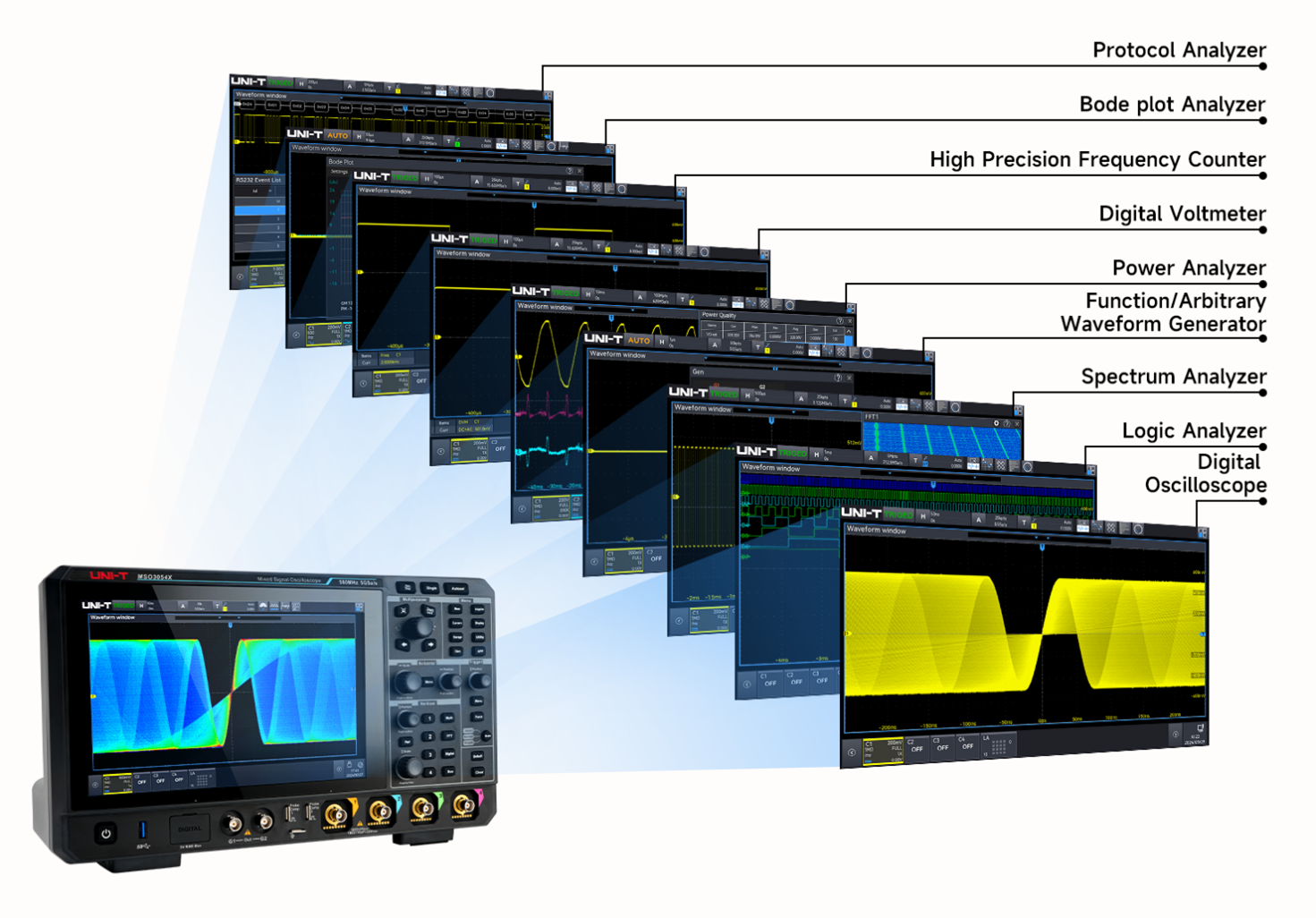
Nine Instruments in One
The MSO3000X integrates nine instrument functions into one bench unit: digital storage oscilloscope, 16-channel logic analyzer (with the optional UT-M15 probe pod), 50 MHz dual-channel function and arbitrary waveform generator (optional), 1.25 GHz spectrum analyzer (FFT up to 4 Mpts), 4-digit DVM, 7-digit hardware frequency counter, multi-protocol serial-bus analyzer covering 12 bus types, Bode plot analyzer (optional, paired with the AWG for closed-loop sweep), and a six-measurement power-electronics analyzer (optional). For mid-tier R&D benches consolidating across protocol decode, spectrum analysis, AWG-driven stimulus, and four-channel scope work in the same session, the integration eliminates the cable-swap-and-instrument-handoff cycle that breaks engineering flow on multi-instrument bench setups, and the optional power-analysis package adds a working power-electronics analyzer alongside the existing acquisition path.
Nine instruments integrated: scope, logic analyzer, AWG, spectrum analyzer, DVM, frequency counter, protocol analyzer, Bode plot, power analyzer.
High-Speed Acquisition — 5 GSa/s, 500 Mpts
The 5 GSa/s real-time sample rate (interleave) and 500 Mpts of acquisition memory hold full waveform fidelity across the 350 MHz analog bandwidth. Standard capture rate runs up to 800,000 wfms/s; in Sequential Mode — the segmented-memory mode that conditions captures on a trigger event — capture rate climbs to 2,000,000 wfms/s, recording up to 200,000 frames for post-capture replay and analysis.
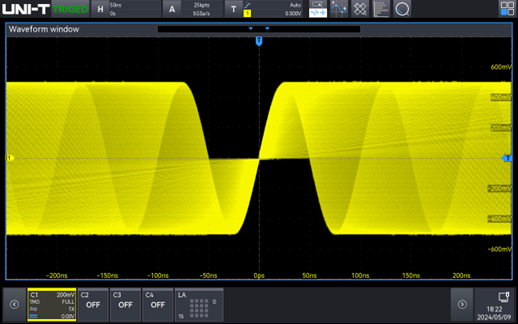 800,000 wfms/s standard; 2,000,000 wfms/s in Sequential Mode.
Deep Memory — 500 Mpts Per Acquisition
The 500 Mpts memory depth holds long acquisition windows at full sample rate — the difference between catching an intermittent fault on a 100 ms capture and missing it because the memory was saturated at 5 ms. For protocol-event hunting on high-traffic CAN-FD or FlexRay buses, switching-supply transient analysis across multiple cycles, and long-term jitter characterization, the deep-memory budget removes the sample-rate vs. window-length trade-off that limits mid-tier 100 Mpts scopes.
Vertical Resolution — 8-Bit Native with ERES to 12-Bit
The MSO3034X uses an 8-bit native ADC with up to 12-bit effective resolution via ERES (enhanced resolution) when bandwidth headroom is available — useful for low-amplitude signal work where quantization noise would obscure detail on switching ripple, sensor outputs, or jitter analysis. For wider-bandwidth designs requiring native 12-bit resolution at full bandwidth, see UNI-T’s MSO3000HD-series scopes, which use the R12™ native 12-bit ADC architecture at the same 200–500 MHz bandwidth tier.
Ultra Phosphor 3.0 — 256-Level Grayscale Persistence
Ultra Phosphor 3.0 is UNI-T’s third-generation waveform-mapping architecture: parallel FPGA acquisition with 256-level grayscale intensity grading, a 20 Gbps internal data path, and sub-1 µs dead time. The scope captures fast-edge signals at 2,000,000 events per second in Sequential Mode without missing the rare-event bracket between redraws. Intensity grading shows frequency-of-occurrence directly — frequent waveforms appear brighter, infrequent ones dimmer — making intermittent faults easy to distinguish from normal behavior.
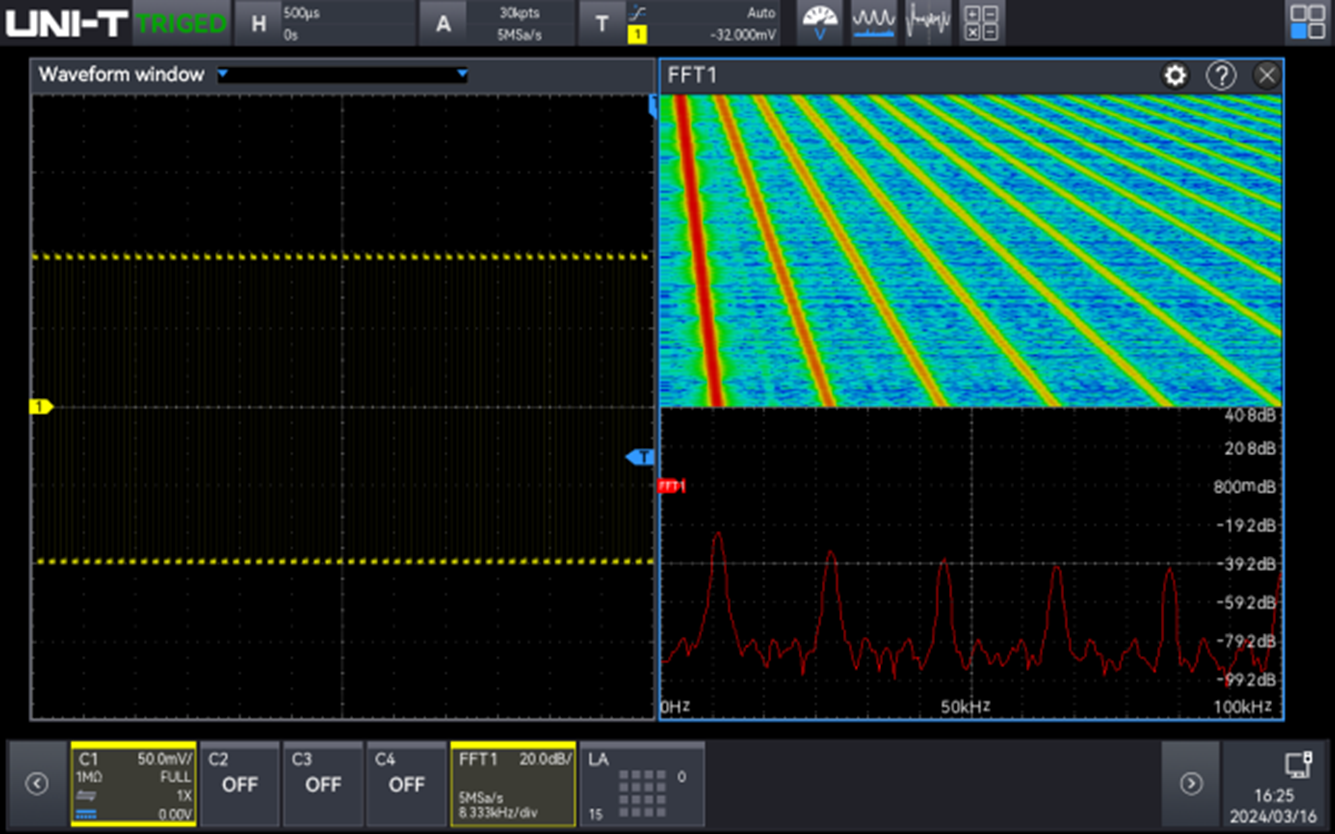
Built-In Spectrum Analyzer — FFT to 4 Mpts
The standard enhanced-FFT spectrum analyzer covers 0 Hz to 1.25 GHz with up to 4 Mpts FFT length, four-channel analysis, four trace types (Normal, Average, Max Hold, Min Hold), and four detection modes. Markers plus a waterfall display track spectral activity over time — for harmonic ID, EMI pre-compliance sweeps, clock-purity verification, and modulated-signal analysis without the cable swap a separate spectrum analyzer requires.
0 Hz to 1.25 GHz, 4 Mpts FFT, four traces, four detections, waterfall.
Protocol Analysis — 12 Bus Types Across Five Domains
Twelve protocols across five bus domains: computer serial (RS-232/422/485/UART, I²C, SPI — standard); automotive (CAN, CAN-FD, LIN, FlexRay, SENT — optional); audio (I²S, LJ, RJ, TDM — optional); aerospace (MIL-STD-1553B, ARINC 429 — optional); and Manchester wireless (optional). Triggering and decoding are integrated — trigger on a frame error, identifier match, CRC failure, or missing-ack condition, and the decode displays inline with the captured waveform. The aerospace and Manchester decode set differentiates this protocol envelope from mid-tier scopes that stop at automotive and audio.
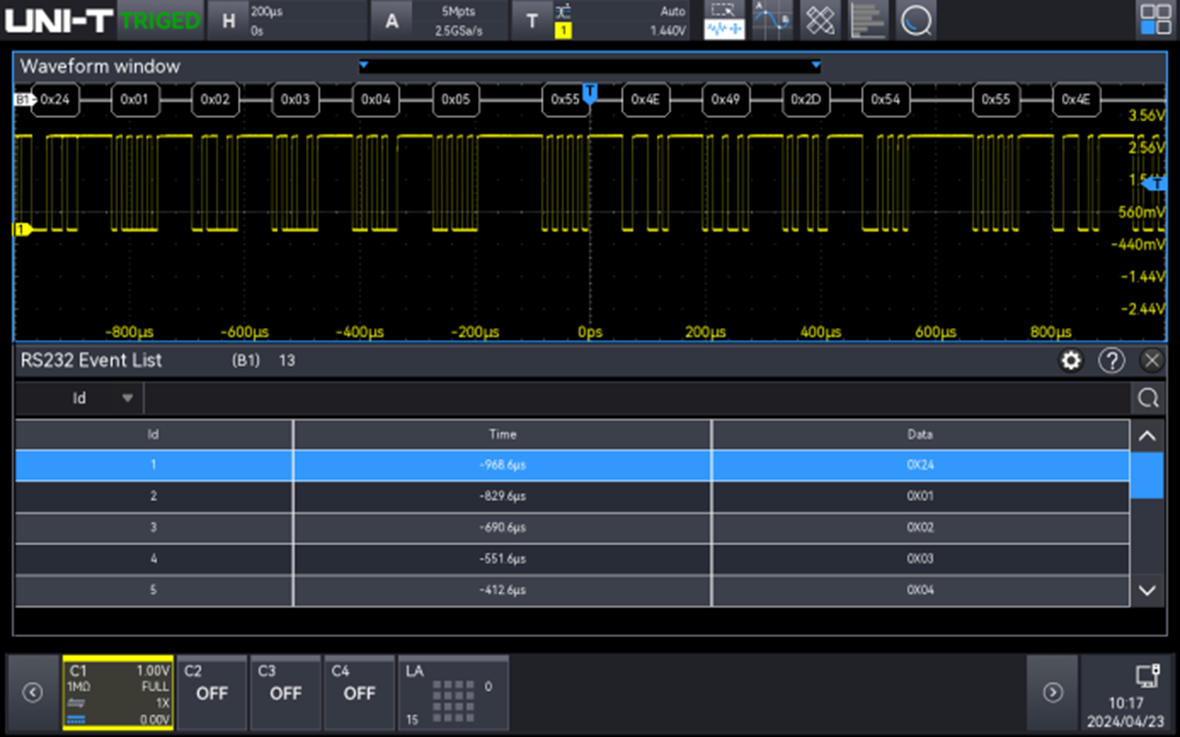 12 protocols across computer, automotive, audio, aerospace, and wireless domains.
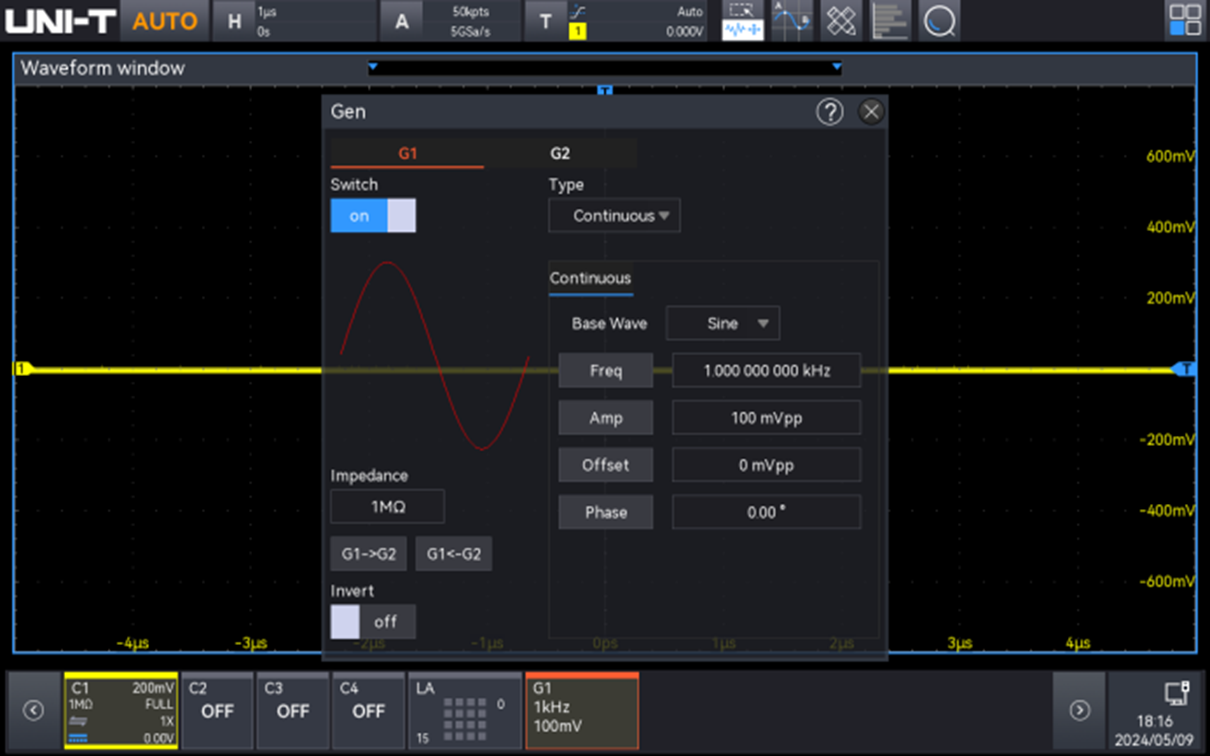
50 MHz Dual-Channel AWG with Bode Plot (Optional)
The optional MSO3000X-AWG package adds a 50 MHz dual-channel function/arbitrary waveform generator (16-bit, 250 MSa/s) plus the Bode plot analyzer for frequency-response, loop-stability, filter, and amplifier characterization. Built-in waveforms include sine, square, pulse, ramp, arbitrary, noise, and DC, with AM, FM, ASK, FSK, and sweep modulation. On-screen captures load directly into the AWG for stimulus-response replay.
MSO3000X-AWG: 50 MHz, 2-channel, 16-bit, 250 MSa/s; Bode plot analyzer included.
Power Analysis (Optional) — Six Measurement Types
For switching-mode power-supply validation, motor-drive characterization, and DC-DC converter design at moderate switching frequencies, the optional power-analysis package adds a six-measurement suite (power quality, harmonic analysis, switching loss, ripple analysis, loop analysis, safe operating area) to the four-channel acquisition path. The same scope that captures the gate-drive waveform also computes switching loss across the cycle, replaces a separate power analyzer for early-stage characterization, and pairs with the Bode plot analyzer (included with the optional AWG) for closed-loop stability sweeps on switching converters.
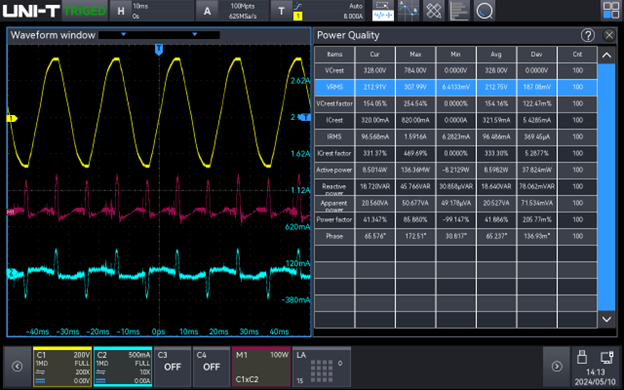 Optional MSO3000X-PWR: power quality, harmonics, switching loss, ripple, loop, SOA.
Zone Triggering — Rectangle-Drawn Trigger Conditions
Zone triggering isolates an occasional anomaly by trigger condition rather than waveform stability. Draw a rectangle on the display, set Must Intersect or Must Not Intersect, and the scope triggers when the waveform meets the spatial condition. With eleven additional trigger types (edge, pulse width, ramp, runt, over-amplitude, delay, timeout, duration, setup & hold, Nth edge, code pattern), zone triggering turns rare-event hunting into a defined acquisition.
54 Automated Measurements with Histogram and Trend Statistics
54 automated measurement parameters on the analog channels — voltage, time, frequency, statistical, and burst measurements — with up to 27 displayed simultaneously. Statistics include mean, max, min, standard deviation, count, tendency chart, and histogram. The burst function reports values across burst segments — useful for jitter analysis, long-capture characterization, and pass/fail evidence reports.
Fast Fuzzy Autoset
The fuzzy-logic autoset algorithm uses the 7-digit hardware frequency counter and multi-channel parallel processing to lock onto unknown signals quickly: all-channel autoset in under 1.5 seconds, single-channel under 1 second — meaningful on production-line spot-check work and engineering benches that swap test articles often.
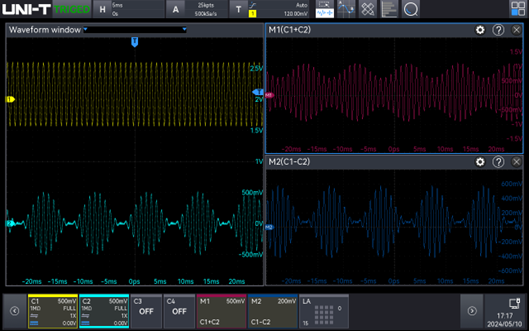
10.1-Inch Capacitive Multi-Touch UI
The 10.1-inch 1280×800 HD capacitive multi-touch display supports standard touch gestures (click, slide, zoom, edit, drag) for direct waveform manipulation, plus rectangle-draw for zone triggering. Multi-window layout lets waveform, FFT, decode-list, and measurement-table panels be dragged and resized independently. Knob-and-key controls remain; HDMI output mirrors the display to an external monitor or projector.
10.1-inch 1280×800 capacitive multi-touch with multi-window layout.
Connectivity, SCPI, and WebServer Remote Control
USB 3.0 Host (one front, two rear), USB 3.0 Device, LAN (10/100/1000 BASE-T, VXI-11), HDMI display output, two front-panel Gen Out connectors (paired with the optional AWG), 10 MHz reference In/Out, and AUX Out (Trig Out / Pass-Fail / DVM). Full SCPI command set; the built-in WebServer provides browser-based remote control from PC or mobile without driver installation.
Applications
For R&D Engineers
- For mainstream R&D validation at 350 MHz, the MSO3034X covers ARM Cortex-A microcontroller debug, mid-speed FPGA reference designs, four-channel time-correlated mixed-signal work (with the UT-M15 logic probe pod), and 12-protocol decode across computer, automotive, audio, and aerospace buses — covering a broad envelope of design-validation work in one instrument.
- Time-correlated mixed-signal capture across analog channels and 16 digital lines (with the UT-M15 probe pod) on the same instrument and the same trigger event.
- 12-protocol decode set covering computer, automotive, audio, aerospace, and Manchester-wireless buses; up to four simultaneous decodes plus event list and search.
- Zone triggering for rare-event hunting on intermittent timing anomalies, runts, and glitches; eleven trigger types cover the full embedded-systems debug envelope.
- 500 Mpts memory captures long acquisition windows for protocol-event hunting and post-event analysis; Sequential Mode records up to 200,000 frames of triggered events.
For Power Electronics Engineers
- For switching-mode power-supply validation and DC-DC converter characterization at moderate switching frequencies, the MSO3034X pairs four-channel acquisition with the optional six-measurement power-analysis suite, the optional 50 MHz AWG with Bode plot analyzer for closed-loop stability sweeps, and 500 Mpts memory for multi-cycle transient capture — covering the full converter-design workflow on one instrument.
- Optional six-measurement power-analysis package: power quality, harmonic analysis, switching loss, ripple analysis, loop analysis, and safe operating area visualization.
- Four-channel acquisition supports vIN / vOUT / IL / vGS measurement on switching converters and DC-DC supplies in a single time-correlated capture.
- Optional dual-channel 50 MHz AWG with Bode plot analyzer for closed-loop frequency-response and stability sweeps on power-supply controllers.
- Sequential Mode captures 200,000 frames of triggered events for fault-recovery and burst-mode analysis on intermittent power events and load-step transients.
For Education and Teaching Labs
- For undergraduate and graduate-track engineering labs running advanced embedded-systems, signals-and-systems, and power-electronics-introduction coursework, the MSO3034X delivers 350 MHz of analog bandwidth alongside the integrated nine-instrument suite and 12-protocol decode — covering scope, FFT spectrum, protocol decode, AWG-driven stimulus, and power-electronics fundamentals in one teaching-bench footprint, with HDMI projection for instructor-led demonstrations.
- Nine integrated instruments cover most of the bench-instrument curriculum on one operator-training surface, from analog-and-digital fundamentals through introductory power-electronics topics.
- HDMI output mirrors the display to a projector or external monitor for instructor-led demonstrations.
- WebServer remote access lets students view captures and run measurements from networked classroom devices without crowding the bench.
- 10.1-inch capacitive multi-touch UI plus traditional knob-and-key controls support a range of student comfort levels with bench-instrument operation.
Accessories & In the Box
Included
- UT-P07A (500 MHz, 10:1) × 4 [supports 350 MHz scope BW] passive probes (one per channel)
- UT-D30 USB 3.0 cable
- UT-L45 BNC-to-BNC direct-through cable
- UT-L02A BNC red and black alligator connecting wire
- National-standard power cable
- Quick start guide
Available Options
- MSO3000X-AWG — Dual-channel 50 MHz AWG with Bode plot analyzer
- MSO3000X-PWR — Power analysis package (6 measurement types)
- MSO3000X-BND — Full serial-bus triggering and decoding bundle (AUTO + AUDIO + MIL-STD + ARINC429 + MANCH)
- MSO3000X-AUTO — Automotive serial bus bundle (CAN, CAN-FD, LIN, FlexRay, SENT)
- Individual protocol licenses: CAN, CAN-FD, LIN, FlexRay, SENT, AUDIO, MIL1553, ARINC429, MANCH
- MSO3000X-BW3M5T5M — 350 MHz to 500 MHz bandwidth upgrade
Recommended Accessories
- UT-M15 — 16-channel logic probe pod
- UT-PA2000 — 2 GHz active probe (auto-sense attenuation, ±8 V offset range)
- UT-P07A — 500 MHz high-resistance passive probe
- UT-P20 / UT-P21 — High-voltage probes
- UT-P30 / UT-P31 / UT-P32 / UT-P33 — High-voltage differential probes
- UT-P40 / UT-P41 / UT-P42 / UT-P43 / UT-P44 — Current probes
- UT-ISOT — Isolation transformer
- UT-M13X — Oscilloscope demo board
Family Members and Related Scopes
Frequently Asked Questions
What’s the difference between standard capture rate and Sequential Mode capture rate?
Standard capture rate (800,000 wfms/s) is the rate at which the MSO3034X acquires waveforms during continuous real-time operation. Sequential Mode (2,000,000 wfms/s) uses segmented memory to condition captures on a trigger event, holding up to 200,000 frames of triggered acquisitions for post-capture replay. Use standard mode for general waveform observation; use Sequential Mode for rare-event hunting where the trigger condition is well-defined.
Should I size up to the MSO3054X instead?
If your fastest signal edges are below ~300 MHz and you don’t need deeper visibility into 500 MHz analog content, the MSO3034X has the same 5 GSa/s, 500 Mpts platform, the same 12-protocol decode set, and the same Ultra Phosphor 3.0 waveform-mapping engine as the MSO3054X — the 350 MHz bandwidth is the only meaningful difference on the spec sheet. The MSO3054X is worth the step-up when you’re working at the rise-time edge of 500 MHz analog signal-integrity, characterizing higher-bandwidth switching converters, or running closed-loop stability sweeps on wide-bandgap (GaN/SiC) power converters where the additional headroom shows up in measurement accuracy.
See more in the MSO3000X collection, or browse all UNI-T digital oscilloscopes.
Design. Debug. Deploy.
Warranty
This instrument is backed by UNI-T's 3+2 Year Warranty — 3 years of standard coverage, plus 2 additional years free when you register your product. That's 5 years of total protection at no extra cost.
The warranty covers manufacturing defects and component failures under normal use conditions. UNI-T instruments are built for professional daily use, and our warranty reflects that commitment to long-term reliability.
| Model Number | MSO3034X |
| Analog Bandwidth | 350 MHz |
| Calculated Rise Time (10% to 90%, typical) | ≤1.0 ns |
| Analog Channels | 4 (plus 1 external trigger channel) |
| Digital Channels | 16 (with optional UT-M15 probe pod) |
| Maximum Real-Time Sample Rate | 5 GSa/s (interleave) / 2.5 GSa/s (non-interleave) |
| Maximum Digital Sample Rate | 1.25 GSa/s |
| Maximum Memory Depth | 500 Mpts |
| Vertical Resolution | 8-bit native; up to 12-bit via ERES |
| Standard Capture Rate | 800,000 wfms/s |
| Sequential Mode Capture Rate | 2,000,000 wfms/s (up to 200,000 frames recorded) |
| Trigger Types | Edge, pulse width, ramp, runt pulse, over-amplitude pulse, delay, timeout, duration, setup & hold, Nth edge, code pattern, video, zone |
| Protocol Decoding (Standard) | RS-232/422/485/UART, I²C, SPI |
| Protocol Decoding (Optional) | CAN, CAN-FD, LIN, FlexRay, SENT, Audio (I²S/LJ/RJ/TDM), MIL-STD-1553B, ARINC 429, Manchester |
| Spectrum Analyzer (FFT) | 0 Hz to 1.25 GHz, up to 4 Mpts FFT, 4 traces, 4 detections, waterfall |
| AWG (Optional MSO3000X-AWG) | 50 MHz, 2 channels, 16-bit, 250 MSa/s; includes Bode plot analyzer |
| Power Analysis (Optional MSO3000X-PWR) | Power quality, harmonic analysis, switching loss, ripple analysis, loop analysis, safe operating area |
| Automated Measurements | 54 (analog channels); up to 27 displayed simultaneously |
| Display | 10.1-inch 1280×800 capacitive multi-touch |
| Interfaces | USB 3.0 Host (3) / USB 3.0 Device (1) / LAN (VXI-11) / HDMI / Gen Out (2) / 10 MHz In/Out / AUX Out |
| Remote Control | SCPI; built-in WebServer (PC and mobile) |
| Certifications | CE, cETLus |
Data Sheets and Manuals
Software / Firmware Downloads
Authentic UNI-T accessories are an affordable way to extend the functionality of your instrument.
MSO3000X Options 14
Need to add specific functionality to your UNI-T instrument? Here are our options for specific applications and measurement types. Have a question? Contact us at 888-668-UniT (8648).

MSO3000X-ARINC429 Aerospace ARINC429 Serial Bus Trigger and Analysis
$279.00
MSO3000X-AUDIO Serial Bus Trigger and Analysis Option (I2S, LJ, RJ, TDM)
$279.00
MSO3000X-AUTO Serial Bus Trigger and Decode Bundle (CAN, CAN-FD, LIN, FlexRay, SENT)
$705.00
MSO3000X-AWG Arbitrary Waveform Generator option
$280.00
MSO3000X-BND Serial Bus Trigger and Decode Bundle (incl. AUTO, AUDIO, MIL-STD, ARINC429, MANCH)
$1,129.00
MSO3000X-BW3M5T5M 500MHz Bandwidth Upgrade
$845.00
MSO3000X-CAN Automotive CAN Serial Bus Trigger and Analysis
$279.00
MSO3000X-CANFD Automotive CAN-FD Serial Bus Trigger and Analysis
$279.00
MSO3000X-FLEX Automotive FlexRay Serial Bus Trigger and Analysis
$279.00
MSO3000X-LIN Automotive LIN Serial Bus Trigger and Analysis
$279.00
MSO3000X-MANCH Manchester Serial Bus Trigger and Analysis Option
$279.00
MSO3000X-MIL1553 MIL-STD-1553 Serial Bus Trigger and Analysis Option
$279.00
MSO3000X-PWR Power Analysis Option
$845.00
MSO3000X-SENT Automotive SENT Sensor Bus Trigger and Analysis
$279.00Passive Probes 10

UT-P01 25 MHz 10:1 General Purpose Oscilloscope Probe
$15.00
UT-P03 60 MHz 10:1 General Purpose Oscilloscope Probe
$18.00
UT-P04 100 MHz 10:1 General Purpose Oscilloscope Probe
$15.99
UT-P05 200 MHz 10:1 General Purpose Oscilloscope Probe
$20.00
UT-P06 300 MHz 10:1 General Purpose Oscilloscope Probe
$36.00
UT-P07A 500 MHz 10:1 General Purpose Oscilloscope Probe
$49.00
UT-P08A 350 MHz 10:1 General Purpose Oscilloscope Probe
$49.00
UT-P20 250 MHz 100:1 High Voltage Oscilloscope Probe
$54.00
UT-P21 50 MHz 1000:1 High Voltage Oscilloscope Probe
$410.00
UT-V23 High Voltage Scope Probe
$24.00Current Probes 6

UT-P40 DC-100 kHz 60A AC/DC Current Probe
$430.00
UT-P41 DC-100 kHz 100A AC/DC Current Probe
$567.00
UT-P4150 12 MHz High-Frequency DC/AC Current Probe
$2,529.00
UT-P42 150 kHz 200A AC/DC Current Probe
$437.00
UT-P43 DC-25 MHz 20A 100mV/A Current Probe
$910.00
UT-P44 DC-50 MHz 40A 50mV/A Current Probe
$1,615.00Differential Probes 6

UT-P30 100 MHz 10:1/100:1 Differential Oscilloscope Probe
$379.00
UT-P31 100 MHz 10:1/100:1 Differential Oscilloscope Probe
$666.00
UT-P32 50 MHz 100:1/1000:1 Differential Oscilloscope Probe
$820.00
UT-P33 120 MHz 10:1/100:1 Differential Oscilloscope Probe
$1,396.00
UT-P35 50 MHz 50:1/500:1 Differential Oscilloscope Probe
$376.00


