


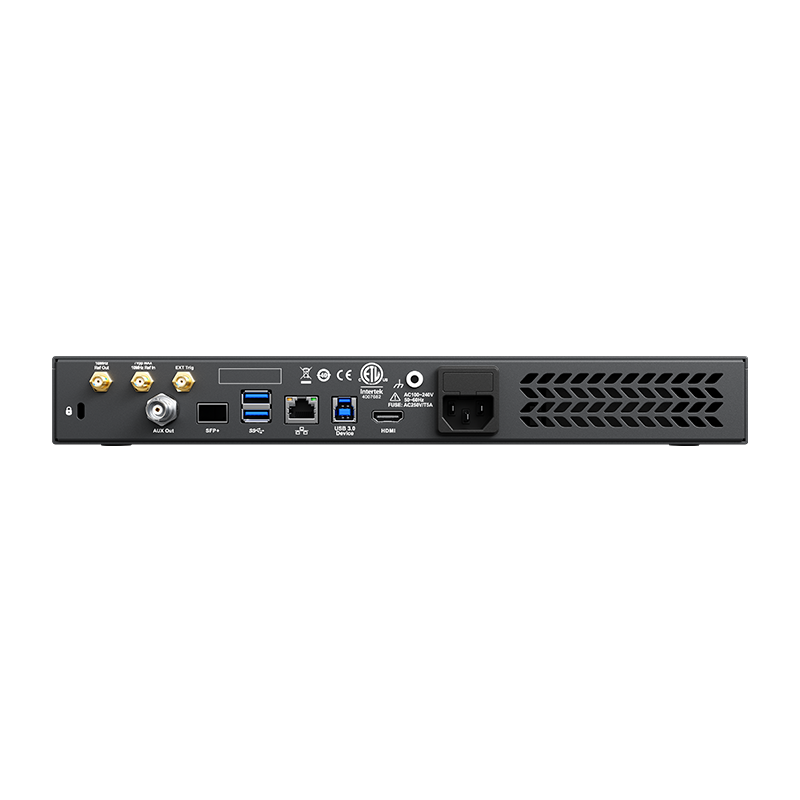
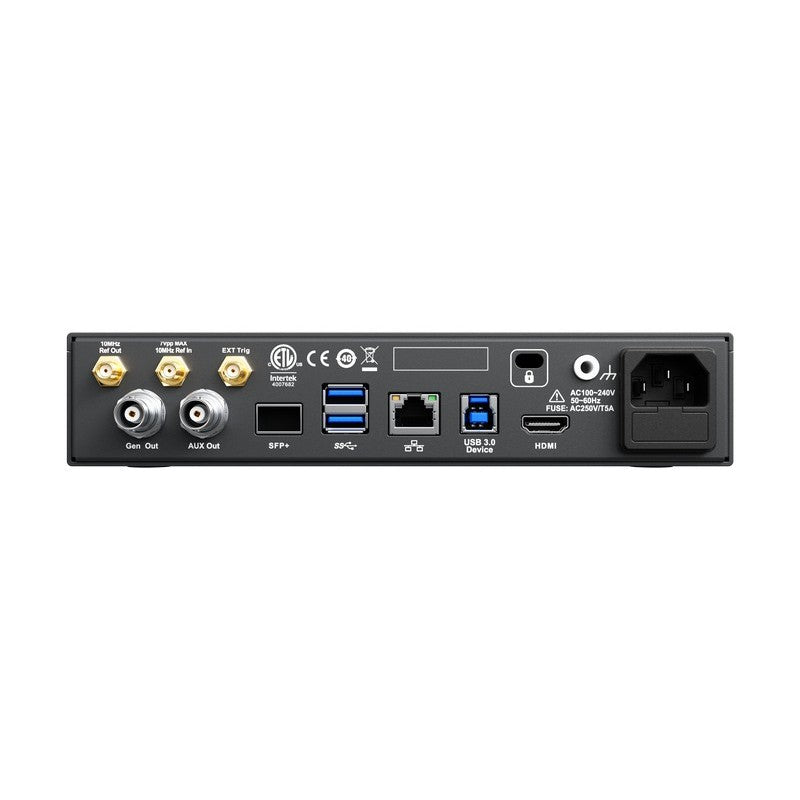
Overview
The UPO6038LP is a 12-bit, 350 MHz bandwidth, 8-channel high-resolution oscilloscope on UNI-T's UPO6000LP 1U rack-mount platform. The chassis interleaves to 5 GSa/s, holds 500 Mpts/CH of memory, and captures 500,000 waveforms per second (up to 1 M wfm/s in sequence mode) through the Ultra Phosphor 3.0 display engine. The 12-bit native ADC delivers 4× the vertical resolution of an 8-bit scope at every gain setting — small-signal detail resolves without the gain shifts that 8-bit instruments require to recover it.
The UPO6038LP ships in an 8-channel configuration. The chassis is the platform for the optional UPO6000LP-PWR power analysis suite, including three-phase analysis. Twelve serial protocol families decode across industrial, automotive, computer, embedded, and audio buses. The 1U headless form factor stacks into 19-inch racks and synchronizes to other chassis for combined-channel capture.
Choosing Your Model — UPO6000LP High-Resolution Oscilloscopes
All six UPO6000LP models share the same 12-bit native ADC, 5 GSa/s interleaved sample rate, 500 Mpts/CH memory depth, 500,000 wfm/s capture rate, Ultra Phosphor 3.0 display, 56-parameter measurement suite, and 1U headless rack-mount chassis. The matrix below shows the differentiators that vary across the family — bandwidth determines rise time and the highest-frequency content the front end resolves; channel count determines which advanced options the chassis can carry. The 4-channel chassis accepts the optional built-in 50 MHz AWG, which adds Bode plot and PSRR loop analysis; the 8-channel chassis is the platform for the power analysis option, including three-phase analysis.
| Bandwidth | 4 channels AWG + Bode/PSRR option |
8 channels Power analysis option (incl. three-phase) |
|---|---|---|
| 1 GHz |
UPO6104LP Rise time ≤0.35 ns |
UPO6108LP Rise time ≤0.35 ns |
| 500 MHz |
UPO6054LP Rise time ≤0.70 ns |
UPO6058LP Rise time ≤0.70 ns |
| 350 MHz |
UPO6034LP Rise time ≤1.00 ns |
UPO6038LP Rise time ≤1.00 ns |
Key Features
- 12-bit native vertical resolution at every gain setting — 4× the dynamic range of an 8-bit scope, with HR mode extending effective resolution to 16 bits
- 350 MHz analog bandwidth with ≤1.00 ns rise time (typical)
- 5 GSa/s real-time sample rate interleaved, 2.5 GSa/s non-interleaved on each channel
- 500 Mpts/CH maximum memory depth — capture tens of thousands of waveform cycles in a single acquisition
- 500,000 wfms/s capture rate via Ultra Phosphor 3.0; 1,000,000 wfms/s in sequence mode
- 8 analog channels on a 1U headless rack-mount chassis with HDMI display output
- Power analysis option (UPO6000LP-PWR) — 12 automated analyses including switching loss, Rds(on), inrush current, SOA and IEC 61000-3-2 harmonics
- Three-phase power analysis included in UPO6000LP-PWR — synchronous voltage and current capture with DQ0 analysis and space-vector diagram (8-channel models)
- 12 serial protocol families — RS232/422/485/UART, I²C, and SPI standard; CAN, CAN-FD, LIN, FlexRay, SENT, audio, MIL-STD-1553, ARINC429, and Manchester optional
- 56 automated parameter measurements with histogram and trend statistics
- Zone triggering and hardware-accelerated mask test for intermittent-anomaly isolation
- 5 Mpts FFT for spectrum analysis up to the Nyquist limit
- Multi-machine synchronization — combine up to 16 UPO6000LP chassis for 64-channel (4-ch) or 128-channel (8-ch) acquisition
- USB Host (×4), USB Device, LAN (VXI-11), HDMI, 10 MHz reference in/out — full SCPI 1999.0 / IEEE-488.2 control
- WebServer remote control from PC or mobile device, plus free UNI-T instrument management software
UNI-T UPO6038LP Details

12-Bit Native Resolution with Ultra Phosphor 3.0 Display Engine
Vertical resolution is 12 bits native at every gain setting. An 8-bit oscilloscope offers 256 ADC codes; the 12-bit ADC provides 4,096 codes — 4× the dynamic range and 16× the amplitude granularity. Low-amplitude features on a high-amplitude carrier resolve directly without rescaling the input range. HR (high-resolution) acquisition mode raises effective resolution further, up to 16 bits.
Ultra Phosphor 3.0 is UNI-T's proprietary capture and display engine. Multi-bank interleaved mapping and a segmented matrix processing architecture push capture rate to 500,000 wfm/s in standard mode, 1,000,000 wfm/s in sequence mode. Information-entropy-based abnormal-signal detection runs in hardware, so intermittent events that appear once per million cycles land in the persistence buffer rather than going missed between triggers.
All-in-One Instrument Platform
The UPO6038LP integrates multiple instruments into one chassis: digital storage oscilloscope, hardware frequency counter (7-digit, multi-channel), 4-digit RMS voltmeter, FFT spectrum analyzer (up to 5 Mpts), 56-parameter automated measurement suite, serial protocol decoder (12 families), and timing analyzer. The 4-channel configuration adds an optional 50 MHz function/arbitrary waveform generator. Each function uses the same calibrated front end, eliminating impedance and timebase drift between separate instruments.
Bench space, BNC inventory, calibration overhead, and inter-instrument synchronization consolidate into one chassis — cross-domain debug across voltage waveform, frequency content, protocol decode, and parameter trend on one time axis.


Zone Triggering — Isolate Intermittent Anomalies
Zone triggering captures intermittent anomalies that conventional trigger logic cannot isolate. Engineers draw a rectangular zone on the touch UI or via SCPI and the instrument captures only waveforms that enter (or avoid) the zone. The behavior simplifies debug for glitches, runt pulses, jitter excursions, and protocol field violations that standard edge or pattern triggers cannot pin to a stable display.
Two zones combine with Boolean logic — capture only waveforms entering zone A AND zone B, or A AND NOT B. The zones travel with the waveform across acquisitions; once a fault is defined it stays captured for the test duration.
12 Serial Protocols with Decode, Trigger, and Event Search
Twelve serial protocol families are decodable. Three ship standard: RS232/422/485/UART, I²C, and SPI. The remaining nine are licensed options: CAN and CAN-FD (industrial and motor drives), LIN (low-speed sensor networks), FlexRay (deterministic distributed control), SENT, audio (I²S/LJ/RJ/TDM), MIL-STD-1553, ARINC 429, and Manchester.
Protocol decode pairs with serial-bus trigger and protocol-event search — find a specific frame ID or data payload across the full memory depth without paging through millions of cycles manually. Decoded data exports as a conformance report for design verification.


56-Parameter Measurement Suite with Histogram and Trend Statistics
The instrument supports 56 automated parameter measurements covering voltage, time, area, frequency, slew rate, duty cycle, jitter, eye-pattern parameters, and statistical aggregates. Up to 27 parameters display simultaneously; 9 parameters per page show full statistics including measured value, histogram of the distribution, and trend plot over time. The parameter snapshot function captures 39 measurements for a single channel in one read.
Three measurement strategies — amplitude, top-value, and base-value — tune how the instrument computes parameters on noisy, modulated, or non-flat-top signals. A burst-setup function adds burst-specific parameters (burst width, repetition rate, intra-burst period) for pulsed and packetized signals.
Hardware-Accelerated Mask Test
Mask test compares each acquired waveform against a tolerance template and counts pass/fail in hardware. The test uses an FPGA-resident comparator and runs at full waveform-capture rate — testing that takes minutes on software-only platforms completes in seconds on the UPO6000LP. Mask shapes are user-defined or imported from compliance specifications.
Pass/fail output is wired through the AUX BNC for production-line integration; the instrument can stop on first fail, count to a threshold, or log failure waveforms to USB while continuing.


Math, Digital Filters, and 5 Mpts FFT
The math system supports the four arithmetic operations between analog channels (+, −, ×, ÷), four digital filter types (high-pass, low-pass, band-pass, band-limit) with user-set cutoff and order, and custom function operations that combine multiple channels through user-defined expressions. Math waveforms are full-rate and can be used as trigger or measurement sources.
FFT spectrum analysis runs up to 5 Mpts with five window functions, displaying magnitude, phase, real, or imaginary content with cursor and peak-search — sufficient to resolve narrow spectral features at high span and to support EMI pre-compliance work.
Search and Navigate Across 500 Mpts of Memory
Capturing 500 Mpts of memory per channel means hours of waveform activity in a single acquisition. The search engine indexes user-defined events — edges, pulse widths, runt pulses, protocol decode values, mask violations — across the entire memory and lets the user step between matches with the navigation controls.
Search and navigation pair with the zoom architecture; the engineer jumps from event to event at full resolution without leaving the record. Events are bookmarked and exported with the waveform file for later analysis on a connected PC.


1U Rack-Mount Chassis and Multi-Machine Synchronization
The UPO6038LP is a 1U headless rack-mount chassis — no integrated display, no front-panel keys beyond the power button. Control is via the external touch display (HDMI), the WebServer interface (LAN or USB), or SCPI from a host system. The 1U form factor stacks into 19-inch racks; multiple chassis share one bench display via KVM.
Multi-machine synchronization combines up to 16 chassis into a coordinated acquisition system — 64 channels (4-ch) or 128 channels (8-ch). The sync subsystem distributes timebase, trigger, and 10 MHz reference across the rack; cross-chassis measurements share one time axis without external delay-line compensation.
WebServer Remote Control and SCPI Automation
The UPO6038LP runs an embedded WebServer accessible from any browser on the same network. Open the chassis IP in a PC or mobile browser and the instrument's display, controls, and waveform data render in the browser. SCPI commands route through the same interface for automation; waveform files and the user manual download directly to the host. The architecture eliminates the need for a vendor-specific driver or installer for casual remote access.
Higher-throughput automation runs through the SCPI 1999.0 / IEEE-488.2 command set over USB-Device or LAN (VXI-11). LabVIEW, Python-VISA, and any standard ATE framework integrate directly. The free UNI-T instrument management software for Windows handles bulk waveform pull, settings save/restore, and firmware update.


Power Analysis and Three-Phase Power Analysis (Optional)
The UPO6038LP supports the optional UPO6000LP-PWR power analysis — 12 automated analyses: power quality, harmonics against IEC 61000-3-2, inrush current, Rds(on), switching loss, slew rate, SOA, modulation, ripple, turn-on/off time, transient response, and efficiency. Values compute from the voltage and current channels with connected probes; no external wattmeter needed.
Three-phase power analysis, included in the same option, adds synchronous voltage and current sampling across all three phases — power quality, harmonic analysis, ripple, efficiency, and DQ0 analysis with space-vector display. Real-time display accelerates debug of motor drives, EV inverters, and grid-tied power conversion. Three-phase analysis runs on the 8-channel models, which have the channels for three voltages and three currents at once.
Primary Applications
Multi-Channel R&D Validation and Debug
The 12-bit ADC and 5 GSa/s sample rate make the UPO6038LP a primary debug instrument for mixed-signal designs where small-signal detail matters. Low-amplitude noise on a high-amplitude rail, slow droop on a switching transient, and protocol-field margin violations all resolve at one gain setting without rescaling. The 500 Mpts memory holds a full debug session for after-the-fact search.
ATE Integration and Long-Duration Automated Test
The headless 1U rack-mount chassis is built for automated test environments. SCPI 1999.0 / IEEE-488.2 over LAN (VXI-11) or USB integrates with LabVIEW, Python-VISA, and any major ATE framework. Hardware-accelerated mask test runs pass/fail at full capture rate; the AUX output drives production-line bin sorters directly. Multi-machine sync scales channel count for parallel device-under-test stations sharing one timebase.
Power Integrity and Switching Power Supply Characterization
The 8-channel chassis is the platform for the UPO6000LP-PWR power analysis option, including three-phase analysis. Combined with 12-bit vertical resolution, the instrument resolves switching-loss waveforms, Rds(on) ramps, and inrush currents that 8-bit scopes compress into noise. Three-phase analysis captures motor drives and inverters on three voltage and three current channels with real-time space-vector display.
Accessories and Family Options
UPO6000LP Family Members
| Model | Bandwidth | Ch | Rise time | AWG opt | Power opts |
|---|---|---|---|---|---|
| UPO6108LP | 1 GHz | 8 | ≤0.35 ns | — | Available |
| UPO6104LP | 1 GHz | 4 | ≤0.35 ns | Available | — |
| UPO6058LP | 500 MHz | 8 | ≤0.70 ns | — | Available |
| UPO6054LP | 500 MHz | 4 | ≤0.70 ns | Available | — |
| UPO6038LP | 350 MHz | 8 | ≤1.00 ns | — | Available |
| UPO6034LP | 350 MHz | 4 | ≤1.00 ns | Available | — |
Available Options
- UPO6000LP-PWR — Power analysis: 12 automated analyses plus three-phase analysis with DQ0 and space-vector diagram
- UPO6000LP-TIMING — Timing analyzer for bus communication timing (I²C, SPI, CAN, I²S)
- UPO6000LP-CAN, UPO6000LP-CANFD, UPO6000LP-LIN, UPO6000LP-FLEX, UPO6000LP-SENT — Automotive and industrial serial bus decode options
- UPO6000LP-AUDIO — Audio bus decode option (I²S, left/right justified, TDM)
- UPO6000LP-MIL1553, UPO6000LP-ARINC429, UPO6000LP-MANCH — Additional serial bus decode options
- UPO6000LP-BND — Software analysis bundle
- UPO6000LP-AUTO — Vehicle bus diagnostic bundle
Recommended Probes
- UT-P08A — 350 MHz passive voltage probe (for 350 MHz models)
- UT-P07A — 500 MHz passive voltage probe (for 500 MHz models)
- UT-PA2000 — 2 GHz active single-ended voltage probe (for 1 GHz models)
- UT-P30 / UT-P31 — 100 MHz high-voltage differential probes for floating and line-referenced power measurements
- UT-P40, UT-P41, UT-P42 — AC/DC current probes to 60, 100 and 200 A; UT-P43 / UT-P44 for higher-bandwidth switching current (25–50 MHz)
Frequently Asked Questions
What does "headless rack-mount" mean — do I need an external display?
The UPO6000LP chassis is a 1U rack-mount form factor with no integrated display. Operation is via an external touch display on the HDMI port, the WebServer interface in any browser, or SCPI from a host system. The headless architecture trades the front-panel screen for rack density — multiple chassis share one bench display through a KVM switch.
Can I synchronize multiple UPO6000LP chassis?
Yes. Up to 16 chassis combine on a shared timebase, trigger, and 10 MHz reference — 64 channels (4-ch) or 128 channels (8-ch). The chassis present as one combined acquisition system to the SCPI controller.
Does the 8-channel model include a built-in waveform generator?
No. The built-in 50 MHz AWG is 4-channel-only; the 8-channel chassis cannot accept the Gen option. For 8-channel applications requiring AWG stimulus, an external UNI-T UTG-series benchtop AWG pairs with the chassis over LAN or USB.
What's the difference between standard and sequence-mode capture rate?
Standard capture rate is 500,000 wfm/s — new waveforms acquired and processed into the persistence display in real time. Sequence mode raises capture rate to 1,000,000 wfm/s by storing memory segments to a high-speed buffer for post-acquisition display. Sequence mode is preferred for intermittent-event capture; standard mode for continuous-trace persistence work.
Do I need specific probes for the power analysis option?
The power analysis software runs on whatever voltage and current probes are connected. For switching-supply work, pair a high-voltage differential probe (UT-P30 or UT-P31) with an AC/DC current probe sized to the load (UT-P40 to UT-P42, or UT-P43/UT-P44 for faster switching edges). The chassis computes analysis from the captured channels — probe selection determines accuracy and bandwidth, not feature availability.
×Ultra Phosphor 3.0 persistence display — 500,000 wfm/s standard, 1 M wfm/s sequence
×Multiple instruments integrated into one calibrated chassis
×Zone triggering — isolate intermittent anomalies
×12 serial protocol families with trigger, decode, and event search
×56 automated measurements with histogram and trend statistics
×FPGA-resident mask test — runs at full capture rate
×Math operations, digital filters, and 5 Mpts FFT
×Event search across 500 Mpts of memory with navigation
×1U rack-mount form factor — stacks into 19-inch racks
×Multi-machine sync — up to 16 chassis combined
×WebServer remote control from PC or mobile browser
×Power analysis — single-phase and three-phase with space-vector display
| Analog Bandwidth | 350MHz |
|---|---|
| Channels | 8Ch |
| Sample Rate | 5GSa/s |
| Memory Depth | 500Mpts |
| Vertical Resolution | 12 bits |
| Built-in Signal Generator | Not Available |
| Digital Channels | Not Available |
| Instrument Type | DSO |
Features
- Frequency Counter
- Digital Voltmeter
Full specifications (17)
| Details | |||||
|---|---|---|---|---|---|
| Waveform Capture Rate |
|
||||
| Input Impedance | 1 MΩ | 50 Ω | ||||
| Vertical Scale (1 MΩ) | 500μV/div to 10V/div | ||||
| Vertical Scale (50 Ω) | 500μV/div to 1V/div | ||||
| Automated Measurements | 56 | ||||
| Bus Protocols (Standard) | RS232|UART|RS422|RS485|I2C|SPI | ||||
| Bus Protocols (Optional) | CAN|CAN-FD|LIN|FlexRay|SENT|Audio|MIL-STD-1553B|ARINC429|Manchester | ||||
| Protocol Decoders | 12 | ||||
| Measurement Parameters | 56 | ||||
| Fft Points | 5Mpts | ||||
| Features | |||||
| Frequency Counter Bits | 7-digit | ||||
| Rise Time | ≤1.00 ns | ||||
| Power Analysis | 13 | ||||
| Dvm Bits | 4-digit | ||||
| General Information | |||||
| Interface | USB Host|USB Device|LAN|HDMI|AUX|EXT|10MHz Ref In/Out | ||||
| Warranty | 3+2 years | ||||
| Certifications | CE|cETLus | ||||
Data Sheets and Manuals
Authentic UNI-T accessories are an affordable way to extend the functionality of your instrument.
Passive Probes 11

UT-P01 25 MHz 10:1 General Purpose Oscilloscope Probe
$15.99
UT-P03 60 MHz 10:1 General Purpose Oscilloscope Probe
$18.99
UT-P04 100 MHz 10:1 General Purpose Oscilloscope Probe
$15.99
UT-P05 200 MHz 10:1 General Purpose Oscilloscope Probe
$20.99
UT-P06 300 MHz 10:1 General Purpose Oscilloscope Probe
$37.99
UT-P07A 500 MHz 10:1 General Purpose Oscilloscope Probe
$51.99UT-P07B 500 MHz 10:1 General Purpose Oscilloscope Probe
$119.00
UT-P08A 350 MHz 10:1 General Purpose Oscilloscope Probe
$51.99
UT-P20 250 MHz 100:1 High Voltage Oscilloscope Probe
$56.99
UT-P21 50 MHz 1000:1 High Voltage Oscilloscope Probe
$430.00
UT-V23 High Voltage Scope Probe
$25.00Current Probes 6

UT-P40 DC-100 kHz 60A AC/DC Current Probe
$452.00
UT-P41 DC-100 kHz 100A AC/DC Current Probe
$595.00
UT-P4150 12 MHz High-Frequency DC/AC Current Probe
$2,529.00
UT-P42 150 kHz 200A AC/DC Current Probe
$459.00
UT-P43 DC-25 MHz 20A 100mV/A Current Probe
$956.00
UT-P44 DC-50 MHz 40A 50mV/A Current Probe
$1,695.00Differential Probes 6

UT-P30 100 MHz 10:1/100:1 Differential Oscilloscope Probe
$399.00
UT-P31 100 MHz 100:1/1000:1 Differential Oscilloscope Probe
$699.00
UT-P32 50 MHz 100:1/1000:1 Differential Oscilloscope Probe
$860.00
UT-P33 120 MHz 100:1/1000:1 Differential Oscilloscope Probe
$1,465.00
UT-P35 50 MHz 50:1/500:1 Differential Oscilloscope Probe
$395.00

