

UTS3015T+ 1.5 GHz Spectrum Analyzer with Tracking Generator
$1,299.00
In StockView Product →
UTS3032T+ 3.2 GHz Spectrum Analyzer with Tracking Generator
$1,699.00
In StockView Product →UTS3021B
2.1GHz Performance-Series Spectrum Analyzer
Low stock: 1 left
2.1 GHz spectrum analyzer and -161dBm/Hz DANL. Professional-grade RF measurement for telecom, broadcast, and production test environments.


UNI-T UTS3021B 2.1GHz Performance-Series Spectrum Analyzer: 2.1 GHz Performance Analyzer (TG-Upgradeable)
Overview
The UNI-T UTS3021B Performance-Series Spectrum Analyzer covers 9 kHz – 2.1 GHz with a 10.1-inch capacitive multi-touch display, a 1 Hz resolution-bandwidth floor, and up to 40,001 sweep points. It targets the sub-2.1 GHz bench measurement workload — communications module verification, IoT and wireless development, harmonic and spurious testing — with the option to add a tracking generator in the field when your work demands scalar transmission measurements.
A typical displayed average noise level of -161 dBm/Hz (preamp on) and phase noise of <-98 dBc/Hz at a 10 kHz offset deliver the dynamic range needed for serious signal characterization in the sub-2.1 GHz band. Standard interfaces include HDMI 1.4 display output, USB-A 3.0 (Host), USB-B 2.0 (Device), and Gigabit LAN with full SCPI support — the UTS3021B drops into an automated test rack as easily as it sits on a development bench.
Key Features
- 9 kHz – 2.1 GHz frequency coverage — sub-2.1 GHz for general RF dev, communications, harmonic surveys, and EMI pre-compliance work

- -161 dBm/Hz typical DANL (preamp on) — sensitive enough to resolve low-level signals, spurs, and harmonic energy near the noise floor
- <-98 dBc/Hz phase noise @ 10 kHz offset (typical, 1 GHz carrier) — clean enough for close-in spectral measurements and modulated-signal analysis
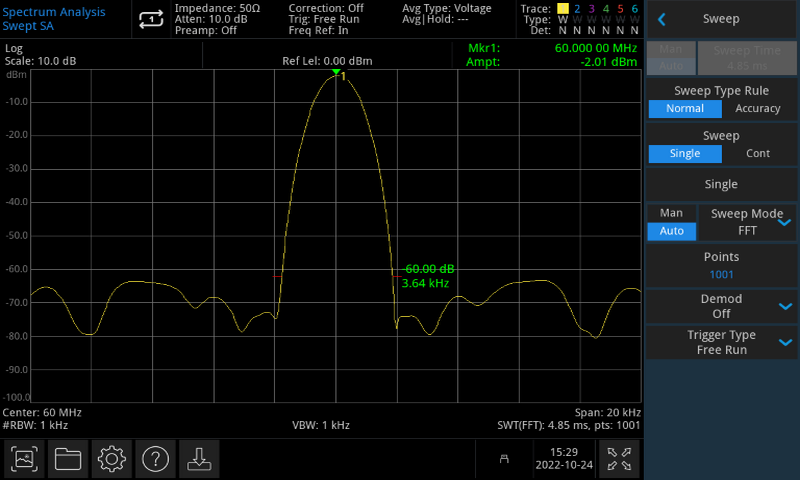
- 1 Hz – 3 MHz RBW in 1-3-10 steps — fine resolution control all the way down to a 1 Hz floor, with FFT mode for faster narrowband sweeps
- 40,001 sweep points — deep trace detail (4× the count of UNI-T's entry tier) for catching signals that coarser analyzers miss
- 10.1-inch capacitive multi-touch display (1280 × 800) — pinch, drag, and tap to set markers, with full mouse/keyboard support via USB
- Six traces with five detector modes — Sample, Peak, Negative, Normal, Average; Clear/Write, Average, Max Hold, Min Hold trace types
- Field-upgradeable tracking generator — add scalar network analysis later by ordering the UTS3000-TG option (TG range matches analyzer frequency: 100 kHz – 2.1 GHz)
- Full SCPI remote control — over USB-Device (USB-B 2.0) and LAN VXI-11 (10/100/1000 Base) for automated test, production lines, and unattended data collection
- Option-extensible — add UTS3000-AMA (analog demodulation), UTS3000-AMK (advanced measurement kit), or UTS3000-EMI (EMI pre-compliance) as your work scope grows
- Built to last in working environments — forced-air cooling with a user-removable dust filter to keep the internals clean across years of bench use
UNI-T UTS3021B Details
Frequency Coverage (9 kHz – 2.1 GHz)
The UTS3021B sweeps continuously from 9 kHz up to 2.1 GHz, with 1 Hz frequency resolution and marker counter accuracy on the same order. The 2.1 GHz ceiling covers the 2.4 GHz ISM band's lower edge (with appropriate care near the limit), all sub-GHz ISM bands (315/433/868/915 MHz), common 1.8/2.0 GHz cellular bands, and a comfortable harmonic margin for HF and VHF transmitter work. A 1 Hz frequency reference calibration accuracy with <1 ppm temperature stability keeps measurements steady across the calibration cycle.
Sensitivity (DANL as low as -161 dBm/Hz)
Weak-signal testing depends on how quiet the analyzer itself is. With the preamp on, the UTS3021B reaches a typical displayed average noise level of -161 dBm/Hz in the 200 MHz – 1.5 GHz band — low enough to resolve faint emissions, identify harmonic energy well below the carrier, and characterize signals near the noise floor. Five detector modes (Sample, Peak, Negative, Normal, Average) and four trace types give you the flexibility to tune what the trace shows for any measurement context. A switchable 20 dB preamp adds gain when you need it, and the input attenuator adjusts in 1 dB steps from 0 to 51 dB.
Phase Noise (<-98 dBc/Hz at 10 kHz offset)
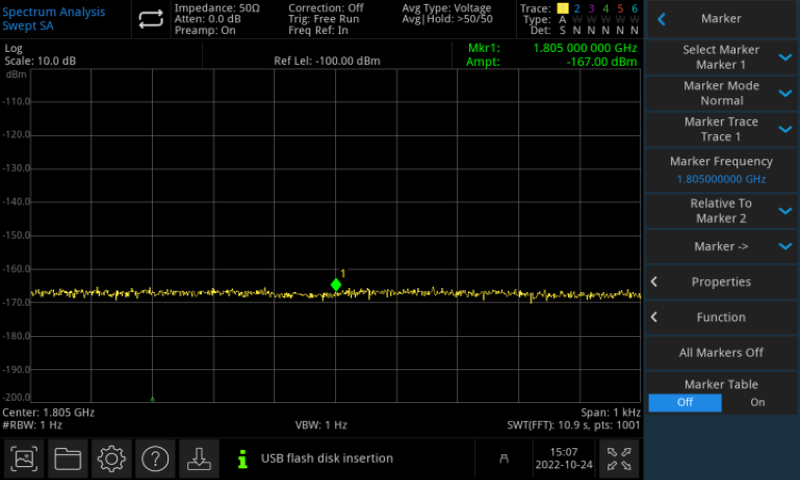
Clean local-oscillator performance matters when you're working close to a strong carrier — modulated signal analysis, narrowband interference identification, or oscillator-quality measurement. With typical phase noise of <-98 dBc/Hz at a 10 kHz offset from a 1 GHz carrier (measured with a 1 kHz RBW and 10 Hz VBW), the UTS3021B resolves close-in spectral content without the phase noise pedestal washing it out. Typical performance at a 1 MHz offset is in the -112 to -116 dBc/Hz range — well-suited for general modulated-signal and oscillator work.
1 Hz – 3 MHz Resolution Bandwidth
Resolution bandwidth in 1-3-10 steps, from 1 Hz all the way to 3 MHz, gives you the right sweep speed / selectivity trade-off for any measurement. Drop the RBW to 1 Hz to separate signals closer together in frequency than most mid-tier analyzers can manage; widen it for fast high-level surveys. Bandwidth accuracy holds within 5% nominal, and switching between resolution settings introduces only ±0.2 dB relative amplitude uncertainty. The shape factor (-60 dB / -3 dB ratio) is <4.8:1 nominal — tight skirts that help you separate close-in signals of unequal amplitude. FFT sweep mode is also available for faster narrowband measurements.
40,001 Sweep Points
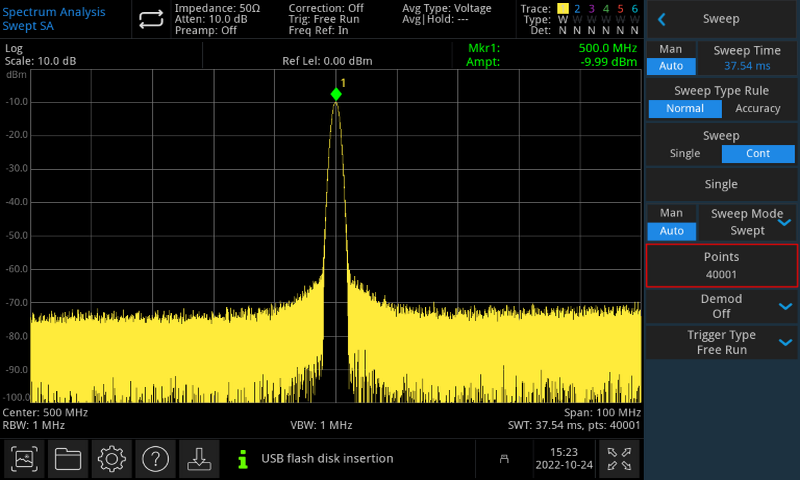
More points across a trace means finer frequency resolution per pixel and a much better chance of catching signals that fall between coarser bins. The UTS3021B provides up to 40,001 sweep points per trace — four times the count of UNI-T's entry-tier UTS1000B series, and high enough to clearly distinguish closely-spaced signals, identify intermittent emissions, and read marker frequencies with confidence. Combined with six independent traces, you can simultaneously display raw, max-hold, min-hold, and averaged versions of the same span.
10.1-inch Multi-Touch Interface
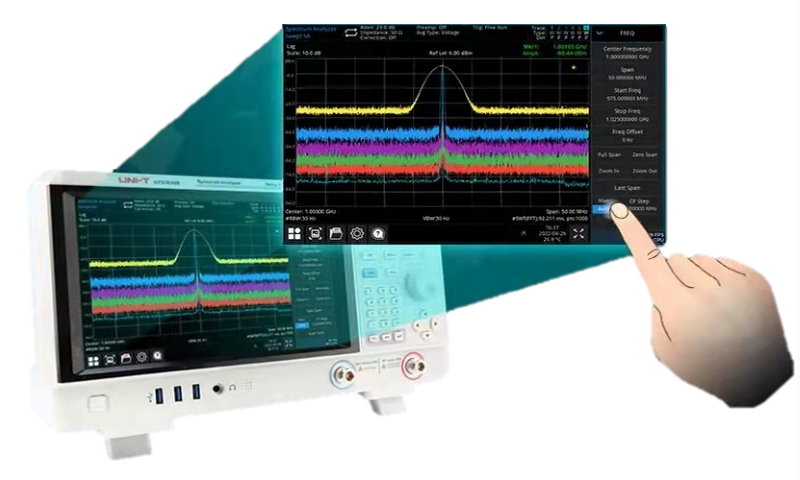
The UTS3021B uses a 10.1-inch capacitive multi-touch display (1280 × 800 HD resolution) for direct interaction with traces, markers, and menus. Pinch, drag, and zoom directly on the trace; set markers by tapping where you want them; navigate menus the way you'd expect on a modern tablet. For lab environments where a USB mouse or keyboard is more practical, the UTS3021B accepts those through the USB Host port. The touch UI cuts measurement setup time noticeably on day-to-day bench work — especially when you're repeatedly adjusting span, RBW, and marker positions across many sweeps.
Marker Suite (4 Markers, 5 Functions)
Four markers with three modes (Normal, Delta, Fixed) cover the basic measurement vocabulary — reading absolute level, computing delta between two points, locking a marker to a frequency for sweep-to-sweep comparison. Five built-in marker functions go further: Marker Noise reads noise density in dBm/Hz at the marker, Band Power integrates total power over a user-defined band, Band Density reports power per Hz across that band, N dB auto-finds the points N dB down from a peak (useful for measuring -3 dB or -6 dB bandwidths), and Counter reads frequency to 1 Hz resolution.
Connectivity (HDMI, USB, LAN, 10 MHz Ref)
A full set of standard rear-panel interfaces makes the UTS3021B easy to fit into any workflow:
- RF Input: Type-N female, 50 Ω
- HDMI 1.4 display output — mirror the trace to an external monitor for shared review or training
- USB-A 3.0 Host + USB-B 2.0 Device — thumb drive, mouse/keyboard, and SCPI over USB
- LAN VXI-11 (10/100/1000 Base, RJ-45) — networked remote control
- 10 MHz reference in/out (BNC) — lock to an external timebase or share the internal reference
- External trigger input (TTL, BNC, rising/falling edge)
SCPI Remote Control for Automated Test
The UTS3021B responds to industry-standard SCPI commands over both USB-Device (USB-B 2.0) and LAN VXI-11 (RJ-45). That means it drops cleanly into pyvisa, LabVIEW, NI-MAX, or any other test framework that talks to standard instruments — no proprietary protocol layer to learn, no special drivers beyond a USB or LAN connection. Whether you're building a production test rig, automating a parametric sweep across DUTs, or running unattended overnight data collection, the interface scales the same way the rest of the bench does. The full SCPI command set is documented in the UTS3000B Programming Manual.
Tracking Generator Upgrade Path (UTS3000-TG Option)
The UTS3021B chassis is provisioned for tracking generator hardware that you can add in the field by ordering the UTS3000-TG option. The TG range matches the analyzer's frequency: 100 kHz – 2.1 GHz. Output power is adjustable from -40 dBm to 0 dBm in 0.5 dB steps with ±3 dB flatness relative to 50 MHz. Once installed, the TG output appears on its own dedicated front-panel Type-N female 50 Ω connector.
Why this matters: a tracking generator turns the UTS3021B into a scalar network analyzer for transmission measurements. Sweep filters to read insertion loss and frequency response, characterize amplifier gain across a band, measure matching-network response, and check antenna return loss (with a directional coupler) — all without a separate signal generator. Many teams start with the UTS3021B for general spectrum work and add the TG option later when a project demands scalar transmission measurements.
Software Options for Specialized Measurements
The UTS3021B starts as a capable general-purpose spectrum analyzer and grows into specialized roles through software options — the instrument hardware is the same; the options unlock measurement modes:
- UTS3000-AMK (Advanced Measurement Kit) — adds channel power, adjacent channel power (ACP), occupied bandwidth (OBW), time-domain power, carrier-to-noise ratio (CNR), third-order intercept (TOI), and harmonic measurements (up to the 10th harmonic), plus a spectrogram display for time-history visualization
- UTS3000-AMA (Analog Demodulation) — AM and FM demodulation analysis with modulation rate, depth, and frequency offset measurements (20 Hz – 100 kHz modulation rate range)
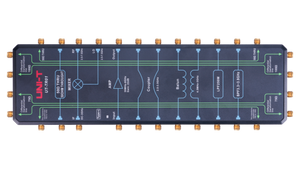
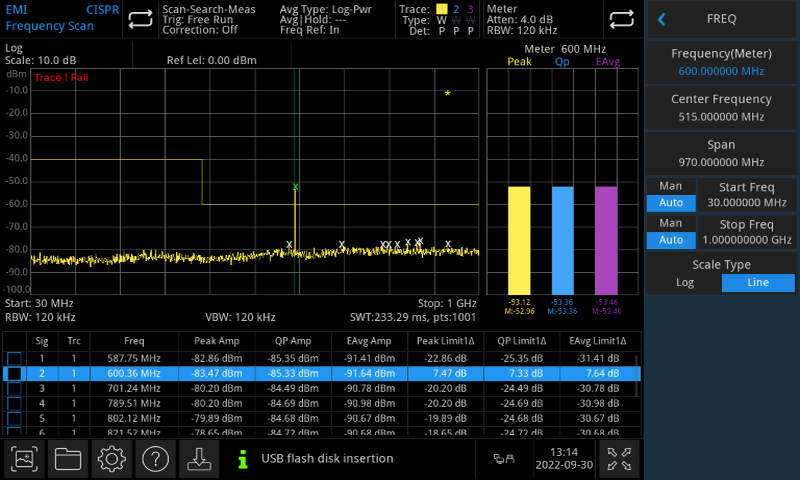
- UTS3000-EMI (EMI Pre-Compliance) — CISPR-aligned QP/AVG/PEAK detectors, EMI band sweep, and limit-line analysis. Pairs with the optional UTS-EMI01 near-field probe kit (3 mm to 10 cm probes, 30 MHz – 3 GHz) for board-level emission hunting
Built for Working Lab Environments
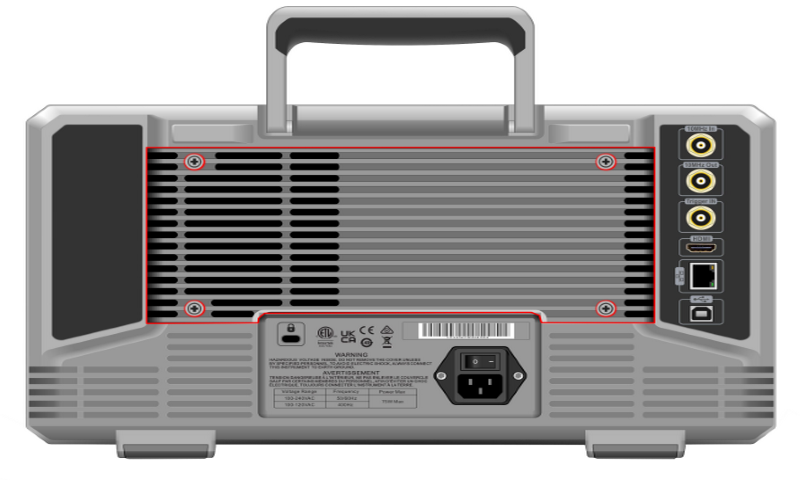
A spectrum analyzer that lives next to soldering stations, drilling, and general bench work will breathe in dust over time. The UTS3021B addresses this with forced-air cooling and a user-removable dust filter — pop it out, vacuum or blow it off, and slide it back. No tools, no service-center trip, no fan failures from dust accumulation. Operating range is 0 °C to +40 °C, storage to -20 °C / +70 °C, with full ±1 ppm timebase stability across the operational temperature range. The full IEC 61326 EMC compliance and EN 61010 safety qualification (with cETLus mark) round out a unit built to hold up across years of bench use.
 UNI-T UTS3021B 40,001-Point Sweep
×
UNI-T UTS3021B -161 dBm/Hz DANL
×
UNI-T UTS3021B RBW Selectivity
×
UNI-T UTS3021B 10.1-inch Multi-Touch UI
×
UNI-T UTS3021B TG Output with UTS3000-TG Option
×
UNI-T UTS3021B EMI Pre-Compliance Mode
×
UNI-T UTS3021B User-Removable Dust Filter
UNI-T UTS3021B 40,001-Point Sweep
×
UNI-T UTS3021B -161 dBm/Hz DANL
×
UNI-T UTS3021B RBW Selectivity
×
UNI-T UTS3021B 10.1-inch Multi-Touch UI
×
UNI-T UTS3021B TG Output with UTS3000-TG Option
×
UNI-T UTS3021B EMI Pre-Compliance Mode
×
UNI-T UTS3021B User-Removable Dust Filter
Applications
RF Design and Validation (sub-2.1 GHz)
Characterize transmit spectrum, harmonics, spurious emissions, and channel power for sub-2.1 GHz designs. The UTS3021B covers all the major sub-GHz ISM bands (315/433/868/915 MHz, LoRa sub-GHz), common 1.8/2.0 GHz cellular bands, and broad harmonic margin for HF/VHF transmitter work. With the AMK option, ACP and OBW measurements add channel-respect verification for designs targeting tight regulatory band edges.
Communications and IoT Module Verification
Production engineering and incoming-inspection workflows for wireless modules — verify TX power, occupied bandwidth, harmonic emissions, and spurious responses against datasheet specs and regulatory limits. SCPI automation lets you build a repeatable production test station around the analyzer, with pass/fail logging against limit lines.
EMI Pre-Compliance Investigation
Catch radiated and conducted emissions issues before sending boards to a full CISPR/FCC compliance lab. With the UTS3000-EMI option plus the UTS-EMI01 near-field probe kit (3 mm to 10 cm probes, 30 MHz – 3 GHz), the UTS3021B becomes a board-level emission hunter — sweep with QP/AVG/PEAK detectors, overlay limit lines, and localize hot spots on the PCB before they cost you a failed compliance test.
Filter and Component Characterization
With the UTS3000-TG option installed, the UTS3021B adds scalar transmission measurements: insertion loss, gain, frequency response, and stopband rejection on filters, amplifiers, attenuators, and antennas. Sweep across 100 kHz – 2.1 GHz and read the response directly on the analyzer trace. Add a directional coupler for return-loss measurements on antennas and matching networks.
Production Test and Quality Control
SCPI automation over USB or LAN (VXI-11) lets the UTS3021B drop into pyvisa, LabVIEW, or NI-TestStand workflows for repeatable production verification. Run end-of-line tests on transmitter modules, RF amplifier gain stages, oscillator output, or filter assemblies; log pass/fail results against limit lines; and feed data into MES or QC databases. Six independent traces, max-hold detection, and 40,001-point sweeps give production-engineering teams the trace depth needed to catch intermittent issues that single-sweep tests miss.
RF Service, Repair, and Maintenance
A capable bench instrument for two-way radio shops, broadcast engineering, antenna service work, and field calibration support. Marker counter functions, harmonic measurements (with AMK), and the touch interface make routine service work quick. The 2.1 GHz ceiling covers commercial broadcast, public-safety and amateur radio, broadcast TV harmonics, and (on 3.6 GHz+ units) sub-6 GHz wireless infrastructure.
In the Box
- UTS3021B spectrum analyzer
- Power cord (region-appropriate)
- USB 2.0 cable, 1.5 m (USB-A to USB-B)
- Factory calibration certificate
Accessories and Family Options
Included with Every Unit
- UTS3000B-series Spectrum Analyzer (UTS3021B)
- Power cord
- USB cable (UT-D04)
- English download guide
- Multi-language safety manual
- Factory calibration certificate
Recommended Software Options
- UTS3000-TG — Tracking Generator field-upgrade (100 kHz – 2.1 GHz) for scalar transmission measurements
- UTS3000-AMK — Advanced Measurement Kit (channel power, ACP, OBW, CNR, TOI, harmonics, spectrogram)
- UTS3000-AMA — Analog Demodulation Analysis (AM and FM)
- UTS3000-EMI — EMI Pre-Compliance (CISPR-aligned QP/AVG/PEAK detectors, limit-line analysis)
Recommended Accessories
- UTS-EMI01 Near-Field Probe Kit — Four probes (30 MHz – 3 GHz, 3 mm to 10 cm resolution) for PCB-level emission hunting with the UTS3000-EMI option
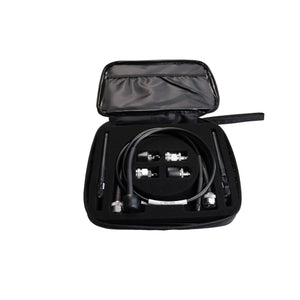
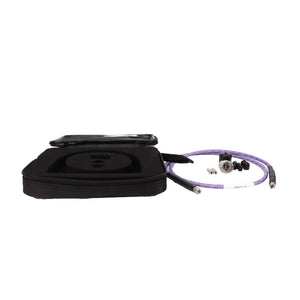
- UT-CK01 Utility Kit — SMA/N adapters, cables, and antennas for general RF setup
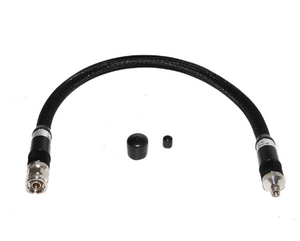
- UT-W01-6GHz Cable — N-to-N RF cable, 0.7 m, DC – 6 GHz
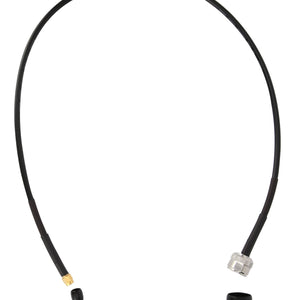
- UT-W02-6GHz Cable — N-to-SMA RF cable, 0.7 m, DC – 6 GHz
Family Members
Frequently Asked Questions
What's the DANL of the UTS3021B, and what does that mean for my measurements?
The UTS3021B reaches a typical displayed average noise level of -161 dBm/Hz with the preamp on in the 200 MHz – 1.5 GHz band. Practically: signals down around -120 dBm are visible above the noise floor with reasonable RBW settings (e.g., 1 kHz). For ultimate weak-signal work, narrow the RBW (each 10× reduction drops the noise floor by 10 dB) and enable averaging across multiple sweeps.
Can I add a tracking generator to the UTS3021B later?
Yes. The UTS3021B chassis is provisioned for the UTS3000-TG option, a field-installable tracking generator covering 100 kHz – 2.1 GHz — the full analyzer range. Output is adjustable from -40 dBm to 0 dBm in 0.5 dB steps with ±3 dB flatness relative to 50 MHz. Once installed, the TG output appears on its own dedicated front-panel Type-N connector, and the UTS3021B becomes a scalar network analyzer for transmission measurements on filters, amplifiers, matching networks, and antennas. Many teams start with the UTS3021B for general spectrum work and add the TG later when a project demands scalar transmission measurements.
How does the UTS3021B compare to the UTS3000T+ Performance series?
The UTS3000B/T family and the newer UTS3000T+ family share core architecture — the same 10.1-inch multi-touch UI, the same 40,001-point sweeps, -161 dBm DANL, and <-98 dBc/Hz phase noise. The UTS3000T+ family steps up to typically -164 to -165 dBm DANL, adds features like a waterfall display, peak tables, and VSWR/return-loss measurement modes, and bundles the tracking generator as standard across all SKUs. For production validation, RF service work, EMI pre-compliance, and IoT/wireless module verification at the sub-2.1 GHz workload, the UTS3021B is well-matched at a lower price point. For new RF design work where the newer feature set and additional measurement margin matter, the UTS3000T+ family is the active upgrade path within UNI-T's spectrum analyzer lineup.
What software options are available, and what do they add?
Three software options expand the UTS3021B's measurement capabilities: UTS3000-AMK (Advanced Measurement Kit) adds channel power, ACP, OBW, time-domain power, CNR, TOI, and harmonic measurements with a spectrogram display. UTS3000-AMA adds AM/FM analog demodulation analysis. UTS3000-EMI adds CISPR-aligned EMI pre-compliance with QP/AVG/PEAK detectors and limit-line support — it pairs with the optional UTS-EMI01 near-field probe kit for PCB-level emission localization.
Is the UTS3021B suitable for automated test (ATE)?
Yes. The UTS3021B accepts standard SCPI commands over USB-Device (USB-B 2.0) and LAN VXI-11 (RJ-45). It drops into pyvisa, LabVIEW, NI-MAX, or any framework that talks to standard test instruments — no proprietary driver layer required beyond a USB or LAN connection. The full SCPI command set is documented in the UTS3000B Programming Manual.
Warranty
This instrument is backed by UNI-T's 3+2 Year Warranty — 3 years of standard coverage, plus 2 additional years free when you register your product. That's 5 years of total protection at no extra cost.
The warranty covers manufacturing defects and component failures under normal use conditions. UNI-T instruments are built for professional daily use, and our warranty reflects that commitment to long-term reliability.
Product Status: Discontinued Replaced By: UTS3015T+ 1.5 GHz Spectrum Analyzer with Tracking Generator · UTS3032T+ 3.2 GHz Spectrum Analyzer with Tracking Generator
| Frequency Range | 9kHz - 2.1GHz | ||||||||||||||||||||||||||||||||||||||||||||||||||||||||
|---|---|---|---|---|---|---|---|---|---|---|---|---|---|---|---|---|---|---|---|---|---|---|---|---|---|---|---|---|---|---|---|---|---|---|---|---|---|---|---|---|---|---|---|---|---|---|---|---|---|---|---|---|---|---|---|---|---|
| DANL | -161dBm/Hz · 26 values · Preamp Off / Preamp On
|
||||||||||||||||||||||||||||||||||||||||||||||||||||||||
| RBW | 1 Hz to 3 MHz, 1-3-10 steps | ||||||||||||||||||||||||||||||||||||||||||||||||||||||||
| Phase Noise | <-98dBc/Hz · 6 values · 10 kHz / 100 kHz / 1 MHz
|
||||||||||||||||||||||||||||||||||||||||||||||||||||||||
| Tracking Generator | Optional | ||||||||||||||||||||||||||||||||||||||||||||||||||||||||
| Instrument Type | Spectrum Analyzer | ||||||||||||||||||||||||||||||||||||||||||||||||||||||||
Features
- Touch Screen
Full specifications (29)
| Details | |||||||||||||||||||||
|---|---|---|---|---|---|---|---|---|---|---|---|---|---|---|---|---|---|---|---|---|---|
| Amplitude flatness |
|
||||||||||||||||||||
| Sweep Span | 0Hz, 100 Hz to 2.1 GHz | ||||||||||||||||||||
| Sweep Time | 1 μs to 4,000 s(span = 0) | ||||||||||||||||||||
| Sweep Type | Swept, FFT | ||||||||||||||||||||
| Sweep Points | 40,001 | ||||||||||||||||||||
| Traces | 6 | ||||||||||||||||||||
| Tracking Generator Range | 10MHz-2.1GHz | ||||||||||||||||||||
| Frequency Resolution | 1Hz | ||||||||||||||||||||
| Channels | 1 | ||||||||||||||||||||
| Features | |||||||||||||||||||||
| Reference Level Range | -100 dBm to+30 dBm, steps 1 dB | ||||||||||||||||||||
| Input Attenuator Range | 0 to 51 dB, 1 dB Step | ||||||||||||||||||||
| Selectivity (60/3 dB) | <4.8: 1 | ||||||||||||||||||||
| Frequency Reference Temp Stability | <1 ppm | ||||||||||||||||||||
| Frequency Reference Aging | 0.5 ppm/ year, 3 ppm/20 years | ||||||||||||||||||||
| Detector Types | Sample, Peak, Negative, Normal, Average | ||||||||||||||||||||
| Trace Types | Clear/Write, Average, Max Hold, Min Hold | ||||||||||||||||||||
| Trigger Types | Free Run, External, Video | ||||||||||||||||||||
| Marker Functions | Marker Noise, Band Power, Band Density, N dB, Counter | ||||||||||||||||||||
| Display Range Log | 1 dB to 200 dB | ||||||||||||||||||||
| Display Range Linear | 0 to Reference level | ||||||||||||||||||||
| Amplitude Units | dBm, dBmV, dBμV, V, W | ||||||||||||||||||||
| General Information | |||||||||||||||||||||
| Display Size | 10.1in | ||||||||||||||||||||
| Display Type | TFT LCD | ||||||||||||||||||||
| Display Resolution | 1280×800, RGB Vertical pixel | ||||||||||||||||||||
| Interface | T Gen|10MHz In/Out|Trg In|HDMI|USB-Host|USB-Device|LAN|audio | ||||||||||||||||||||
| Dimensions (W×H×D) | 378 × 218 × 120 mm | ||||||||||||||||||||
| Weight | 4.55 kg | ||||||||||||||||||||
| Warranty | 3+2 years | ||||||||||||||||||||
| Certifications | CE|cETLus | ||||||||||||||||||||
Data Sheets and Manuals
- UTS1000B-T UTS3000B-T UTS3000T+ UTS3000A UTS5000A UTS7000A Spectrum Analyzer Analog Demodulation Function - User Manual →
- UTS1000B-T UTS3000B-T UTS3000T+ UTS3000A UTS5000A UTS7000A Spectrum Analyzer EMI Function - User Manual →
- UTS3000B Series Spectrum Analyzers - User Manual →
- UTS3000B User Manual HQ →
Older firmware versions (2)
Check your instrument’s hardware revision before updating firmware — different hardware revisions take different builds.
Authentic UNI-T accessories are an affordable way to extend the functionality of your instrument.
UTS3000B Options 4
Need to add specific functionality to your UNI-T instrument? Here are our options for specific applications and measurement types. Have a question? Contact us at 888-668-UniT (8648).