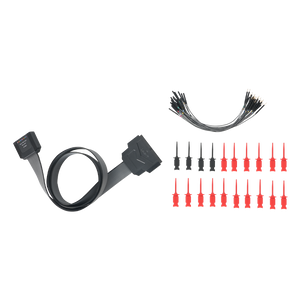


MSO1254HD | 250 MHz 4Ch 12-Bit Mixed Signal Oscilloscope
Overview
The MSO1254HD is a 250 MHz, 4-channel, 12-bit Mixed Signal Oscilloscope built around UNI-T's native 12-bit ADC architecture (R12™). It samples at 2.5 GSa/s with 100 Mpts of memory depth per channel and captures waveforms at 200,000 wfms/s, up to 1,000,000 wfms/s in Sequence Mode on a 7-inch capacitive touchscreen powered by Ultra Phosphor 3.0 acquisition technology.
Built for switching-supply validation, power-stage characterization, and faster-edge embedded debug, the 12-bit ADC delivers 4,096 vertical levels at the full 250 MHz bandwidth — the resolution that lets you measure mV-scale ripple on a 400 V rail, characterize gate-drive ringing on a GaN/SiC half-bridge, and read efficiency curves with confidence in the small numbers. Standard protocol decoding covers the full embedded-systems vocabulary (RS-232, UART, I²C, SPI, RS-422, RS-485, CAN, CAN-FD, LIN, and Audio) at no additional cost. An optional 16-channel logic analyzer pod adds mixed-signal correlation between control firmware and the analog power stage.
The 9-in-1 architecture consolidates oscilloscope, logic analyzer (with optional UT-M26 pod), spectrum analyzer, protocol analyzer, digital voltmeter, frequency counter, and power analyzer into one instrument.
Key Features
- 250 MHz Bandwidth, 4 Analog Channels — Four-channel acquisition at 12-bit native resolution for mixed-signal debugging, switching-power analysis, and precision sensor work.
- R12™ — Native 12-Bit ADC at Full Bandwidth — 4,096 vertical levels at every supported bandwidth — no ERES averaging, no sample-rate trade.
- 2.5 GSa/s Sample Rate, 100 Mpts/Channel — Captures fast edges with sufficient timing resolution and holds long records without dropping sample rate.
- 200,000 wfms/s Capture Rate — 1,000,000 wfms/s in Sequence Mode — Ultra Phosphor 3.0 intensity-graded display reveals rare anomalies and timing violations that slower scopes miss.
- 16 Optional Digital Channels — Add mixed-signal debugging with the UT-M26 logic probe pod for time-correlated analog and digital views.
- All Protocol Decoding Standard — RS-232/UART, I²C, SPI, RS-422, RS-485, CAN, CAN-FD, LIN, and Audio decoding included at no additional cost.
- Built-In Spectrum Analyzer — FFT analysis up to 1 Mpts with peak detection and markers for harmonics, clock spurs, and EMI investigation.
- 56 Automated Measurements — Time, voltage, frequency, and power-quality parameters with statistical analysis and trend graphs.
- Built-In Power Analysis — 12 power-quality parameters including efficiency, ripple, and switching loss for switching-supply characterization.
- 7-Inch Capacitive Touchscreen — 1024×600 multi-gesture display with pinch-to-zoom, drag, and gesture navigation.
- Lab-Friendly Connectivity — USB Host/Device, LAN, AUX Out, HDMI.
R12™ — Native 12-Bit ADC at Full Bandwidth
R12™ is UNI-T's native 12-bit ADC architecture. It samples at 4,096 quantization levels — sixteen times the vertical detail of a conventional 8-bit oscilloscope — and holds that resolution at the full 250 MHz bandwidth and 2.5 GSa/s sample rate. There's no ERES averaging step, no sample-rate trade, and no asterisk on the spec sheet.
For power-electronics validation at full bandwidth, R12 is what lets the MSO1254HD characterize a GaN/SiC half-bridge in the same bench session as the gate-drive ringing analysis. On a switching-node measurement where 8-bit quantization noise would obscure the µV-scale ripple riding on a 400 V rail, the 12-bit resolution recovers the signal that drives design decisions.
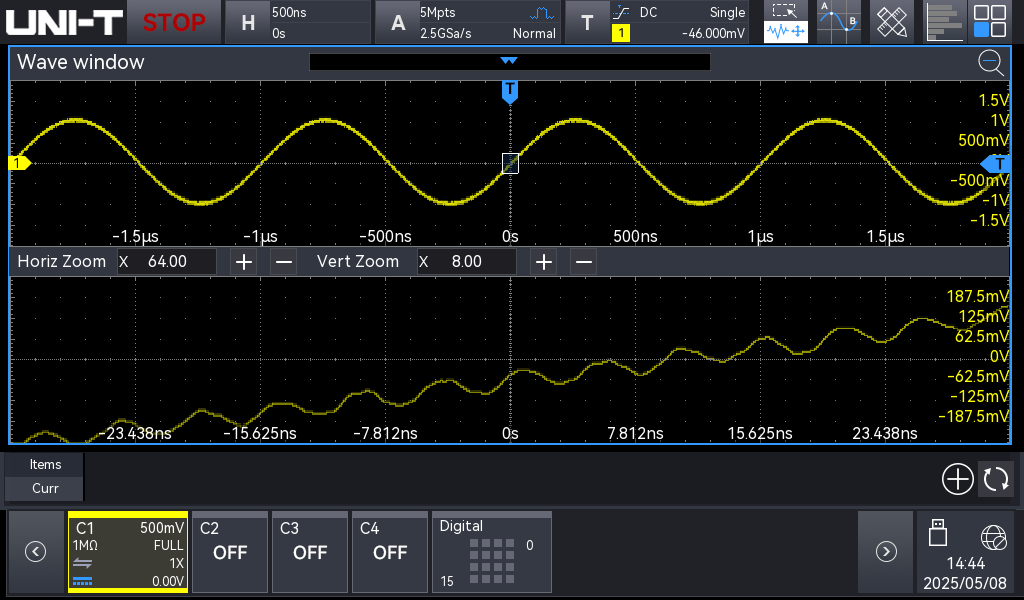 Native 12-bit ADC delivers 4,096 vertical levels at full bandwidth
Ultra Phosphor 3.0 — 200,000 wfms/s Acquisition, 1,000,000 wfms/s in Sequence Mode
Ultra Phosphor 3.0 drives the acquisition system at up to 200,000 waveforms per second, rising to 1,000,000 in Sequence Mode, with 256 levels of color intensity mapping. The intensity-graded display shows you signal behavior patterns that a slower scope flattens into solid traces — rare glitches, edge jitter, and occasional protocol-layer anomalies appear as faint trace markings against the dominant signal.
For intermittent-fault investigation, this is the difference between catching the event in a two-minute capture and waiting for it across an overnight run. The probability of capturing rare anomalies scales with capture rate; one million waveforms per second puts you in the territory where most timing violations show up before lunch.
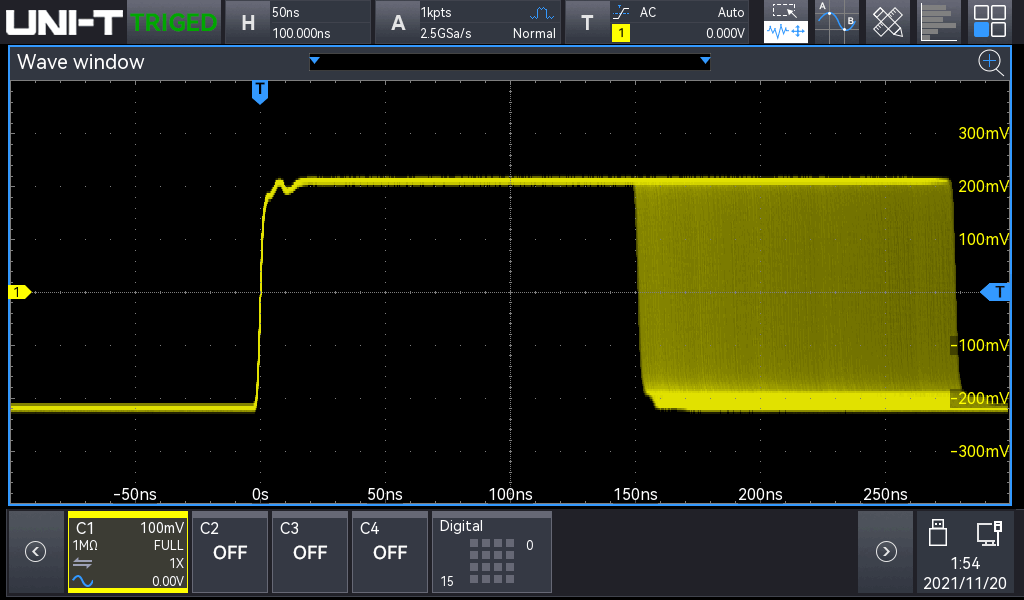 Ultra Phosphor 3.0 reveals rare events with intensity grading
Deep Memory — 100 Mpts Per Channel
100 Mpts of memory depth per channel maintains the full 2.5 GSa/s sample rate across wide time-base settings — useful for capturing complete switching cycles in power-electronics validation, or recording an entire startup transient at full resolution. Zoom into any portion of the captured record at full resolution.
For switching-supply analysis, deep memory captures both the fast-edge transitions and the slow-recovery thermal events in a single acquisition. Soft-start sequences, fault-recovery behavior, and burst-mode operation become visible without piecing together multiple captures.
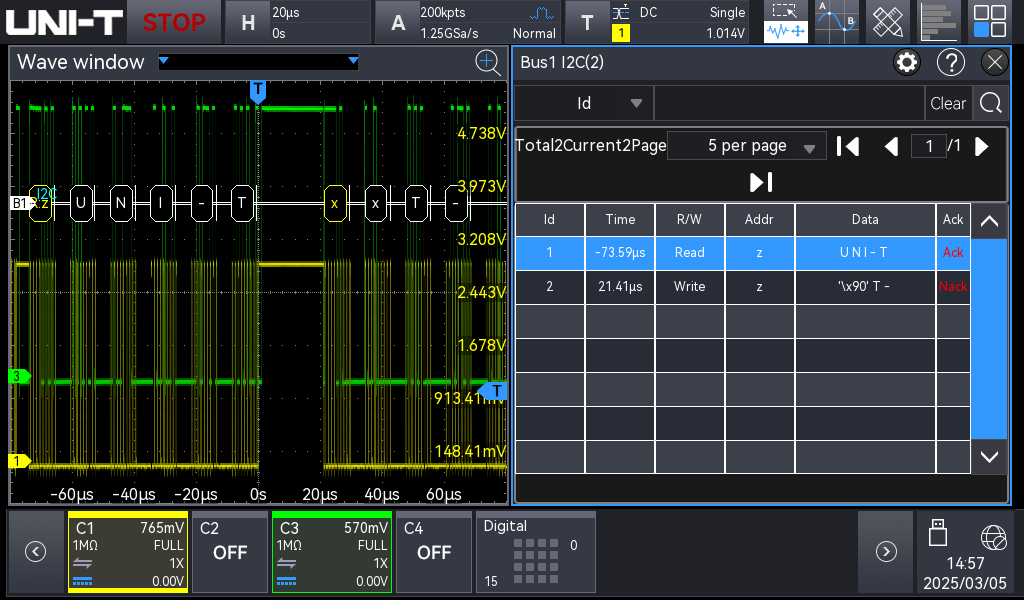
All Protocols Included Standard
Unlike higher-tier families that charge separately for automotive and industrial protocols, the MSO1000HD platform includes RS-232/UART, I²C, SPI, RS-422, RS-485, CAN, CAN-FD, LIN, and Audio decoding standard at no additional cost. This makes it one of the most complete embedded-debug platforms in its segment, with no surprise license invoices when an automotive project crosses your bench.
Each decoder correlates the physical-layer signal with the decoded data above the trace, so you can see signal-integrity anomalies and protocol errors in the same acquisition. Search and trigger on data patterns, error conditions, or specific bus events to isolate intermittent communication faults.
Comprehensive protocol decoding included standard
Built-In Power Analysis — 12 Parameters
12 standard power-quality parameters cover efficiency analysis, switching-loss measurement, safe-operating-area visualization, ripple-and-noise characterization, and harmonic content. The measurements run inline on the captured waveform — no scripting, no external software, no PC connection required.
Combined with the 12-bit ADC and 100 Mpts memory, the power-analysis suite handles workloads that previously required a dedicated power analyzer. For switching-supply validation, gate-drive characterization, and small-signal-on-DC-rail measurements, the integrated functions consolidate a multi-instrument workflow into one bench unit.
Built-In Spectrum Analyzer — FFT to 1 Mpts
Frequency-domain analysis with peak detection, markers, and waterfall display — up to 1 Mpts FFT length. Identify harmonics, clock spurs, switching-frequency content, and EMI contributions without switching to a separate spectrum analyzer or exporting waveform data to PC software.
The same trace that captured a glitch in the time domain immediately reveals its spectral character on the FFT — useful for chasing down EMI sources during pre-compliance work, or for distinguishing switching-supply harmonics from coupled noise on adjacent rails.
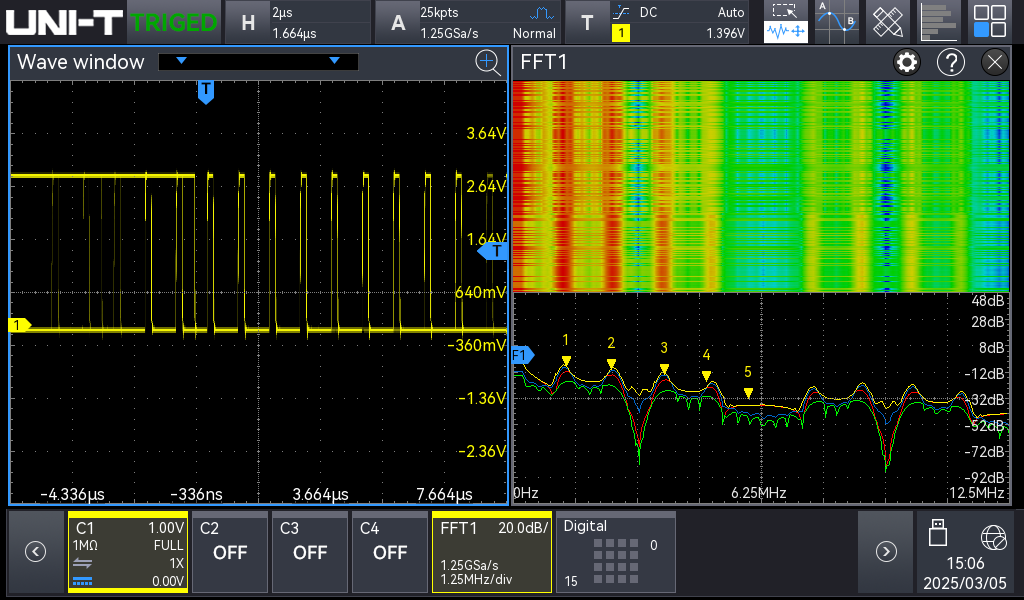 Built-in FFT spectrum analyzer for harmonics and EMI investigation
Mixed-Signal Debugging — 16 Optional Digital Channels
16 optional digital channels add mixed-signal debugging via the UT-M26 logic probe pod. The digital traces display alongside analog channels with full time correlation — see I²C bus traffic and analog ADC output on the same time axis, or watch a control firmware state machine drive the gate signals on a switching power stage.
Time-correlated mixed-signal views are essential for debugging the boundary between firmware and analog hardware. A timing-violation that's invisible on either domain alone often becomes obvious when you can see the digital command and the analog response on the same trace.
56 Automated Measurements with Statistics
56 automated measurements cover time, voltage, frequency, and power-quality parameters with statistical analysis (min, max, mean, standard deviation) and trend graphs over long captures. For QA work and bench characterization, the statistical view is more useful than the instantaneous reading — it tells you whether a parameter is drifting, jittering, or holding steady.
Pass/fail mask testing applies user-defined tolerance bands across captured waveforms — useful for rapid go/no-go testing during bring-up, or for validating board-to-board consistency in small-volume production.
Touch UI and Connectivity
The 7-inch 1024×600 capacitive touchscreen supports pinch-to-zoom, drag, and gesture navigation across waveforms, menus, and measurement readouts. For students and lab newcomers, the touch interface lowers the barrier to advanced features that are buried behind menu trees on older instruments.
Connectivity covers USB Host, USB Device, LAN, AUX Out, and HDMI. The HDMI output drives an external display for classroom demonstration, and LAN connectivity integrates the instrument into automated test scripts and remote-access workflows.
Applications
R&D Engineer (Embedded / Hardware Design)
- Switching-Supply Validation — Capture switching transitions and measure mV-scale ripple on multi-hundred-volt rails. The 12-bit ADC at full 250 MHz bandwidth resolves the small-signal-on-large-DC measurements that drive design decisions.
- Mixed-Signal Debug — Time-correlated analog and digital views with the optional UT-M26 logic pod. Track firmware state machines against analog responses on the same trace.
- Protocol Investigation — All standard embedded protocols included; no license fees for automotive (CAN, CAN-FD, LIN), industrial (RS-422/485), or audio buses.
- Signal Integrity Spot Checks — FFT analysis identifies harmonics, clock spurs, and EMI sources without switching to a separate spectrum analyzer.
Power Electronics Engineer
- Switching-Loss Characterization — Built-in power-analysis measurements run inline on the captured waveform — no scripting, no external software. Quantify gate-drive losses, conduction losses, and switching transient energy in one capture.
- Soft-Start and Fault-Recovery Capture — 100 Mpts deep memory records the entire transient at sample-rate resolution; no piecing together multi-pass captures.
- Ripple and Noise on DC Rails — The 12-bit ADC resolves µV-scale ripple on multi-hundred-volt DC rails — measurements that an 8-bit scope fundamentally cannot make.
- Harmonic Content Investigation — Built-in FFT to 1 Mpts identifies switching-frequency content, harmonics, and coupled noise sources.
Accessories & In the Box
Included with the Instrument
- MSO1254HD oscilloscope
- 4 × passive probes (1:1 / 10:1 switchable, bandwidth matched to instrument)
- USB cable (USB-A to USB-B)
- Power cord (region-appropriate)
- Quick-start guide
- Factory calibration certificate
Recommended Accessories
- UT-M26 — 16-channel logic probe pod for mixed-signal debugging
- UT-P07A — 500 MHz passive probe for higher-bandwidth applications
- UT-P20, UT-P21, UT-V23 — high-voltage passive probes
- UT-P30, UT-P31, UT-P32, UT-P33 — differential probes for floating measurements
- UT-P40, UT-P41, UT-P42, UT-P43, UT-P44 — current probes for power-stage and switching-loss measurement
- UT-ISOT — isolation transformer for safe line-powered measurements
- UT-M13X — oscilloscope demo board for protocol decoding practice and curriculum modules
Need an integrated signal generator and Bode plot analysis? See the MSO1254HD-S. Need a 150 MHz value-tier option? See the MSO1154HD.
Frequently Asked Questions
What protocols are included with the MSO1254HD?
RS-232/UART, I²C, SPI, RS-422, RS-485, CAN, CAN-FD, LIN, and Audio decoding are included standard at no additional cost. All supported protocols are available out of the box — no optional licenses required.
What is the advantage of native 12-bit resolution?
A 12-bit ADC provides 4,096 vertical levels compared to 256 for an 8-bit scope — sixteen times greater detail. This reveals small signals riding on large ones, reduces quantization noise, and improves measurement accuracy on low-amplitude signals like power-supply ripple, sensor outputs, and precision analog circuits. R12™ holds the 12-bit resolution at the full bandwidth and sample rate, with no ERES averaging or sample-rate trade-off.
Can I add digital channels for mixed-signal debugging?
Yes. The UT-M26 logic probe pod adds 16 digital channels for time-correlated analog and digital views.
Does this model include a signal generator?
No. For an integrated 1-channel 25 MHz AWG with Bode plot analysis, see the MSO1254HD-S.
How does the MSO1254HD compare to the higher-bandwidth UPO2000HD or MSO3000HD scopes?
The MSO1000HD platform shares the same R12™ 12-bit ADC architecture, Ultra Phosphor 3.0 acquisition, and standard-included protocol decoding as the UPO2000HD and MSO3000HD families. The differences are bandwidth (150–250 MHz here vs 100–500 MHz on UPO2000HD and 350–1000 MHz on MSO3000HD), capture rate (1,000,000 wfms/s in Sequence Mode here vs 1,500,000 wfms/s on MSO3000HD), and the front-panel form factor. For embedded prototyping and mid-tier power-electronics work, the MSO1000HD platform delivers the same architectural advantages at a lower price point.
Is the firmware field-upgradable?
Yes. Firmware updates are free over the product's lifetime and install via USB drive or LAN transfer.
Part of the MSO1000HD oscilloscope series. See the series page to compare bandwidth and channel options across the lineup.
Warranty
This instrument is backed by UNI-T's 3+2 Year Warranty — 3 years of standard coverage, plus 2 additional years free when you register your product. That's 5 years of total protection at no extra cost.
The warranty covers manufacturing defects and component failures under normal use conditions. UNI-T instruments are built for professional daily use, and our warranty reflects that commitment to long-term reliability.
| Analog Bandwidth | 250MHz |
|---|---|
| Channels | 4Ch+16D (opt) |
| Sample Rate | 2.5GSa/s |
| Memory Depth | 100Mpts |
| Vertical Resolution | 12 bits |
| Built-in Signal Generator | Not Available |
| Digital Channels | Optional |
| Touch Screen | ✓ |
| Instrument Type | HD MSO |
Features
- Frequency Counter
- Digital Voltmeter
Full specifications (18)
| Details | |||||
|---|---|---|---|---|---|
| Waveform Capture Rate |
|
||||
| Input Impedance | 1 MΩ | ||||
| Vertical Scale (1 MΩ) | 500μV/div to 10V/div | ||||
| Automated Measurements | 56 | ||||
| Bus Protocols (Standard) | RS232|UART|RS422|RS485|I2C|SPI|CAN|CAN-FD|LIN|Audio | ||||
| Protocol Decoders | 7 | ||||
| Measurement Parameters | 56 | ||||
| Fft Points | 1Mpts | ||||
| Features | |||||
| Frequency Counter Bits | 7-digit | ||||
| Power Analysis | 12 | ||||
| Dvm Bits | 4-digit | ||||
| General Information | |||||
| Display Size | 7in | ||||
| Display Type | TFT LCD | ||||
| Interface | USB|LAN|AUX|HDMI | ||||
| Dimensions (W×H×D) | 282 × 175 × 49 mm | ||||
| Weight | 1.56 kg | ||||
| Warranty | 3+2 years | ||||
| Certifications | CE|cETLus | ||||
Data Sheets and Manuals
Older firmware versions (1)
Check your instrument’s hardware revision before updating firmware — different hardware revisions take different builds.
Authentic UNI-T accessories are an affordable way to extend the functionality of your instrument.
Passive Probes 11

UT-P01 25 MHz 10:1 General Purpose Oscilloscope Probe
$15.99
UT-P03 60 MHz 10:1 General Purpose Oscilloscope Probe
$18.99
UT-P04 100 MHz 10:1 General Purpose Oscilloscope Probe
$15.99
UT-P05 200 MHz 10:1 General Purpose Oscilloscope Probe
$20.99
UT-P06 300 MHz 10:1 General Purpose Oscilloscope Probe
$37.99
UT-P07A 500 MHz 10:1 General Purpose Oscilloscope Probe
$51.99UT-P07B 500 MHz 10:1 General Purpose Oscilloscope Probe
$119.00
UT-P08A 350 MHz 10:1 General Purpose Oscilloscope Probe
$51.99
UT-P20 250 MHz 100:1 High Voltage Oscilloscope Probe
$56.99
UT-P21 50 MHz 1000:1 High Voltage Oscilloscope Probe
$430.00
UT-V23 High Voltage Scope Probe
$25.00Current Probes 6

UT-P40 DC-100 kHz 60A AC/DC Current Probe
$452.00
UT-P41 DC-100 kHz 100A AC/DC Current Probe
$595.00
UT-P4150 12 MHz High-Frequency DC/AC Current Probe
$2,529.00
UT-P42 150 kHz 200A AC/DC Current Probe
$459.00
UT-P43 DC-25 MHz 20A 100mV/A Current Probe
$956.00
UT-P44 DC-50 MHz 40A 50mV/A Current Probe
$1,695.00Differential Probes 6

UT-P30 100 MHz 10:1/100:1 Differential Oscilloscope Probe
$399.00
UT-P31 100 MHz 100:1/1000:1 Differential Oscilloscope Probe
$699.00
UT-P32 50 MHz 100:1/1000:1 Differential Oscilloscope Probe
$860.00
UT-P33 120 MHz 100:1/1000:1 Differential Oscilloscope Probe
$1,465.00
UT-P35 50 MHz 50:1/500:1 Differential Oscilloscope Probe
$395.00