


UNI-T UDP6932B DC Switching Power Supply
Overview
The UDP6932B is a 200W programmable DC switching supply at 60V/10A — a working-tier instrument for DC-DC converter characterization, low-voltage inverter input-stage testing, and gate-driver supply work. Auto-range output gives flexible V/I combinations within the 200W envelope from a single instrument.
Full programmable interface set: USB Device, USB Host, RS-232, RS-485, LAN with web control, and external analog I/O — with SCPI, Multi-SCPI, and Modbus RTU command support. Built-in 4½-digit DVM monitors a second voltage point on the DUT without an external instrument. Slope control configures rise/fall rates independently in voltage-slope (VSR) and current-slope (ISR) modes for soft start/stop. Remote sense (S+/S−) compensates for IR drop on the test leads. List mode and delayer functions program up to 512 voltage/current/time groups, stored to internal Flash or USB.
Across the Design. Debug. Deploy.™ Lifecycle
Design. Sourcing the bench supply for general-purpose power-electronics bench work is the first commit. 200 W at 60 V / 10 A with 1 mV / 0.1 mA resolution covers the envelope this work needs, with the four-wire sense and slope-controlled startup that DUT-protective work requires from the first turn-on. Programmable from the front panel or remotely — list mode, slope control, OVP/OCP, and DVM are first-class controls, not buried menu options.
Debug. At validation, the 4½-digit DVM and 512-group list mode replace a second DMM and an external sequencer. Capture power-up profiles, automate sweeps, and record DUT-side voltage drift while sourcing — without leaving the supply's front panel or rebuilding the test harness.
Deploy. Production go/no-go testing runs over LAN with SCPI, Multi-SCPI, or Modbus RTU. The web server gives a shared bench remote access without a host-software install. RS-485 multi-machine networking scales the station as the throughput requirement does. From first prototype to production verification — design, debug, deploy.
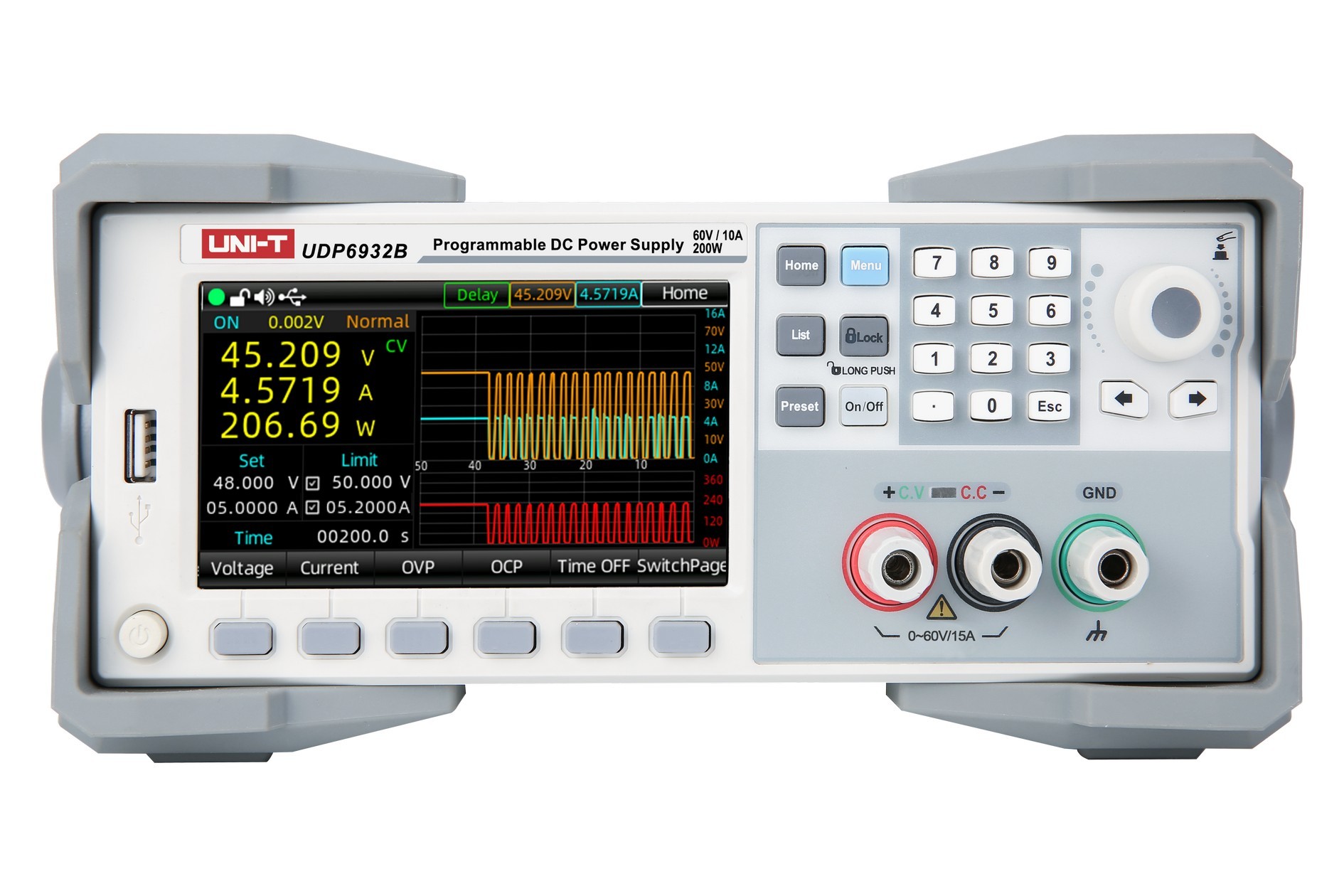 UDP6932B — from prototype bench to production rack
Key Features
- 200W Auto-Range Output (0–60V, 0–10A) — Flexible V/I combinations within rated power. One supply handles multiple test configurations.
- High Accuracy & Low Ripple — 1 mV/0.1 mA resolution with low ripple and noise for sensitive DUT testing.
- OVP/OCP Protection — Independent over-voltage and over-current protection with configurable thresholds protects devices under test.
- List Mode & Delay Function — Program voltage/current sequences with configurable timing for automated test profiles and battery charge simulation.
- Slope Control — Configurable rise/fall rates for soft start/stop, preventing inrush damage to sensitive loads.
- Remote Sense — Four-wire sensing compensates for voltage drop in test leads, ensuring accurate voltage at the load terminals.
- Built-In DVM — Independent digital voltmeter for monitoring a second voltage point without additional equipment.
- Web Remote Control & Multi-Machine — Browser-based control via LAN. Master/slave communication for series/parallel multi-unit configurations.
Front-Panel Interface
A 4.3-inch true color LCD shows set voltage and current alongside actual output values, with output power computed and displayed in real time. The numeric keypad sets values directly without menu diving; the rotary encoder fine-tunes when a small adjustment is faster than typing. Soft-keys map to the function actually in use — list mode, slope, OVP/OCP, or DVM — instead of burying them in nested menus. Output enable is a dedicated hardware button, always visible, never one click away from a keystroke mistake.
UDP6932B front panel — keypad, encoder, and dedicated soft-keys
Remote Sense
Long test leads drop voltage. At higher currents, the drop is no longer a rounding error — a 10 A draw across a meter of 16 AWG returns roughly 50 mV less to the load than the supply set. The UDP6900 series corrects for this with four-wire remote sense: connect the output's + and − terminals to the load through the current-carrying leads, then run a separate pair from S+ and S− directly to the device under test. The supply servo's regulation point shifts from its own terminals to the load's terminals — and the 1 V SENSE compensation headroom keeps the rail accurate where it actually matters.
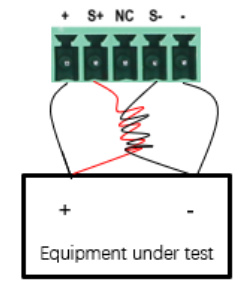 UDP6900 Remote Sense
Over-Voltage/Over-Current Protection (OVP/OCP)
Independent over-voltage and over-current thresholds, both set from the front panel. When either limit trips, the supply latches output off and posts the trigger on the LCD — the kind of unambiguous fault state that matters when a DUT failure during overnight characterization could otherwise damage hardware or lose a test run. Thresholds persist across power cycles and survive front-panel lock for unattended operation.
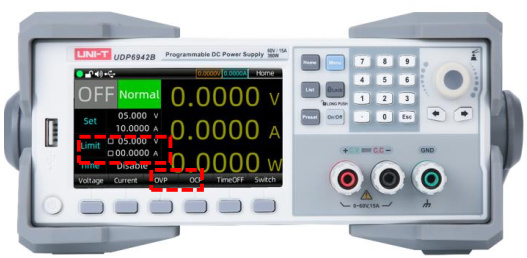 UDP6900 Protection Modes
List Output and Delay Function
List mode programs up to 512 voltage/current/time groups, executed in sequence — useful for DC-DC converter input sweeps where the same supply walks through 12 V, 24 V, and 48 V input rails per characterization run, or for repeatable step-response work into a dynamic load. The delay function programs output on/off sequencing for power-cycling reliability tests. Both modes save to Flash or USB in .lst.csv and .dly.csv formats — open in Excel, edit, reload.
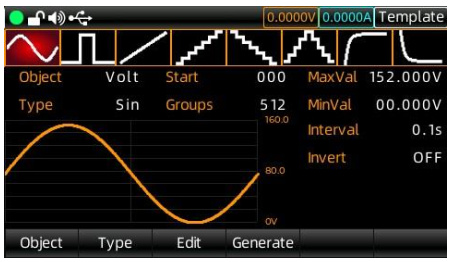 UDP6900 Delayer
Slope Mode Options
Three configurable slope modes — Normal, Voltage Slope (VSR), and Current Slope (ISR) — for controlled startup into the DUT. In DC-DC converter development, VSR mode ramps input voltage at a configurable rate so the converter's soft-start can be characterized without conflating its behavior with supply-side step response. ISR ramps current the same way for current-limit work.
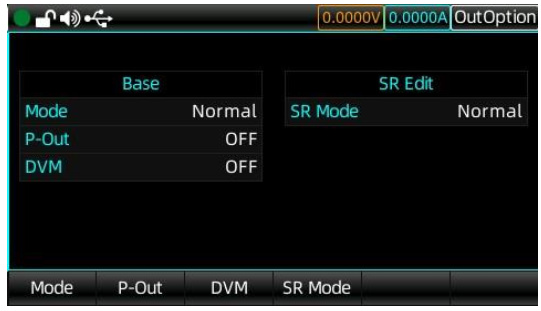 UDP6900 Slope Mode
Auto Range Functionality
Within the 200 W envelope, the UDP6932B reconfigures across the V/I plane on demand: 60 V at 3.3 A for high-side rail characterization, 10 A at 20 V for DC-DC converter input, or any combination between. The auto-range I-V curve is controlled by the rated power, not by hardware range switching — so a single supply covers the bench positions a fixed-range design would handle with two or three.
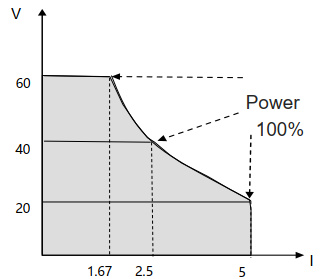 UDP6900 Auto Range
Built-in Digital Voltmeter (DVM)
A built-in 4½-digit voltmeter measures DC voltage on a separate rear-panel pair, displayed alongside the supply's own readbacks on the LCD. For a two-rail bench scenario — measuring the load's regulated DC at the same time the supply is sourcing it — the DVM eliminates a second instrument. Range is 0.001–65.000 V on the 60 V models, up to 160 V on the UDP6933B and UDP6953B.
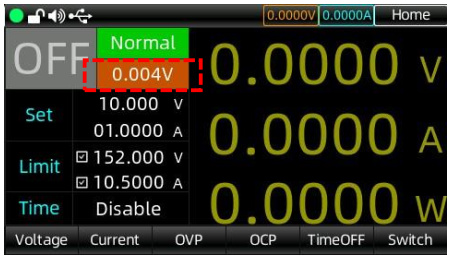 UDP6900 DVM
Multiple Main Menu Options
The main menu structure is shallow by design. Five top-level sections — Monitor, System Settings, User Group, Output Settings, Language — each one or two presses from the front panel. Monitor displays live V/I/P/DVM with per-channel alarms when set conditions deviate. Output Settings configure operating mode, power-up output, and slope. System Settings hold backlight, sound, RS-232/network, and a factory-default restore. The menu hierarchy never exceeds two levels — depth defeats front-panel work, and the UDP6900 doesn't ask the operator to memorize trees.
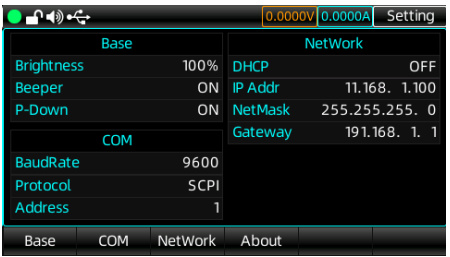 UDP6900 Settings
Computer Software and Remote Control
The UDP6900 series ships with free PC control software — UNI-T's UDP9000 host application, common across the programmable PSU line. Set voltage and current remotely, log readbacks to disk, sequence list and delay programs, and automate complete characterization runs without writing a SCPI parser. For scripted environments, the supply speaks SCPI, Multi-SCPI, and Modbus RTU natively over USB-Device, RS-232, RS-485, or LAN — pick the bus that fits the test station.
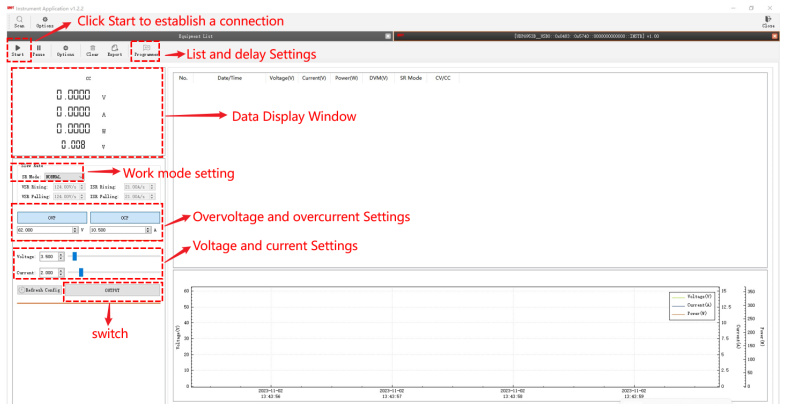 UDP6900 Software
Multi-Machine Communication
RS-485 networking links multiple UDP6900 supplies to a single host. Master/slave configurations enable series-stack for higher voltage or parallel-stack for higher current — useful for multi-rail bench setups or when a single test station needs more total power than one chassis provides. One SCPI session, many supplies, synchronized output.
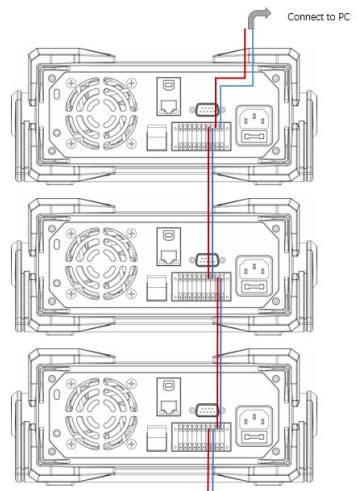 UDP6900 Multi-machine
Web Control
LAN connection brings up an embedded web server — open the supply's IP in any browser to set parameters, run list and delay programs, and configure system settings. No vendor application install on the host machine, no driver headache when the bench runs Linux or a tablet workstation. For shared lab benches and remote-monitored automation, the browser interface is often the cleanest path.
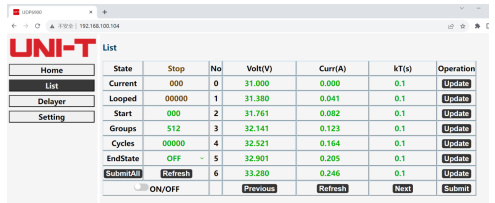
Applications
DC-DC Converter Development
Auto-range covers point-of-load DC-DC characterization across the 60V input range. List mode automates voltage sweep profiles for efficiency mapping. 1 mV resolution resolves the rail variations that affect converter behavior.
Power Electronics Bench (Low-Voltage)
10 A at 60 V suits 12V/24V/48V inverter input-stage testing, gate-driver power supplies, and low-voltage motor drive prototyping. Slope control prevents inrush damage during DUT power-up.
Small-Team Test Lab & Consultancy
Full SCPI/Multi-SCPI/Modbus over USB, RS-232, RS-485, and LAN. Web control via browser. Multi-machine RS-485 enables synchronized series/parallel multi-unit configurations as the lab scales.
Battery Charging & Test
Programmable CC/CV profiles simulate charging curves for 12V/24V batteries. List mode creates multi-step charge/discharge sequences. OVP/OCP protect cells during development testing.
In the Box
- UDP6932B DC power supply
- Power cord (region-appropriate)
- USB 2.0 cable, 1.5 m (USB-A to USB-B)
- High-current terminal blocks
- Multi-function interface accessories
- Factory calibration certificate
- User manual (English)
Frequently Asked Questions
What does auto-range mean?
Auto-range means the supply delivers any voltage/current combination within the rated 200W envelope. The UDP6932B can output 60V at reduced current or 10A at reduced voltage — the power limit is the constraint, not fixed V/I maximums independently.
What's the difference between the UDP6700 and UDP6900B series?
This family (UDP6900B) sits above the UDP6700, adding auto-range output, slope control, built-in DVM, web control over LAN, RS-485 for multi-machine networking, USB Device, Modbus RTU, and external analog control. UDP6700 provides the core CV/CC + list-mode + remote-compensation feature set with RS-232 SCPI at a lower price.
Can I connect multiple UDP6900B units for higher power?
Yes. Multi-machine communication via RS-485 enables master/slave configurations — connect units in series for higher voltage or parallel for higher current, controlled from a single master or via SCPI commands.
What's included with the UDP6932B?
The UDP6932B ships with the instrument, power cable Test leads and sense leads available separately.
Warranty
This instrument is backed by UNI-T's 3+2 Year Warranty — 3 years of standard coverage, plus 2 additional years free when you register your product. That's 5 years of total protection at no extra cost.
The warranty covers manufacturing defects and component failures under normal use conditions. UNI-T instruments are built for professional daily use, and our warranty reflects that commitment to long-term reliability.
| Output Voltage | 0~60V |
|---|---|
| Output Current | 0~10A |
| Total Output Power | 200W |
| Channels | 1Ch |
| Voltage Resolution | 1mV |
| Programmable | ✓ |
| Instrument Type | DC Switching PSU |
| Supply Type | DC Switching |
Features
Full specifications (13)
| Details | |||||||||||
|---|---|---|---|---|---|---|---|---|---|---|---|
| Current Resolution | 0.1mA | ||||||||||
| Features | |||||||||||
| Line Regulation |
|
||||||||||
| Load Regulation |
|
||||||||||
| Ripple & Noise |
|
||||||||||
| Readback Accuracy |
|
||||||||||
| Setting Accuracy (25 °C ± 5 °C) |
|
||||||||||
| Readback Resolution |
|
||||||||||
| Setting Resolution |
|
||||||||||
| General Information | |||||||||||
| Interface | USB-Device|USB-Host|RS232|RS485|LAN|Analog I/O|Sense | ||||||||||
| Dimensions (W×H×D) | 215 × 88 × 373.7 mm | ||||||||||
| Weight | 3.99 kg | ||||||||||
| Warranty | 3+2 years | ||||||||||
| Certifications | CE | ||||||||||
Data Sheets and Manuals
Check your instrument’s hardware revision before updating firmware — different hardware revisions take different builds.
Authentic UNI-T accessories are an affordable way to extend the functionality of your instrument.


