







UNI-T UTS5026A 26.5 GHz Performance-Series Signal Analyzer
Overview
The UNI-T UTS5026A Performance-Series Signal Analyzer covers 9 kHz to 26.5 GHz in a single instrument, with -163 dBm/Hz displayed average noise level (typical, with the UTS5000A-P26 preamp option) and -107 dBc/Hz typical phase noise at 1 GHz, 10 kHz offset. Total absolute amplitude accuracy is ±0.40 dB at 50 MHz reference. RBW resolves from 1 Hz to 8 MHz and the analyzer captures up to 100,001 sweep points per trace.
UTS5026A is built around three pillars: frequency reach through the K-band ceiling at 26.5 GHz, covering all sub-6 GHz cellular and Wi-Fi bands plus 5G mmWave-adjacent spectrum, SATCOM downlinks, and microwave point-to-point links; a quiet front end with -163 dBm/Hz typical DANL (P26 option) and -107 dBc/Hz typical phase noise that resolves low-level spurs and characterizes oscillator skirts cleanly; and a modular measurement library covering vector signal demodulation, I/Q capture, EMI pre-compliance, 5G NR and LTE air-interface decoding, dedicated phase-noise measurement, and analog AM/FM demodulation — each available as a no-expiration license unlock. Engineered for RF and microwave design teams, EMC pre-compliance benches, cellular and SATCOM development groups, and private-sector test labs.
Key Features
- 9 kHz to 26.5 GHz spectrum measurement — covers sub-6 GHz, K-band, and microwave point-to-point bands in one instrument
- DANL: -163 dBm/Hz typical (with UTS5000A-P26 preamp option, 20 MHz to 1.5 GHz, 1 Hz RBW); -150 dBm/Hz typical baseline (preamp off)
- Phase noise: -107 dBc/Hz typical at 1 GHz, 10 kHz offset
- Total absolute amplitude accuracy: ±0.40 dB at 50 MHz reference
- RBW: 1 Hz to 3 MHz in 10% steps, plus 4, 5, 6, 8 MHz wide-band settings; selectivity <4.1 : 1 nominal
- Sweep points: up to 100,001 per trace; counter resolution 0.001 Hz
- Trace detectors: Normal, Peak, Sample, Negative Peak, Log Power Average, RMS Average, Voltage Average
- Maximum safe input: +27 dBm average / +47 dBm peak (gated)
- 15.6-inch 1920×1080 multi-touch HD capacitive display
- Optional licenses: VSA (digital demod), I/Q analyzer, EMI pre-compliance, 5G NR / LTE FDD / LTE TDD demod, AMA (analog AM/FM), PNM (phase noise), AMK (advanced measurement kit), P26 (preamp gain)
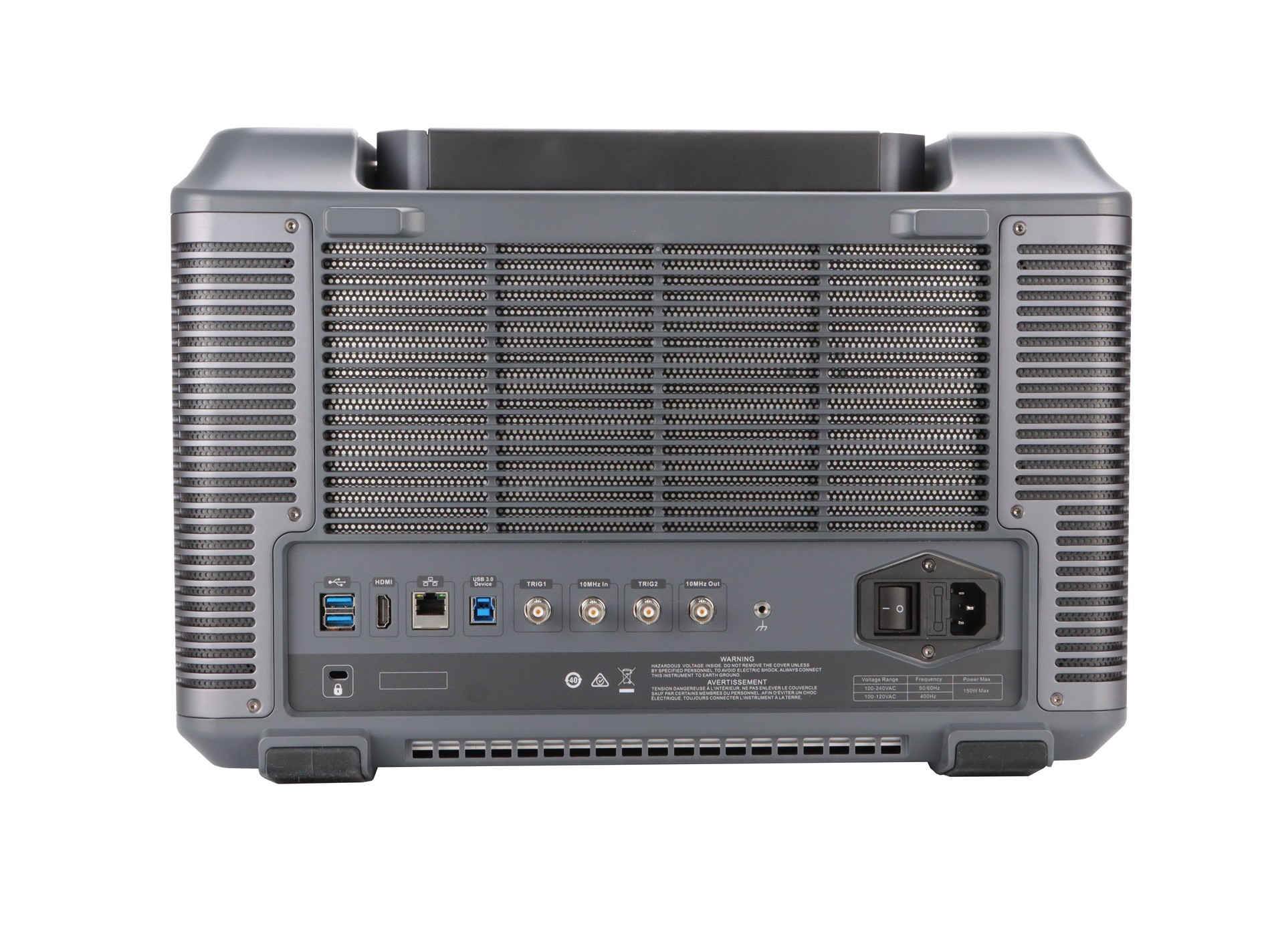
- Interfaces: RF input (NMD 2.92 mm), 10 MHz Ext Ref In/Out (BNC), Ext Trigger In (BNC, TTL), HDMI 1.4, USB-A 3.0 + USB-A 2.0 Host, USB-B 2.0 Device, LAN (VXI11)
- Free firmware updates and no-expiration license unlocks
UNI-T UTS5026A Detailed Features
9 kHz to 26.5 GHz Frequency Coverage
The UTS5026A spectrum input covers 9 kHz at the low end and 26.5 GHz at the high end, spanning eleven internal LO frequency bands to maintain calibrated response across the full range. That single-instrument reach removes the need for separate analyzers when work moves between sub-6 GHz cellular spectrum, ISM and Wi-Fi bands, K-band SATCOM downlinks, point-to-point microwave links, and radar IF chains.
Frequency span is selectable from 0 Hz (zero-span time-domain capture) to the full 26.5 GHz range. Sweep time runs 1 ms to 4,000 s for spans ≥10 Hz, and 1 µs to 6,000 s in zero span for capturing transient events. The 10 MHz internal reference (with ±3×10⁻⁸ temperature stability) ties measurements to a stable timebase, with external 10 MHz reference in/out on rear-panel BNC for shared-clock instrument racks.
 UTS5026A front panel with 15.6-inch multi-touch display, RF input (NMD 2.92 mm), and full benchtop instrument footprint.
Sensitivity for Low-Level Signal Detection (DANL -163 dBm/Hz typ.)
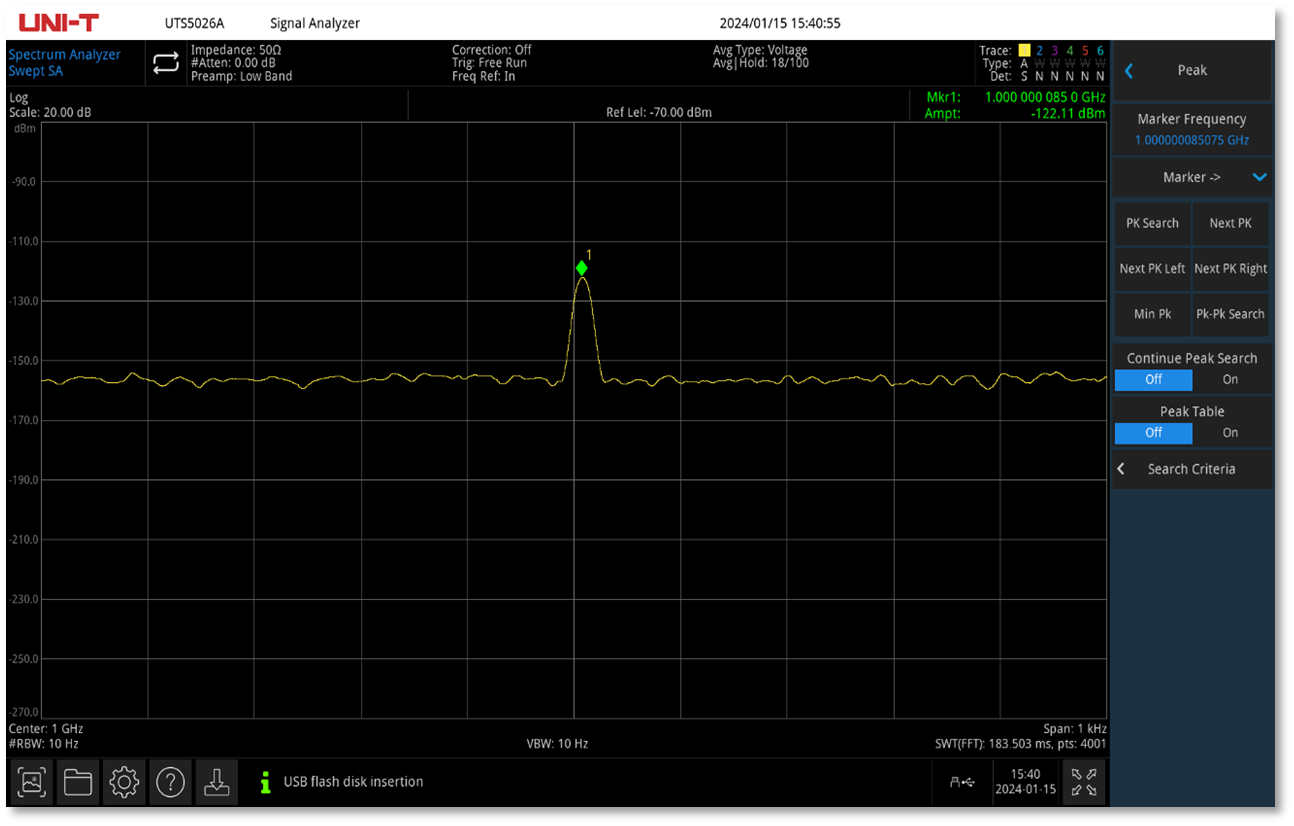
Weak-signal work — identifying low-level spurs in oscillator output, characterizing leakage from a shielded enclosure, capturing intermittent interference — is rate-limited by how far the analyzer’s own noise floor sits below the signal of interest. UTS5026A reaches -163 dBm/Hz typical DANL in the 20 MHz to 1.5 GHz band with the UTS5000A-P26 preamp option, and -160 dBm/Hz typical across most of the analyzer’s mid-band range with preamp engaged. Without P26, baseline DANL runs -145 to -150 dBm/Hz typical mid-band — competitive for general spectrum work, but P26 is what unlocks the headline number.
Preamp coverage extends from 100 kHz to 7.5 GHz on the low-frequency band and 100 kHz to 26.5 GHz on the high band. Maximum safe input is +27 dBm average (input attenuation ≥20 dB, preamp on) and +47 dBm peak for short-pulse work.
Displayed Average Noise Level reaches -163 dBm/Hz typical (with UTS5000A-P26 preamp option, 20 MHz to 1.5 GHz, 1 Hz RBW).
Phase Noise (-107 dBc/Hz typ.) for Clean Oscillator Characterization
The local oscillator’s phase noise is the floor that limits how cleanly the analyzer can resolve close-in spurs, modulation sidebands, and reciprocal mixing artifacts on the device under test. UTS5026A specifies -107 dBc/Hz typical at 10 kHz offset from a 1 GHz carrier, with -102 dBc/Hz at 1 kHz, -110 dBc/Hz at 100 kHz, and -132 dBc/Hz at 1 MHz offset (typical, 1 kHz RBW, 10 Hz VBW, log-average over >50 acquisitions).
For RF designers characterizing PLL synthesizers, VCOs, and crystal oscillators, that envelope means close-in noise sidebands on the device under test sit above the analyzer’s own contribution rather than buried beneath it. The UTS5000A-PNM Phase Noise Measurement option adds a dedicated measurement mode with logarithmic offset axes, jitter calculation, and integration limits.
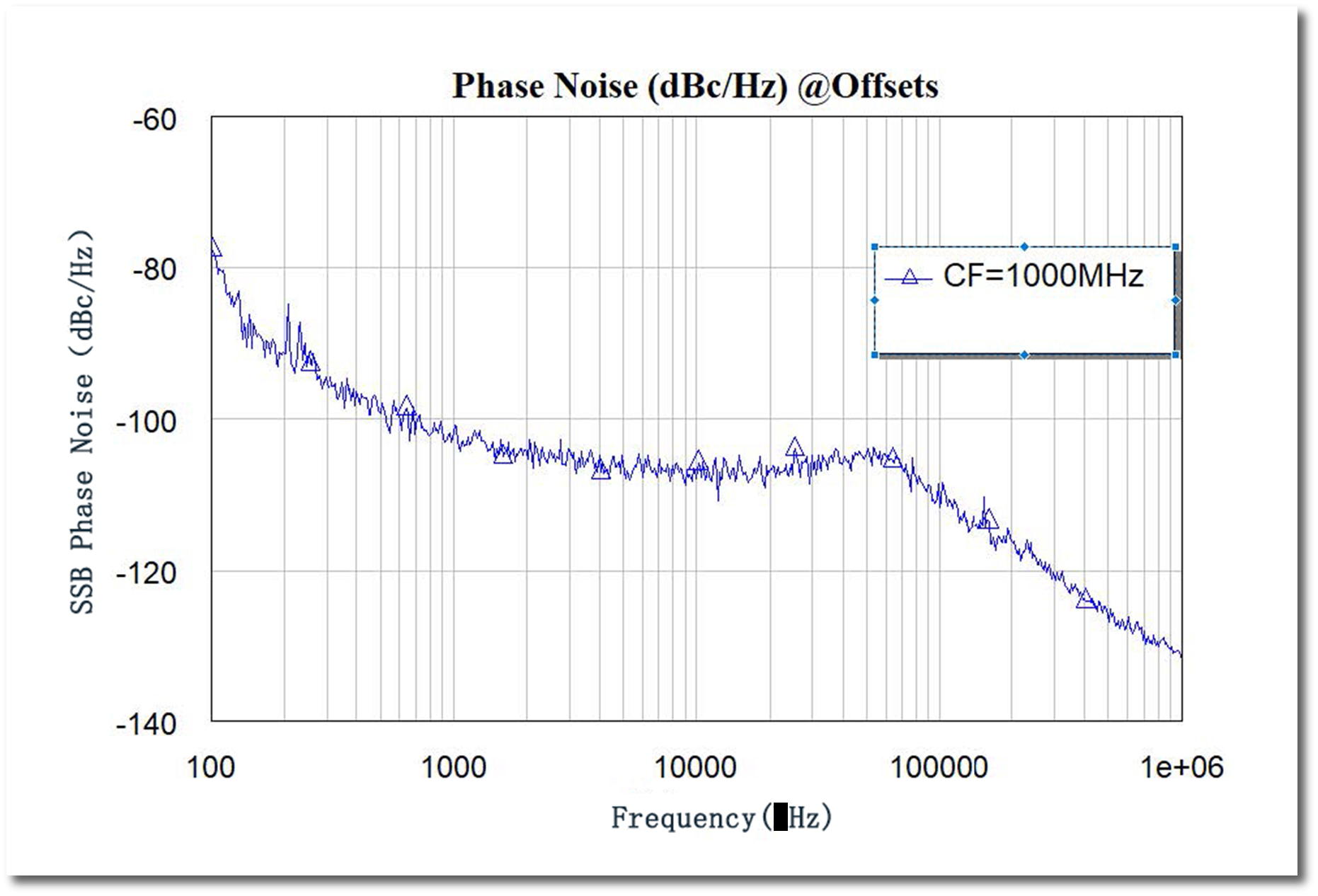 Nominal phase noise at 1 GHz center frequency: -100 dBc/Hz at 1 kHz offset, -107 dBc/Hz at 10 kHz offset, -132 dBc/Hz at 1 MHz offset (typical).
RBW Resolution and Selectivity (1 Hz to 8 MHz)
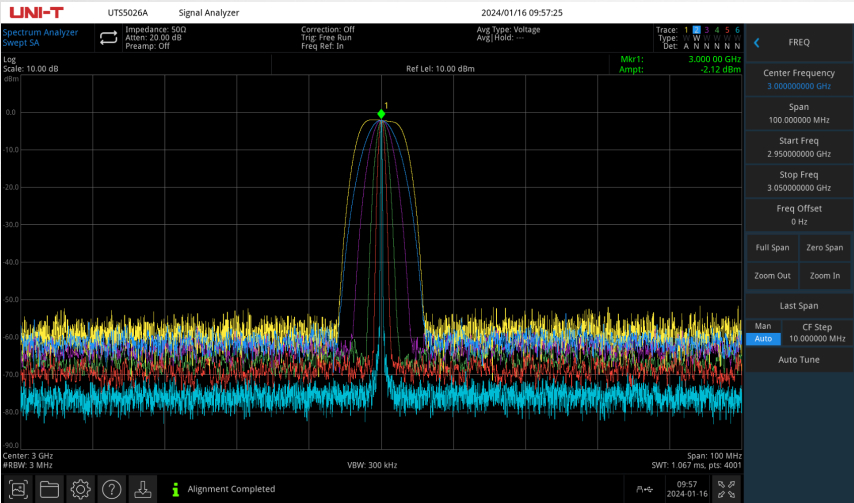
Resolution Bandwidth selects from 1 Hz to 3 MHz in 10% steps (the standard 10:1 ratio family used across professional spectrum analyzers), plus dedicated 4, 5, 6, and 8 MHz wide-band settings for fast sweeps over wide spans. Bandwidth accuracy is ±1.0% (±0.044 dB) nominal from 1 Hz to 750 kHz.
Selectivity (the −60 dB to −3 dB shape factor) measures <4.1 : 1 nominal, which lets two adjacent unequal-amplitude carriers resolve cleanly without the smaller signal disappearing into the larger one’s skirt. Video bandwidth tracks the same range, and seven trace detectors cover both general-purpose and standards-specific measurement modes.
RBW: 1 Hz to 3 MHz in 10% steps, plus 4, 5, 6, and 8 MHz wide-band settings.
100,001 Sweep Points for Fine-Grained Frequency Analysis
Sweep point count is configurable from 11 to 100,001 across all spans. At 100,001 points across a 1 GHz span, frequency resolution per trace bin is 10 kHz — tight enough to localize narrow-band interference, identify specific ITU channel allocations, and walk between adjacent regulatory mask boundaries without interpolation between coarse sweep bins.
Marker resolution scales with the trace span and sweep-point count. A dedicated frequency counter mode tightens uncertainty further, with counter resolution at 0.001 Hz.
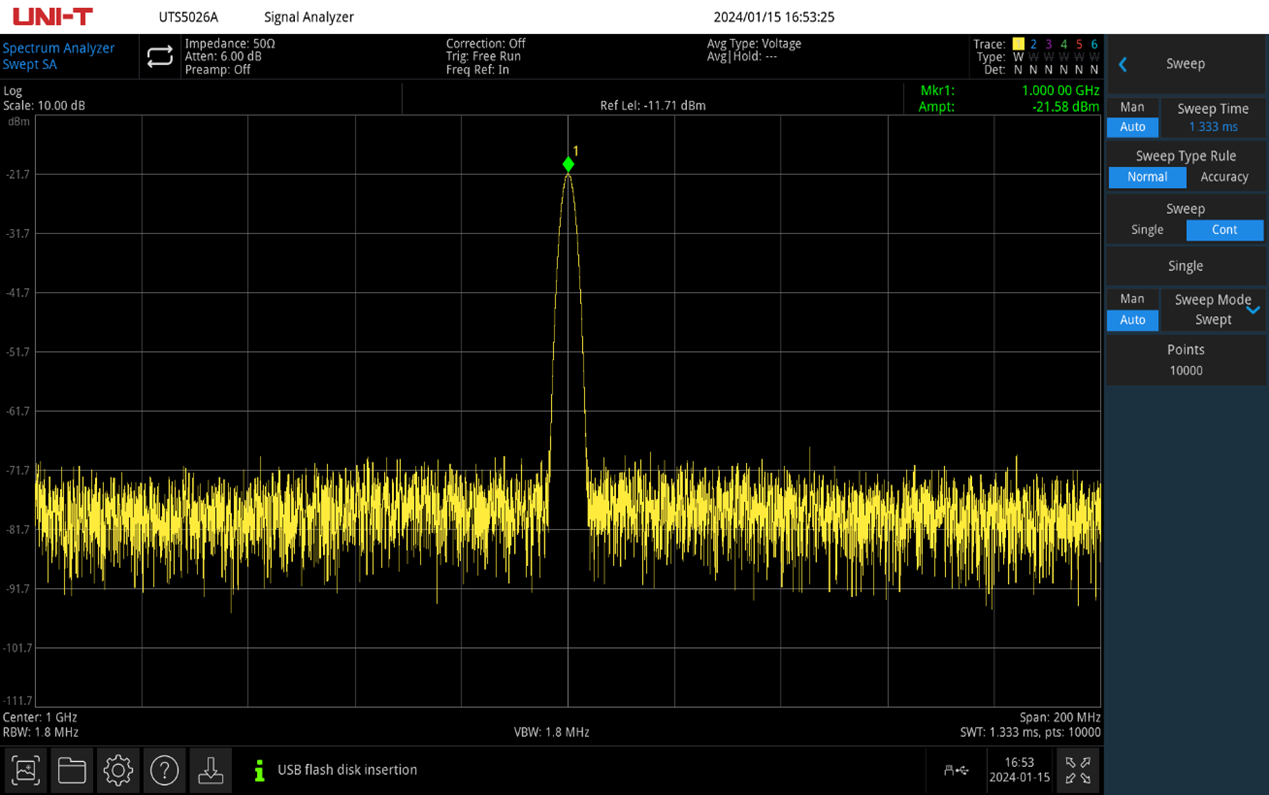 Trace acquisition supports up to 100,001 sweep points across any selected span.
Vector Signal Analysis and I/Q Capture (UTS5000A-VSA + UTS5000A-I/Q Options)
The UTS5000A-VSA Digital Demodulation option adds a vector demodulation engine covering 2 MHz to 26.5 GHz carrier and the major digital modulation formats: ASK (2-ASK); FSK (2/4/8/16); MSK (GMSK); PSK (BPSK, QPSK, OQPSK, 8PSK); DPSK (DBPSK, DQPSK, D8PSK, π/4-DQPSK, π/8-D8PSK); QAM (16, 32, 64, 128, 256). Symbol rate ranges 1 ksps to 2.5 Msps, with EVM/SNR statistics displayed alongside IQ constellation, eye, and time-domain views.
The UTS5000A-I/Q Analyzer option adds direct I/Q capture and spectrum analysis at 9 kHz to 25 MHz analysis bandwidth standard (extended to 40 MHz with B40), with a 14-bit ADC at 90 MSa/s capturing up to 4,000,000 IQ sample pairs per acquisition. Window selection covers Flat-top, Uniform, Hanning, Gaussian, Blackman, Blackman-Harris, and Kaiser-Bessel shapes. Together, the two options form the foundation for waveform-level characterization of arbitrary digitally-modulated carriers.
5G NR and LTE Air-Interface Demodulation (UTS5000A-NR / FDD-LTE / TDD-LTE Options)
For teams developing 5G New Radio infrastructure, LTE base-station components, or cellular-band devices, three dedicated demodulation licenses extend the analyzer into protocol-aware air-interface measurement: UTS5000A-NR for 5G New Radio, UTS5000A-FDD-LTE, and UTS5000A-TDD-LTE. Each license is a standalone purchase.
Combined with the analyzer’s 26.5 GHz frequency reach, the cellular licenses cover sub-6 GHz LTE and 5G NR FR1 deployments directly, plus 5G NR FR2 mmWave bands at 24.25–26.5 GHz. The instrument’s low phase noise and tight amplitude accuracy translate into clean EVM measurements on the device under test. License unlocks are no-expiration: once added, they remain on the instrument for the life of the unit.
EMI Pre-Compliance to 26.5 GHz (UTS5000A-EMI Option)

The UTS5000A-EMI Pre-Compliance Measurement option transforms the analyzer into a CISPR/EN-class pre-compliance instrument with regulatory limit lines, quasi-peak and average detectors, and band-segmented scan modes. Measurement extends to the analyzer’s full 26.5 GHz ceiling, covering not just the traditional 30 MHz to 1 GHz radiated-emissions band but also the higher-frequency emissions from 5G transceivers, automotive radar, and microwave data links.
The companion UTS-EMI01 near-field probes kit adds four probe heads spanning 30 MHz to 3 GHz at three resolution scales plus a 5 mm resolution probe to 2 GHz, for localizing radiating components on a populated PCB. Pre-compliance use moves EMI debugging earlier in the development cycle — before the formal test-house chamber visit, when board-level fixes are still cheap.
EMI pre-compliance measurement mode with regulatory limit lines, quasi-peak detection, and near-field probe support.
15.6″ Multi-Touch HD Display and Serviceable Front End
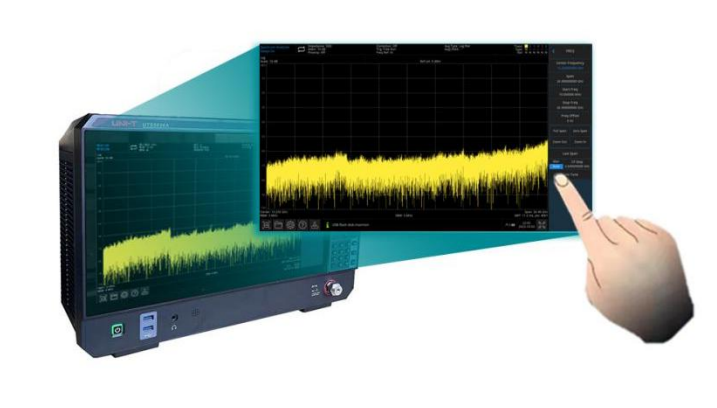
The front-panel display is a 15.6-inch 1920×1080 multi-touch capacitive TFT LCD — a deliberate departure from the 7-to-10-inch displays common at this frequency tier. Capacitive multi-touch supports drag-to-pan, pinch-zoom on traces, and gesture-based menu navigation, with the larger display real estate accommodating up to 4-window simultaneous layouts in the VSA and I/Q modes. The instrument is built for serviceability over the warranty lifetime: a removable dust filter on the air inlet lifts out for cleaning, preventing the dust-accumulation failure mode that limits long-term reliability on cooled bench instruments.
15.6-inch multi-touch capacitive HD display with gesture support: drag, pinch-zoom, and trace expansion.
Applications
RF and Microwave Design / R&D
For RF and microwave design teams characterizing PLL synthesizers, mixer spurious products, amplifier compression, and front-end module performance, the UTS5026A’s 26.5 GHz reach with -107 dBc/Hz typical phase noise gives the instrument the headroom to act as the reference measurement on the bench. The 100,001-point sweep resolution, ±0.40 dB amplitude accuracy at 50 MHz, and full SCPI/LXI remote control make the analyzer a primary fixture in R&D characterization workflows.
5G NR and LTE Cellular Development
With the UTS5000A-NR, FDD-LTE, and TDD-LTE demodulation licenses, the analyzer covers sub-6 GHz cellular bands plus 5G NR FR2 mmWave allocations in the 24.25 to 26.5 GHz range. Combined with the I/Q analyzer’s 40 MHz (B40) analysis bandwidth, the instrument supports waveform-level evaluation of base-station transmitters, small-cell units, and cellular-band devices.
EMC Pre-Compliance and Production Test Labs
Production characterization labs and EMC pre-compliance benches use the UTS5026A’s combination of 26.5 GHz frequency ceiling, regulatory-grade amplitude accuracy, and the optional UTS5000A-EMI license to run pre-chamber scans across CISPR-band ranges and into 5G transceiver and radar emission bands. Free firmware updates plus no-expiration license unlocks keep the instrument current as standards evolve.
Accessories & In the Box
Standard Accessories
- Power cord × 1
- USB cable × 1 (UT-D14)
Measurement option licenses (no-expiration unlock)
- UTS5000A-NR — 5G New Radio (NR) demodulation analysis
- UTS5000A-FDD-LTE — LTE FDD demodulation analysis
- UTS5000A-TDD-LTE — LTE TDD demodulation analysis
- UTS5000A-VSA — Digital demodulation (ASK/FSK/PSK/QAM/MSK/DPSK) with EVM
- UTS5000A-I/Q — I/Q analyzer (25 MHz / 40 MHz with B40 analysis BW)
- UTS5000A-EMI — EMI pre-compliance measurement to 26.5 GHz
- UTS5000A-AMA — Analog AM/FM demodulation, 2 MHz to 26.5 GHz
- UTS5000A-PNM — Phase Noise Measurement (dedicated mode)
- UTS5000A-AMK — Advanced Measurement Kit (channel power, ACPR, OBW, T-power, harmonics)
- UTS5000A-P26 — Preamplifier gain option (unlocks -163 dBm/Hz typ. DANL)
RF cables and connector kits
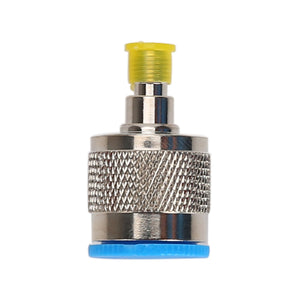
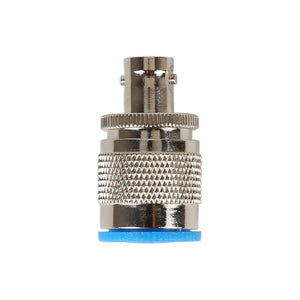
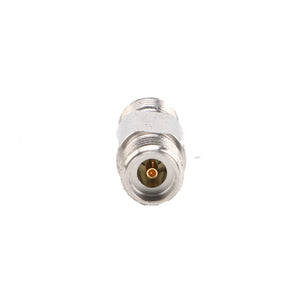
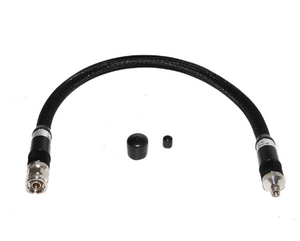
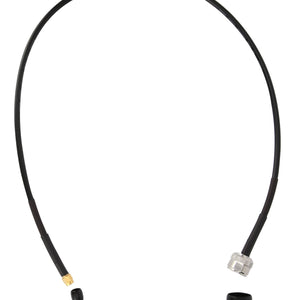
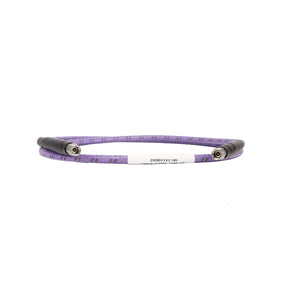
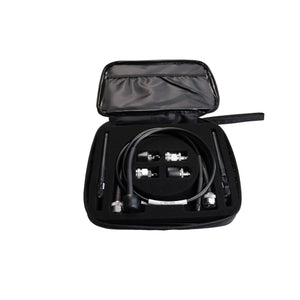
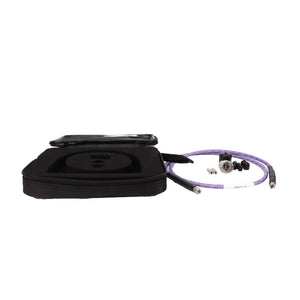
- UT-CK02 kit — RF cables and connectors: UT-W03-40GHz cable, UT-C04-40GHz adapter, UT-C03-18GHz adapter, UT-W03 SMA-SMB cable, UT-C01 SMA-N adapter
Near-field probes
- UTS-EMI01 kit — Four near-field probes: NFP-3G-P1 (30 MHz–3 GHz, 10 cm range), NFP-3G-P2 (30 MHz–3 GHz, 3 cm range), NFP-2G-P3 (30 MHz–2 GHz, 5 mm resolution), NFP-3G-P4 (30 MHz–3 GHz, 2 mm resolution)
Frequently Asked Questions
What's the difference between the UTS5000A and the UTS3000A series?
The two analyzers target different work. The UTS3000A series covers 9 kHz to 3.6 / 6 / 8.4 GHz with a built-in tracking generator and standard real-time spectrum analysis plus VNA capability (S11 + S21); it’s the right choice when work involves stimulus-response measurements, real-time transient capture as a standard capability, and characterization below 8.4 GHz.
The UTS5000A (UTS5026A) is a measurement-only analyzer covering 9 kHz to 26.5 GHz with no tracking generator and no VNA. It targets work that needs frequency reach above 8.4 GHz — K-band SATCOM, 5G NR FR2 mmWave bands, 24 GHz radar, microwave links — or the deeper option library covering 5G NR / LTE demodulation and dedicated phase-noise measurement that the UTS3000A doesn’t offer.
Which capabilities are standard, and which require optional licenses?
Standard (included): swept and FFT spectrum analysis from 9 kHz to 26.5 GHz, with all the headline specifications — 1 Hz to 8 MHz RBW, 100,001 sweep points, ±0.40 dB amplitude accuracy at 50 MHz, -107 dBc/Hz typical phase noise, the full trace-detector set, marker functions, and SCPI/LAN/USB remote control.
Optional licenses (each sold separately, no-expiration unlock): UTS5000A-VSA (digital demodulation), UTS5000A-I/Q (I/Q analyzer), UTS5000A-EMI (EMI pre-compliance), UTS5000A-NR (5G NR demod), UTS5000A-FDD-LTE and UTS5000A-TDD-LTE (LTE demod), UTS5000A-AMA (analog AM/FM demod), UTS5000A-PNM (phase-noise measurement), UTS5000A-AMK (advanced measurement kit), and UTS5000A-P26 (preamplifier gain — unlocks the -163 dBm/Hz typical DANL specification).
Does the UTS5026A include a tracking generator or VNA function?
No. The UTS5026A is a measurement-only signal analyzer — it does not produce stimulus signals. There is no internal tracking generator, no VNA capability, and no S-parameter measurement function. For applications requiring stimulus-response measurements (filter characterization, antenna VSWR, S11 / S21), the UTS3000A series provides those capabilities up to 8.4 GHz with a built-in reflection bridge and tracking generator. For frequencies above 8.4 GHz, an external signal generator paired with the UTS5026A in receive-only mode is the typical configuration.
Can I add the UTS5000A-P26 preamplifier option later, after the original purchase?
Yes. All UTS5000A optional licenses, including the P26 preamplifier gain option, are no-expiration license unlocks that can be added at any time after the original instrument purchase. The hardware to support each option is present in every shipping unit; the license unlocks the firmware functionality. Adding P26 after purchase requires no service-depot return.
That makes a typical procurement path practical: buy the base instrument, then add P26, VSA, I/Q, or cellular demod licenses as the project mix evolves.
Is the UTS5026A remotely programmable?
Yes. The UTS5026A supports a complete SCPI command set covering every front-panel function, accessible over USB-B 2.0, LAN (VXI-11 over 10/100/1000 Base RJ-45), and through the built-in WebServer interface for browser-based access. The full programming manual ships with the instrument, and the analyzer integrates into ATE racks running NI-VISA, Keysight IO Libraries, or any standards-compliant instrument-control framework, with LXI conventions for network discoverability.
Warranty
This instrument is backed by UNI-T's 3+2 Year Warranty — 3 years of standard coverage, plus 2 additional years free when you register your product. That's 5 years of total protection at no extra cost.
The warranty covers manufacturing defects and component failures under normal use conditions. UNI-T instruments are built for professional daily use, and our warranty reflects that commitment to long-term reliability.
| Frequency Range | 9 kHz to 26.5 GHz | ||||||||||||||||||||||||||||||||||||||||||||||||||||||||||||||||||||||||||||||||||||||||||||||
|---|---|---|---|---|---|---|---|---|---|---|---|---|---|---|---|---|---|---|---|---|---|---|---|---|---|---|---|---|---|---|---|---|---|---|---|---|---|---|---|---|---|---|---|---|---|---|---|---|---|---|---|---|---|---|---|---|---|---|---|---|---|---|---|---|---|---|---|---|---|---|---|---|---|---|---|---|---|---|---|---|---|---|---|---|---|---|---|---|---|---|---|---|---|---|---|
| DANL | -163dBm/Hz · 45 values · Preamp Off / Preamp On
|
||||||||||||||||||||||||||||||||||||||||||||||||||||||||||||||||||||||||||||||||||||||||||||||
| RBW | 1 Hz to 3 MHz (10% Steps),4,5,6,8 MHz | ||||||||||||||||||||||||||||||||||||||||||||||||||||||||||||||||||||||||||||||||||||||||||||||
| Phase Noise | <-107dBc/Hz · 9 values · 5 groups
|
||||||||||||||||||||||||||||||||||||||||||||||||||||||||||||||||||||||||||||||||||||||||||||||
| Tracking Generator | Not Available | ||||||||||||||||||||||||||||||||||||||||||||||||||||||||||||||||||||||||||||||||||||||||||||||
| Real-Time Analysis | 25MHz | ||||||||||||||||||||||||||||||||||||||||||||||||||||||||||||||||||||||||||||||||||||||||||||||
| Instrument Type | Signal Analyzer | ||||||||||||||||||||||||||||||||||||||||||||||||||||||||||||||||||||||||||||||||||||||||||||||
Features
- Touch Screen
Full specifications (17)
| Details | |||||||||||||||||||||||||||||||||||||||||||||||||||||||||
|---|---|---|---|---|---|---|---|---|---|---|---|---|---|---|---|---|---|---|---|---|---|---|---|---|---|---|---|---|---|---|---|---|---|---|---|---|---|---|---|---|---|---|---|---|---|---|---|---|---|---|---|---|---|---|---|---|---|
| Amplitude flatness |
|
||||||||||||||||||||||||||||||||||||||||||||||||||||||||
| Sweep Points | 100,001 | ||||||||||||||||||||||||||||||||||||||||||||||||||||||||
| Traces | 6 | ||||||||||||||||||||||||||||||||||||||||||||||||||||||||
| Frequency Resolution | 0.001Hz | ||||||||||||||||||||||||||||||||||||||||||||||||||||||||
| Channels | 1 | ||||||||||||||||||||||||||||||||||||||||||||||||||||||||
| Features | |||||||||||||||||||||||||||||||||||||||||||||||||||||||||
| 1 dB gain compression |
|
||||||||||||||||||||||||||||||||||||||||||||||||||||||||
| Selectivity (60/3 dB) | -60 dB : -3 dB | ||||||||||||||||||||||||||||||||||||||||||||||||||||||||
| Frequency Reference Temp Stability | ±3×10⁻⁸ | ||||||||||||||||||||||||||||||||||||||||||||||||||||||||
| Trigger Types | Free Run,External 1,External 2,Video,Periodic Timer | ||||||||||||||||||||||||||||||||||||||||||||||||||||||||
| Marker Functions | Marker Noise,Band Power,Band Density,N dB,Counter | ||||||||||||||||||||||||||||||||||||||||||||||||||||||||
| General Information | |||||||||||||||||||||||||||||||||||||||||||||||||||||||||
| Display Size | 15.6in | ||||||||||||||||||||||||||||||||||||||||||||||||||||||||
| Display Type | TFT LCD | ||||||||||||||||||||||||||||||||||||||||||||||||||||||||
| Interface | 10MHz In/Out|Trg In|HDMI|USB-Host|USB-Device|LAN|audio | ||||||||||||||||||||||||||||||||||||||||||||||||||||||||
| Dimensions (W×H×D) | 445 × 311 × 195 mm | ||||||||||||||||||||||||||||||||||||||||||||||||||||||||
| Weight | 11 kg | ||||||||||||||||||||||||||||||||||||||||||||||||||||||||
| Warranty | 3+2 years | ||||||||||||||||||||||||||||||||||||||||||||||||||||||||
| Certifications | CE|cETLus | ||||||||||||||||||||||||||||||||||||||||||||||||||||||||
Data Sheets and Manuals
- UTS1000B-T UTS3000B-T UTS3000T+ UTS3000A UTS5000A UTS7000A Spectrum Analyzer Analog Demodulation Function - User Manual →
- UTS1000B-T UTS3000B-T UTS3000T+ UTS3000A UTS5000A UTS7000A Spectrum Analyzer EMI Function - User Manual →
- UTS3000A UTS5000A UTS7000A Signal Analyzer IQ Function - User Manual →
- UTS3000A UTS5000A UTS7000A Signal Analyzer LTE FDD Analysis - User Manual →
- UTS3000A UTS5000A UTS7000A Signal Analyzer LTE TDD Analysis - User Manual →
- UTS3000A UTS5000A UTS7000A Signal Analyzer PNM Function - User Manual →
- UTS3000A UTS5000A UTS7000A Spectrum Analyzer VNA Function - User Manual →
- UTS3000A UTS5000A UTS7000A Spectrum Analyzer VSA Function - User Manual →
- UTS5000A Series Signal Analyzer User Manual V1.0 HQ →
- UTS5000A Series Signal Analyzers - User Manual →
Older firmware versions (1)
Check your instrument’s hardware revision before updating firmware — different hardware revisions take different builds.
Authentic UNI-T accessories are an affordable way to extend the functionality of your instrument.
UTS5000A Options 10
Need to add specific functionality to your UNI-T instrument? Here are our options for specific applications and measurement types. Have a question? Contact us at 888-668-UniT (8648).

UTS5000A-AMA AM/FM Analog Demodulation Option
$725.00
UTS5000A-AMK Advanced Measurement Kit Option
$1,205.00
UTS5000A-EMI EMI Pre-Compliance Measurement Option
$1,068.00
UTS5000A-FDD-LTE FDD-LTE Demodulation Analysis Option
$6,999.00
UTS5000A-I/Q I/Q Analyzer Option
$1,199.00
UTS5000A-NR NR demodulation analysis option for UTS5000A series
$7,299.00
UTS5000A-P26 Preamplifier Gain Option
$2,315.00
UTS5000A-PNM Phase Noise Measurement Option
$999.00
UTS5000A-TDD-LTE TDD-LTE Demodulation Analysis Option
$6,999.00