


UTG912Plus 120 MHz 2-channel function/arbitrary waveform generator with 7-inch touchscreen
Overview
The UTG912Plus puts 120 MHz sine and 30 MHz square output on two equal-performance channels, with 16-bit resolution, 1.25 GSa/s sampling (2× interpolation), up to 128 Mpts of arbitrary memory per channel and a 7-inch 1024 × 600 touchscreen.
Each channel produces sine to 120 MHz, square and pulse to 30 MHz and ramp to 5 MHz with 1 μHz resolution, and noise, harmonics (2nd to 16th), PRBS, DC, arbitrary, multi-pulse and expression waveforms. Output reaches 20 Vpp into high impedance at up to 40 MHz, typical phase noise is ≤-130 dBc/Hz (10 MHz, 10 kHz offset) and THD is below 0.07% from DC to 20 kHz.
Fifteen modulation types, four sweep modes and three burst modes are built in, along with a 600 MHz hardware frequency counter, channel coupling and merging, 10 MHz reference in and out, LAN, USB host and device, HDMI and SCPI control. The 1.5 kg chassis is powered over USB Type-C, from the supplied adapter or a PD power bank. Backed by the 3+2 warranty: three years standard, plus two more years when you register the instrument for free.
Key Features
- 120 MHz sine, 30 MHz square and pulse — two equal-performance, independent channels with 1 μHz frequency resolution.
- 16-bit, 1.25 GSa/s — 2× interpolation; point-by-point arbitrary output up to 625 MSa/s.
- Up to 128 Mpts arbitrary memory per channel — 256 Mpts per channel through the PC software; DDS mode at 8 kpts; over 200 built-in waveforms; 1 GB of file storage.
- Low-distortion output — THD below 0.07% (DC to 20 kHz), phase noise ≤-130 dBc/Hz typical at 10 MHz, 10 kHz offset.
- Up to 20 Vpp into high impedance (≤40 MHz), 10 Vpp at 120 MHz; ±10 V DC offset into high impedance.
- Fast pulse — edges adjustable from 5 ns, 8 ns minimum width with 100 ps steps, 150 ps jitter.
- 15 modulation types — AM, FM, PM, DSB-AM, ASK, FSK, PSK, 3FSK, 4FSK, BPSK, QPSK, OSK, SUM, QAM and PWM.
- Sweep, burst, PRBS, harmonics, multi-pulse and expressions — linear, logarithmic, step and list sweep; N-cycle, gated and infinite burst; PN3 to PN33 at up to 150 Mbps.
- 600 MHz hardware frequency counter — 100 mHz to 600 MHz on a 14-digit display, AC or DC coupling, 50 Ω or 1 MΩ input.
- 7-inch 1024 × 600 capacitive touchscreen with keypad, knob and dedicated waveform keys.
- Connectivity — USB host and device, LAN, HDMI, 10 MHz reference in and out, front Aux I/O, SCPI, browser control and a PC arbitrary waveform editor.
- 1.5 kg, USB Type-C power — supplied USB Type-C power adapter, or a PD power bank that delivers 12 V / 3 A; under 25 W.
Detailed Features
120 MHz, two independent channels
Each channel of the UTG912Plus runs its own waveform, modulation, sweep or burst at up to 120 MHz sine and 30 MHz square, so two separate tests can run at once or one channel can be the reference for the other.
Coupling ties frequency, amplitude or phase between channels by ratio or offset, and channel merge adds the two signals on one output.
 Two synchronized channels on an oscilloscope.

Low-distortion sine output
THD stays below 0.07% from DC to 20 kHz, and harmonic distortion is specified at ≤-60 dBc to 1 MHz down to ≤-40 dBc at 120 MHz (0 dBm, typical). Typical phase noise is ≤-130 dBc/Hz at 10 MHz with a 10 kHz offset.
Small signals can sit on a large DC offset with low added noise, which suits ripple injection and sensor-input tests where the stimulus has to be cleaner than the device under test.
Spectrum of the sine output.
Pulse and fast edges
Pulse output runs to 30 MHz with a minimum width of 8 ns (typical), width adjustable in 100 ps steps and rise and fall times adjustable from 5 ns up to 1,000 s, so the generator can stand in for a dedicated pulse generator.
Square-wave edges are under 5 ns (typical) with less than 2% overshoot, and jitter is 200 ps above 5 MHz.
 Pulse edge measured on an oscilloscope.

PRBS patterns
Fifteen pseudo-random binary sequences from PN3 to PN33 run at bit rates from 1 μbps to 150 Mbps, with edge times adjustable from 5 ns to 1 ks.
They provide repeatable digital stress patterns for receiver, data-path and line-coding tests, and the same sequences drive the BPSK, QPSK and QAM modulators.
PRBS bit rate, pattern and edge-time settings.
Noise superposition and SNR control
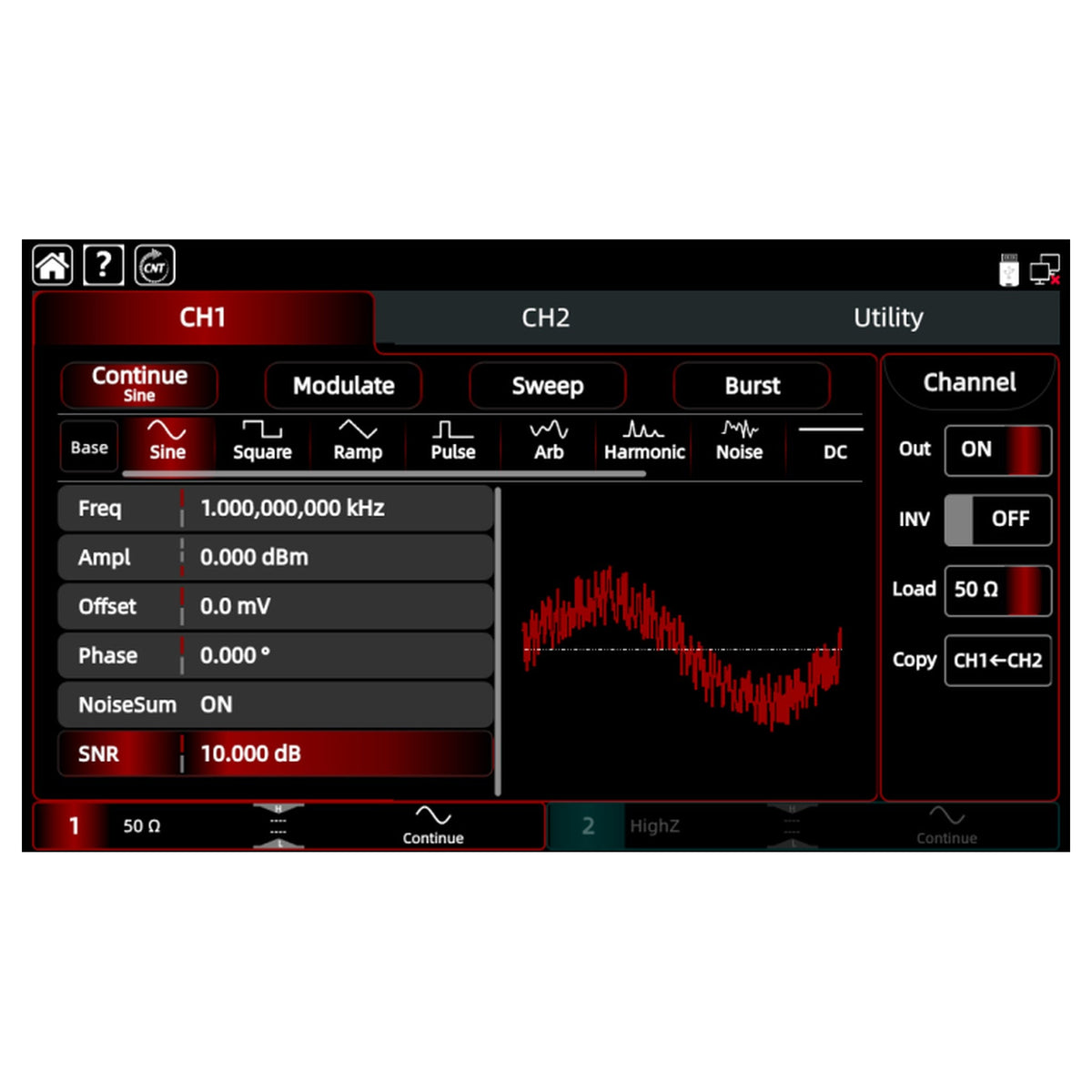
Noise of up to 1 Vrms can be added to sine, square, pulse, ramp, arbitrary and PRBS outputs, and a one-touch SNR setting sets the signal-to-noise ratio directly.
It is a quick way to check how a receiver, filter or detector behaves as the signal degrades.
 Noise added to a sine (left) and the resulting output (right).

Adjustable noise bandwidth
The noise source is flat (typical, -3 dB) from 1 mHz to 120 MHz, and its bandwidth can be limited with low-pass, high-pass or band-pass filtering to model a specific noise environment.
Noise filter type and cutoff frequency.
15 modulation types
AM, FM, PM, DSB-AM, ASK, FSK, PSK, 3FSK, 4FSK, BPSK, QPSK, OSK, SUM, QAM and PWM cover analog and digital modulation. QAM runs from QAM4 to QAM256, BPSK, QPSK and QAM use PN3 to PN33 symbols at up to 2 Mbps, and the internal modulating source reaches 2 MHz.
AM, FM, PM, SUM and PWM can also take an external modulating signal through the front Aux I/O connector, and each channel modulates independently.
 BPSK modulation settings.

Four sweep modes
Linear, logarithmic, step and list sweeps run from internal, external or manual triggers. Sweep and dwell times run from 1 ms to 500 s, step sweeps take 2 to 2,048 steps, and a list file holds up to 2,048 frequency points.
A trigger output marks each sweep for an oscilloscope or analyzer, which makes frequency-response measurements straightforward.
Linear sweep start, stop and time settings.
Three burst modes
N-cycle bursts of 1 to 4,294,967,295 cycles, gated bursts and infinite bursts run from internal, external or manual triggers, with start phase set from 0° to 360°.
The level between bursts can be the default, high, low or a custom value, so the idle state matches the circuit under test.
 N-cycle burst settings.

Harmonics, multi-pulse and expressions
The harmonic function builds a waveform from the 2nd to the 16th harmonic, odd, even, all or custom, with the amplitude and phase of each order set separately, at frequencies up to 60 MHz.
Multi-pulse output generates 2 to 30 pulses with individual widths and gaps from 20 ns, and the expression editor defines a waveform from a formula using functions such as sin, cos, sinc, exp, ln and sqrt.
A sin(x) expression waveform.
Multi-pulse output
Each pulse in a multi-pulse train has its own width, gap and edge times, with internal, external or manual triggering and a trigger delay of up to 1 ks.
Pulse sequences for double-pulse tests, timing checks and stepper or gate-drive stimulus can be built on the instrument without a separate pattern source.
 Multi-pulse width, gap and edge settings.

Channel merge
Channel merge adds CH1 and CH2 on one output, for two-tone tests or a signal with an interfering tone. Merge, coupling and channel copy are set from the Utility menu.
CH1 and CH2 combined on one output.
600 MHz frequency counter
The built-in hardware counter measures external signals from 100 mHz to 600 MHz on a 14-digit display, with AC or DC coupling and a 50 Ω or 1 MΩ input. It shows frequency, period, duty cycle and pulse widths with statistics.
A source frequency can be checked without a separate counter on the bench.
 Counter readings with statistics.

Arbitrary waveforms and editor
Point-by-point arbitrary output plays from 8 points to 128 Mpts per channel, or 256 Mpts per channel loaded from the PC software, at up to 625 MSa/s, with zero-order-hold or linear-interpolation filtering. DDS mode uses 8 kpts at up to 50 MHz.
Over 200 built-in waveforms are stored in non-volatile memory, and up to 1 GB of .bsv or .csv files can be stored on the instrument or loaded from a USB flash drive. Waveforms can be drawn or edited on the touchscreen or in the PC editor, which connects over USB or LAN.
Arbitrary waveform on the instrument (left) and in the PC editor (right).
Remote control
Over USB or LAN the generator takes SCPI commands, works with the UNI-T PC software for control, monitoring and automated tests, and can be operated from a web browser after login.
It is also compatible with the NeptuneLab laboratory management software.
 Control from the PC software.

Portable with USB Type-C power
At 282 × 175 × 49 mm and 1.5 kg, the generator moves easily between benches. It is powered over USB Type-C, from the supplied power adapter or from a PD power bank that delivers 12 V at 3 A (power bank not included), and draws less than 25 W.
USB Type-C PD power from a power bank (power bank not included).
Rear-panel connections
The rear panel has the LAN and USB Device ports, the USB Type-C power input, 10 MHz reference input and output and a security lock slot, and an HDMI output sits on the side panel. The front panel adds a USB host port for flash drives and the Aux I/O connector for modulation input, trigger input and output, sync output and the counter input.
 Rear panel I/O.
Applications
Electronics teaching labs
- One instrument covers function, arbitrary, modulation, sweep and burst exercises, with a touchscreen students can follow.
- Two equal channels support phase, Lissajous and differential exercises.
Embedded and digital design
- Generate clocks, PRBS patterns at up to 150 Mbps and multi-pulse trains with edges from 5 ns.
- Use the trigger output and burst modes to drive timing and reset tests.
Communications and RF development
- Generate ASK, FSK, PSK, BPSK, QPSK and QAM signals for receiver and demodulator work.
- Add noise with a set SNR to check sensitivity and error performance.
Analog, power and sensor testing
- Inject ripple or small signals on a DC offset and sweep frequency response with a marker output.
- Recreate captured sensor signals from arbitrary files of up to 128 Mpts per channel.
In the Box
- USB Type-C power adapter (12 V, 3 A)
- USB data cable (UT-D14)
- BNC-to-BNC cable (UT-L45)
Instrument dimensions 282 × 175 × 49 mm (W × H × D), 1.5 kg.
Frequently Asked Questions
What is the difference between the four UTG900Plus models?
Maximum output frequency: the UTG920Plus (200 MHz), UTG916Plus (160 MHz), UTG912Plus (120 MHz) and UTG908Plus (80 MHz). Square and pulse reach 50, 40, 30 and 20 MHz respectively. All four share the 16-bit, 1.25 GSa/s architecture, 128 Mpts per channel of arbitrary memory, 15 modulation types, the 600 MHz counter and the 7-inch touchscreen.
Is 1.25 GSa/s the native sample rate?
1.25 GSa/s is reached with 2× interpolation. Point-by-point arbitrary waveforms play at up to 625 MSa/s.
Can it run without mains power?
Yes. The generator is powered over USB Type-C, so besides the supplied adapter it runs from a PD power bank that provides 12 V at 3 A. A power bank is not included.
How is the UTG900Plus different from the UTG2000X?
Both are two-channel, 16-bit generators with 1.25 GSa/s sampling using 2× interpolation and the same modulation set. The UTG900Plus reaches up to 200 MHz instead of 120 MHz, holds 128 Mpts per channel instead of 32 Mpts, and has a 7-inch 1024 × 600 touchscreen instead of 4.3 inches, in a 1.5 kg chassis with USB Type-C power.
What warranty applies?
Three years standard, plus two more years when you register the instrument for free.