


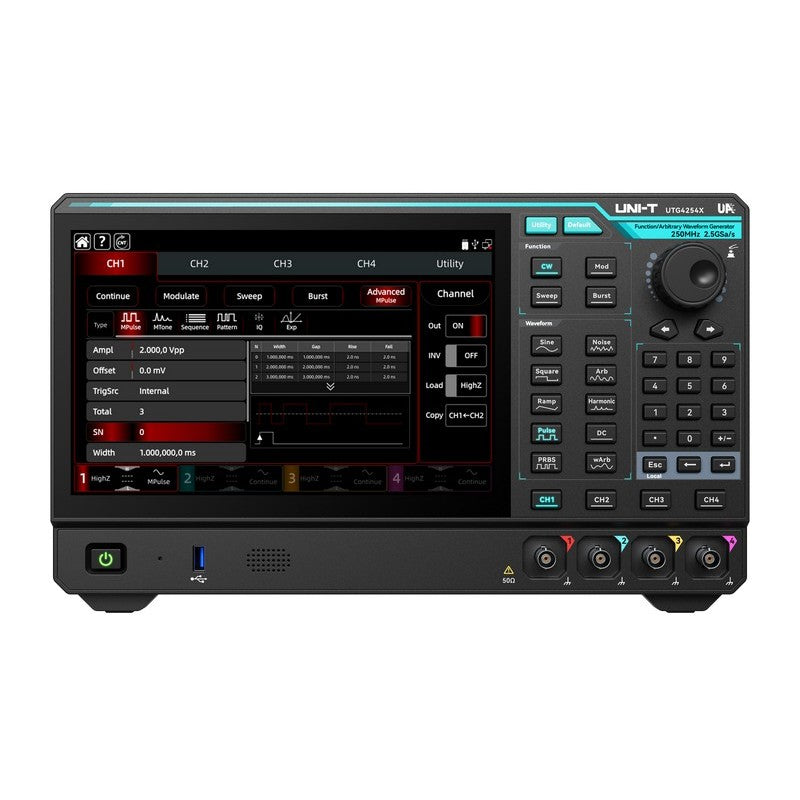
UNI-T UTG4254X 250 MHz 4-Channel Performance-Series Arbitrary Waveform Generator: 16-Bit, 2.5 GSa/s, Touch Display
Overview
The UNI-T UTG4254X is a four-channel arbitrary waveform generator with a maximum sine output of 250 MHz, built around a 16-bit DAC and a 2.5 GSa/s sample rate (2× interpolation). All four channels deliver equal performance with full 20 Vpp output (high-Z), and an 8 pts to 128 Mpts per-channel arbitrary memory supports long-form custom stimulus. A 10.1-inch capacitive touch display replaces menu-driven navigation with direct parameter manipulation.
100 MHz square / pulse output, 1 µHz frequency resolution across the full 250 MHz range, harmonic distortion below 0.07% (DC to 20 kHz), and an 800 MHz hardware frequency counter. Fifteen analog and digital modulation types — including 3FSK, 4FSK, QAM, and the full BPSK / QPSK / OSK set. Linear, logarithmic, list, and step sweep. Three burst modes (N-cycle, gate, infinite). Advanced Multi-Pulse, Multi-Tone, Sequence, Pattern, I/Q, and Expression functions. Over 200 built-in arbitrary waveforms with SPI / I²C / UART digital-protocol output.
Choosing Your Model — UTG4000X Performance-Series
Three four-channel models share one chassis, the same 2.5 GSa/s sample rate, 16-bit DAC, 128 Mpts per-channel memory, full 15-type modulation set, every advanced function, and the same interface and display. They differ in one axis only: maximum output frequency.
| UTG4104X | 100 MHz sine / 50 MHz square & pulse — the choice for general embedded, instrumentation, and teaching-lab work within a 100 MHz envelope. |
| UTG4164X | 160 MHz sine / 80 MHz square & pulse — added headroom for higher-frequency stimulus and wider modulation carriers. |
| UTG4254X | 250 MHz sine / 100 MHz square & pulse — the widest output envelope in the series for the most demanding signal-frequency requirements. |
This page describes the UTG4254X. Channel architecture, modulation, advanced functions, interfaces, and protection below apply to all three models; the Specifications table lists this model's frequency figures.
Key Features
- 250 MHz sine / 100 MHz square & pulse — four-channel output with 1 µHz frequency resolution.
- Four equal-performance channels, 20 Vpp — every channel delivers the full output envelope; independent or combined operation.
- 2.5 GSa/s sample rate, 16-bit DAC — with 2× interpolation; 8 pts to 128 Mpts per-channel arbitrary memory.
- Harmonic distortion below 0.07% — low distortion with −80 dBc spurious-free dynamic range and high SNR on large DC offsets.
- 15 modulation types — AM, FM, PM, DSB-AM, ASK, FSK, PSK, 3FSK, 4FSK, BPSK, QPSK, OSK, SUM, QAM, PWM — analog and digital in one instrument.
- Advanced functions — Multi-Pulse, Multi-Tone, Sequence, Pattern, I/Q, and Expression-based waveform generation built in.
- Wide-dynamic pulse, fast edges — 100 ps edge-time adjustment, 2.4 ns minimum pulse width, per-pulse edge control.
- 800 MHz hardware frequency counter — 100 mHz to 800 MHz, 8-digit, AC / DC / HF-reject coupling.
- Over 200 built-in arbitrary waveforms — plus SPI, I²C, and UART digital-protocol output.
- 10.1-inch capacitive touch display — 1280 × 800; direct parameter manipulation.
- USB Host/Device, LAN, HDMI — with 10 MHz reference in/out and external trigger; full remote-control integration.
UNI-T UTG4254X Details
Four Equal-Performance Channels, 20 Vpp
Four independent channels, every one delivering identical performance — there is no reduced second-bank or derated upper channels. Each channel produces the full output envelope to 20 Vpp (high-Z), and channels can be configured independently or combined: CH2 can mirror CH1, or CH1 = CH1 + CH2 + CH3 + CH4. Four matched channels drive clock, data, trigger, and stimulus simultaneously from a single instrument.


Channel Coupling and Merging
Channels can be freely coupled with configurable frequency, amplitude, and phase relationships (coupling ratio 0.0001 to 10,000), so a parameter change on one channel propagates to its coupled partners by a defined ratio and offset. Outputs can also be merged into arbitrary combinations, producing summed, differential, and composite signals from a single instrument without external combiners.
Low-Distortion Output and High SNR
Digital sampling produces sine, square, ramp, pulse, arbitrary, harmonic, noise, DC, and PRBS waveforms with low distortion and low jitter. Total harmonic distortion is below 0.07% from DC to 20 kHz, with a spurious-free dynamic range to −80 dBc. A small signal superimposed on a large DC offset retains a high signal-to-noise ratio, which matters when the stimulus must be quieter than the device under test.


Wide-Dynamic Pulse with Fast, Independently Adjustable Edges
The pulse generator offers high-precision adjustable edge times with increments as fine as 100 ps and a minimum pulse width of 2.4 ns (Typ.), generating high harmonic content comparable to a dedicated pulse generator. Edge time can be set independently for each pulse, down to a minimum of 2 ns. Square and pulse jitter stays low across the operating range.
15 Modulation Types in One Instrument
Fifteen analog and digital modulation schemes are built in: AM, FM, PM, DSB-AM, ASK, FSK, PSK, 3FSK, 4FSK, BPSK, QPSK, OSK, SUM, QAM, and PWM. QAM supports constellations from QAM4 to QAM256. Each channel supports independent or simultaneous internal/external modulation and internal/external/manual triggering, alongside Linear/Logarithmic/List/Step frequency sweep and N-cycle/gate/infinite burst.


Multi-Pulse and Multi-Tone Generation
Multi-Pulse produces pulse trains of 2 to 30 pulses with independently adjustable edge times and pulse widths for rapid, precise multi-pulse testing without custom code. Multi-Tone synthesizes 2 to 8 simultaneous frequency components across the full output range, reproducing real-world multi-frequency signals for nonlinear-distortion analysis, wideband frequency-response work, and communication-system verification.
Sequence, Pattern, I/Q, and Expression Functions
Sequence chains up to 1,024 waveforms totalling 128 Mpts with continuous, cyclic, and gated modes for one-time loading of multiple test cases. Pattern outputs customizable code (NRZ/RZ/Manchester) at multiple logic standards. I/Q generation with the SignalStudio PC software delivers high-EVM baseband output at any symbol rate. Expression builds complex waveforms directly from mathematical formulas.


Built-In Arbitrary Editor and 800 MHz Frequency Counter
The integrated arbitrary-waveform editor supports manual drawing, line drawing, and expression-based generation with real-time playback, and also runs on a PC over USB or LAN. Point-by-point output spans 8 pts to 128 Mpts with 16-bit vertical resolution. A high-precision hardware frequency counter measures 100 mHz to 800 MHz with 8-digit resolution and selectable AC / DC / high-frequency-reject coupling.
Applications
The Performance-Series envelope — four equal-performance channels, 2.5 GSa/s, 128 Mpts per channel, THD < 0.07%, 15-type modulation, the full advanced-function set, and a capacitive touch UI — targets benchtop work that needs genuine multi-channel stimulus, deep arbitrary support, or wide modulation coverage.
- Multi-channel embedded development — four matched channels drive clock, data, trigger, and stimulus simultaneously from one instrument, conserving bench space and keeping every channel at full performance.
- Communications-stimulus development — 3FSK, 4FSK, BPSK, QPSK, OSK, QAM digital modulation; SUM and DSB-AM analog modulation; configurable hop rate and depth.
- Audio and instrumentation testing — THD below 0.07% from DC to 20 kHz when characterizing op-amp distortion, ADC noise floors, and audio-band response.
- High-speed digital input stimulus — fast adjustable edges, 100 ps edge steps, and 2.4 ns minimum pulse width for edge-rate-sensitivity characterization.
- Long-form arbitrary playback — up to 128 Mpts per channel holds extended protocol streams, sensor-emulation traces, and complex composite waveforms.
- I/Q and modulated-carrier work — SignalStudio-driven I/Q baseband with high EVM at any symbol rate for communication-system verification.
- Automated test (ATE) — LAN/USB remote control and instrument-manager software for synchronized multi-instrument benches.
In the Box
- UTG4254X waveform generator
- Power cord (region-appropriate)
- USB 3.0 cable, 1 m (USB-A to USB-B)
- 4 x BNC-to-BNC cables
- Factory calibration certificate
- Quick-start guide
Accessories and Family Options
Included with Every Unit
- Power cord conforming to destination country standard
- USB data cable (UT-D14)
- BNC-to-BNC cable × 4 (UT-L45)
Family Members
The UTG4000X Performance-Series consists of three four-channel SKUs sharing the same chassis, sample rate, DAC, modulation set, advanced functions, and arbitrary-waveform memory depth:
- UTG4104X — 100 MHz sine / 50 MHz square
- UTG4164X — 160 MHz sine / 80 MHz square
- UTG4254X — 250 MHz sine / 100 MHz square (this product)
Frequently Asked Questions
What does “2.5 GSa/s with 2× interpolation” mean in practice?
The DAC runs at a native rate, and a digital interpolation filter inserts estimated samples to produce a 2.5 GSa/s effective output stream. The reconstruction filter then sees a higher-rate stream and passes more high-frequency signal content with less alias distortion, giving finer detail in the upper portion of the output range.
What is the difference between the UTG4254X and the other UTG4000X models?
All three UTG4000X models are the same four-channel instrument with the same sample rate, DAC, memory, modulation set, advanced functions, interfaces, and chassis. They differ only in maximum output frequency: 100 MHz (UTG4104X), 160 MHz (UTG4164X), and 250 MHz (UTG4254X) sine, with correspondingly scaled square/pulse and modulation ranges. Choose by the highest output frequency your work requires.
Do all four channels run at full performance simultaneously?
Yes. The four channels are equal-performance — each delivers the full output envelope to 20 Vpp (high-Z) independently, with no derating when multiple channels are active. Channels can also be coupled by frequency/amplitude/phase ratio or merged into composite outputs.
What modulation, sweep, and burst envelope does the UTG4000X cover?
Modulation: 15 types — AM, FM, PM, DSB-AM, ASK, FSK, PSK, 3FSK, 4FSK, BPSK, QPSK, OSK, SUM, QAM, PWM, with QAM4 through QAM256 constellations. Sweep: Linear, Logarithmic, List, Step with internal/external/manual triggers. Burst: N-cycle (1 to 1,000,000 cycles), gate, and infinite.
What advanced waveform functions are included?
Multi-Pulse (2 to 30 pulses, per-pulse edge/width), Multi-Tone (2 to 8 components), Sequence (up to 1,024 waveforms, 128 Mpts total), Pattern (NRZ/RZ/Manchester at multiple logic standards), I/Q (SignalStudio baseband), and Expression (formula-defined waveforms) are all standard.
Four independent equal-performance channels, 20 Vpp on every channel
×
Channel coupling and merging — ratio-linked parameters and combined outputs
×
Low-distortion continuous-wave output with high SNR on large DC offsets
×
Wide-dynamic pulse output with fine, independently adjustable edge times
×
Fifteen modulation types — analog and digital — with sweep and burst
×
Multi-Pulse and Multi-Tone generation for complex timing and spectral test
×
Advanced functions: Sequence, Pattern, I/Q, and Expression-based waveforms
×
Built-in arbitrary-waveform editor and 100 mHz–800 MHz hardware counter
Warranty
This instrument is backed by UNI-T's 3+2 Year Warranty — 3 years of standard coverage, plus 2 additional years free when you register your product. That's 5 years of total protection at no extra cost.
The warranty covers manufacturing defects and component failures under normal use conditions. UNI-T instruments are built for professional daily use, and our warranty reflects that commitment to long-term reliability.
| Frequency | 250MHz |
|---|---|
| Sample Rate | 2.5GSa/s |
| Channels | 4Ch |
| Memory Depth | 128Mpts |
| Instrument Type | Waveform Generator |
Features
- Frequency Counter
- Channel Coupling
- Touch Screen
Full specifications (29)
| Details | |||||||||||||||||||||||||
|---|---|---|---|---|---|---|---|---|---|---|---|---|---|---|---|---|---|---|---|---|---|---|---|---|---|
| Standard Waveforms | Sine|Square|Ramp|Pulse|Harmonic|Noise|PRBS|DC|Arbitrary | ||||||||||||||||||||||||
| Built-in Arbitrary Waveforms | 200 | ||||||||||||||||||||||||
| Vertical Resolution | 16 bits | ||||||||||||||||||||||||
| Square / Pulse Frequency | 100MHz | ||||||||||||||||||||||||
| Modulation Types | AM|DSB-AM|FM|PM|ASK|FSK|3FSK|4FSK|PSK|BPSK|QPSK|OSK|QAM|PWM|SUM | ||||||||||||||||||||||||
| Sweep Type | Linear|Logarithm|List|Step | ||||||||||||||||||||||||
| Output Impedance | 50Ω | ||||||||||||||||||||||||
| Harmonic Distortion |
|
||||||||||||||||||||||||
| Total Harmonic Distortion | <0.07% | ||||||||||||||||||||||||
| Frequency Counter Range | 100mHz - 800MHz | ||||||||||||||||||||||||
| Output Amplitude Range |
|
||||||||||||||||||||||||
| Rise Time | <2ns | ||||||||||||||||||||||||
| Features | |||||||||||||||||||||||||
| Frequency Counter Bits | 8-digit | ||||||||||||||||||||||||
| Waveform Jitter | 150ps | ||||||||||||||||||||||||
| Phase Noise | ≤-130dBc/Hz @10kHz | ||||||||||||||||||||||||
| Frequency Resolution | 1 μHz | ||||||||||||||||||||||||
| Storage Temperature | -20°C to +60°C | ||||||||||||||||||||||||
| Pulse Train | N cycle|Gate|Infinite | ||||||||||||||||||||||||
| Bus Protocols (Standard) | SPI|I2C|UART | ||||||||||||||||||||||||
| Advanced Waveforms | Multi-Pulse|Multi-Tone|Sequence|Pattern|I/Q|Expression | ||||||||||||||||||||||||
| Amplitude flatness |
|
||||||||||||||||||||||||
| General Information | |||||||||||||||||||||||||
| Display Size | 10.1in | ||||||||||||||||||||||||
| Display Type | TFT LCD | ||||||||||||||||||||||||
| Interface | LAN|USB-Device|USB-Host|HDMI|10MHz In/Out|Trigger|Mod In | ||||||||||||||||||||||||
| Operating Temperature | +10°C to +40°C | ||||||||||||||||||||||||
| Dimensions (W×H×D) | 361 × 209 × 106 mm | ||||||||||||||||||||||||
| Weight | 4.5 kg | ||||||||||||||||||||||||
| Warranty | 3+2 years | ||||||||||||||||||||||||
| Certifications | CE|cETLus | ||||||||||||||||||||||||
Data Sheets and Manuals
Authentic UNI-T accessories are an affordable way to extend the functionality of your instrument.
