


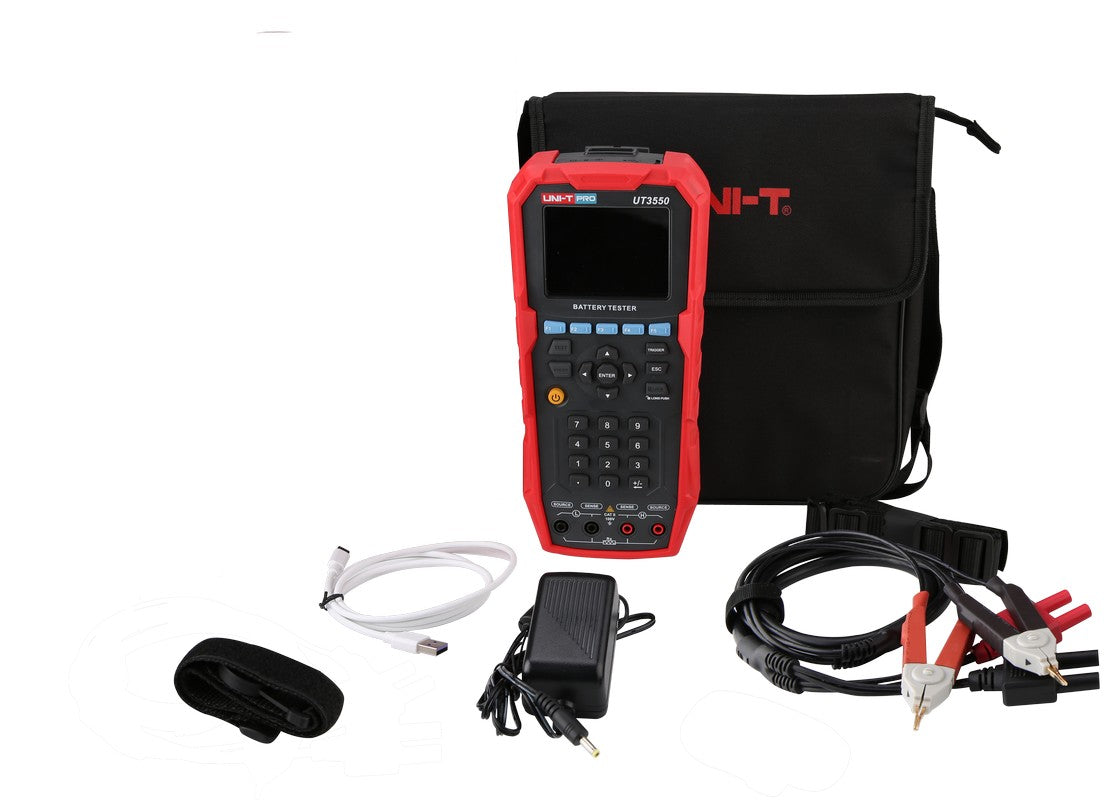
UNI-T UT3550 Handheld Battery Tester
Overview
The UT3550 measures battery internal resistance and voltage together using a 4-wire Kelvin connection and 1 kHz AC injection — the method that reveals a weak cell before it fails under load. It resolves internal resistance from 0.001 mΩ to 30 Ω at ±0.5% and voltage to 100 V at ±0.05%, covering everything from small consumer cells to large industrial battery banks.
A 4-wire connection removes lead resistance for accuracy at low ohms, a comparison function sorts pass/fail against set limits, and results log to 500 groups with CSV export over USB-C. The IP65 body and rechargeable pack suit field and maintenance work. It's backed by UNI-T's nearly 40 years of test-meter manufacturing.
Key Features
- AC-injection internal-resistance method (1 kHz)
- Internal resistance 0.001 mΩ to 30 Ω, ±0.5%
- Voltage 0.0001 V to 100 V, ±0.05%
- 4-wire Kelvin connection removes lead resistance
- Comparison function with pass/fail sorting
- Data logging to 500 groups; CSV export over USB-C
- Dual display (LCD & OLED); IP65 sealing
- Rechargeable 7.4 V 2000 mAh Li-ion
UT3550 Details
Internal Resistance & Voltage Together
Internal resistance rises as a cell ages, often well before its open-circuit voltage drops. By measuring resistance (0.001 mΩ–30 Ω) and voltage (to 100 V) at the same time, the UT3550 flags a weakening cell while it still reads a normal voltage.
4-Wire Kelvin Accuracy
A 4-wire Kelvin connection separates the current and sense paths so lead and contact resistance don't corrupt the reading — essential for the milliohm-level measurements that distinguish a healthy cell from a tiring one.
Sorting & Logging
A comparison function sorts cells pass/fail against set limits for fast battery-bank screening, and logging to 500 groups with CSV export over USB-C builds the record a maintenance program needs.
Field Build
A dual LCD/OLED display, IP65 sealing, and a rechargeable Li-ion pack make the UT3550 practical for moving down a rack of cells in the field.
Applications
UPS, telecom, and stationary battery-bank maintenance; testing consumer and industrial cells from small to large; incoming inspection and pass/fail sorting; and preventive programs that track internal resistance over time.
Frequently Asked Questions
Why measure internal resistance instead of just voltage?
Internal resistance rises as a battery ages, often before voltage drops — so it catches a weak cell earlier.
What is the 4-wire Kelvin method?
It uses separate current and sense leads so lead and contact resistance don't affect the milliohm-level reading.
Can I export results?
Yes — log to 500 groups and export CSV over USB-C.
Warranty
This instrument is backed by UNI-T's 3+2 Year Warranty — 3 years of standard coverage, plus 2 additional years free when you register your product. That's 5 years of total protection at no extra cost.
The warranty covers manufacturing defects and component failures under normal use conditions. UNI-T instruments are built for professional daily use, and our warranty reflects that commitment to long-term reliability.
| Battery Voltage Range | 0.0001V - 100.00V |
|---|---|
| Internal Resistance Range | 0.001mΩ - 30.00Ω |
| Measurement Resolution | 0.001mΩ / 0.1mV |
| Basic DC Accuracy | Resistance: ±0.5%rdg±5dgt | Voltage: ±0.05%rdg±5dgt |
| Instrument Type | Battery Tester |
Features
- Data Logging
- Programmable
- Auto Ranging
- Data Hold
- Comparison Function
- Dual Display
Full specifications (20)
| Details | |
|---|---|
| DC Voltage | 100V (0.0001V - 100.00V) |
| Max Resistance | 30Ω (0.001mΩ - 30.00Ω) |
| Voltage Resolution | 0.1mV |
| Test Frequency | 1kHz±30Hz |
| Measurement Principle | AC Injection |
| Test Method | 4-Wire Kelvin |
| Fastest Test Rate | 1/s manual range |
| General Information | |
| Display Size | 3.5in |
| Display Type | Dual Display LCD & OLED |
| Interface | USB-Type-C|USB-Device |
| Battery | 7.4V 2000mAh Li-ion |
| Battery Life | Approx. 5h (20% brightness) |
| Charging Time | <5 hours |
| IP Rating | IP65 |
| Data Storage | 500 groups internal, CSV export |
| Ambient Temperature Range | 0°C - 40°C |
| Ambient Humidity | 10 - 80%RH |
| Storage Temperature | -20°C - 60°C |
| Warranty | 3+2 years |
| Certifications | CE |