



MSO3034HD | 350 MHz 4Ch 12-Bit Mixed Signal Oscilloscope
Overview
The MSO3034HD is a 350 MHz, 4-channel mixed signal oscilloscope built on the R12™ native 12-bit ADC architecture, with 2.5 GSa/s sample rate, 500 Mpts standard memory depth, and a calculated rise time of ≤1.00 ns. Sixteen digital channels are available with the UT-M15 logic probe pod, and Ultra Phosphor 3.0 acquisition delivers 500,000 wfms/s standard — 1,500,000 wfms/s in Sequential Mode — on a 10.1-inch capacitive multi-touch display.
For wide-bandgap power-electronics validation, faster MCU bring-up, and four-channel mixed-signal debug, the MSO3034HD adds bandwidth headroom over the family entry without giving up native 12-bit fidelity. GaN/SiC gate drives at higher switching frequencies, USB-C power delivery negotiations on faster MCU silicon, and ripple analysis on dense multi-rail boards all stay inside the bandwidth envelope while the 12-bit ADC keeps quantization noise out of the measurement.
Key Features
- 350 MHz Bandwidth, 4 Analog Channels — Full 350 MHz on every channel with a calculated rise time of ≤1.00 ns, sized for fast switching nodes and next-edge MCU clocks.
- R12™ Native 12-Bit ADC — 4,096 quantization levels held at full bandwidth and full sample rate — no ERES averaging required, no sample-rate trade. Up to 16-bit effective resolution with ERES enabled.
- 2.5 GSa/s Sample Rate, 500 Mpts Memory — Real-time sampling up to 2.5 GSa/s (interleave) with 500 Mpts maximum storage per channel for long-window capture without sample-rate compromise.
- Ultra Phosphor 3.0 Acquisition — 500,000 wfms/s standard capture rate; 1,500,000 wfms/s in Sequential Mode for trigger-conditioned anomaly hunting. 256-level intensity grading reveals rare events that slower scopes miss.
- Nine Instruments in One — Oscilloscope, logic analyzer, function/AWG, spectrum analyzer, digital voltmeter, frequency counter, Bode plot analyzer, protocol analyzer, and power analyzer — integrated into a single bench instrument.
- 16 Digital Channels (Optional) — Add the UT-M15 logic probe pod for full mixed-signal debug across analog and digital domains with time-correlated triggering and decoding.
- 12 Protocol Decoders — Standard: RS-232/UART, RS-422/485, I²C, SPI. Optional: CAN, CAN-FD, LIN, FlexRay, SENT, Audio, MIL-STD-1553B, ARINC 429, Manchester.
- 56 Automated Measurements with Statistics — Voltage, time, and frequency-domain measurements with histogram and trend-line display. Up to 27 simultaneous on-screen measurements.
- Optional 50 MHz Dual-Channel AWG — Add a built-in 16-bit dual-channel arbitrary waveform generator with Bode plot loop-stability analysis. Drive stimulus-response testing from the same instrument that captures the response.
- 10.1-Inch Multi-Touch Display + WebServer + SCPI — 1280 × 800 capacitive touchscreen with gesture control, browser-based remote access, and full SCPI automation over USB 3.0, LAN, and HDMI export.
Detailed Features
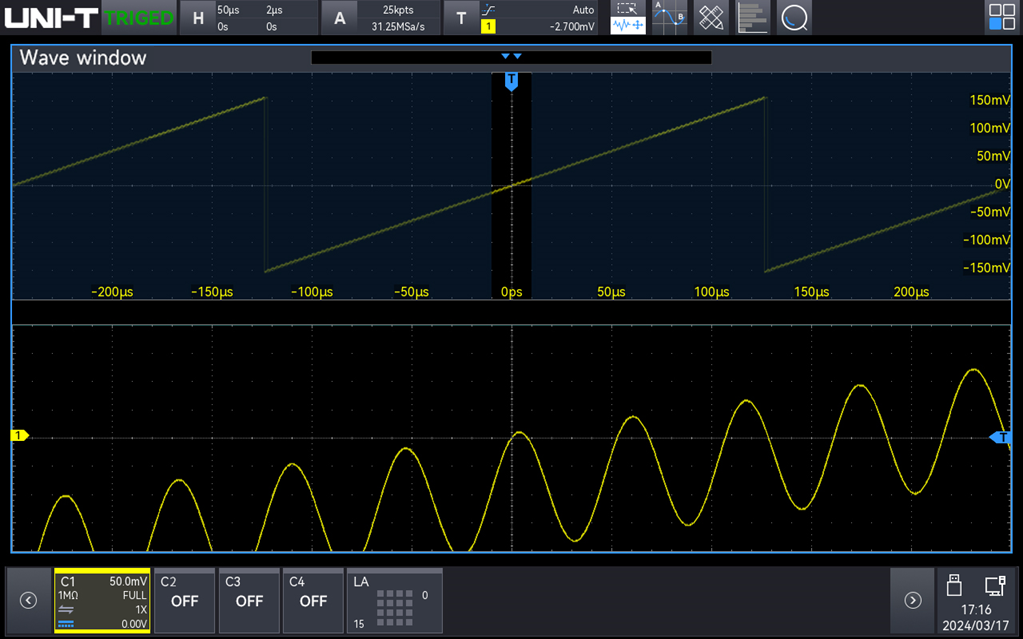
R12™ — Native 12-Bit at Full Bandwidth
R12™ is UNI-T’s native 12-bit ADC architecture: 4,096 vertical quantization levels at the full 350 MHz bandwidth and 2.5 GSa/s sample rate, with no ERES averaging and no sample-rate trade. For wide-bandgap power-electronics work where switching transients and rail-noise content compete for the same channel, the 12-bit headroom matters: the µV-scale ripple riding on a 400 V GaN node stays inside the measurement window instead of being lost to 8-bit quantization noise. Enable ERES for further bandwidth-traded enhancement — up to 16-bit effective resolution — when the application can spare the bandwidth.
R12™ native 12-bit ADC: 4,096 quantization levels, no ERES required.
Ultra Phosphor 3.0 — 1,500,000 wfms/s in Sequential Mode
Ultra Phosphor 3.0 is UNI-T’s third-generation waveform-mapping architecture, combining parallel FPGA acquisition with 256-level grayscale intensity grading. Standard waveform capture rate is 500,000 wfms/s — high enough to surface intermittent timing anomalies on a long capture window. In Sequential Mode — the segmented-memory acquisition mode that conditions captures on a trigger event — capture rate climbs to 1,500,000 wfms/s, and the scope holds up to 125,000 frames of uninterrupted hardware real-time recording for post-capture replay and analysis. Rare-event hunting on a live system stops being a watch-and-wait exercise and starts being a hunt with the right tool for it.
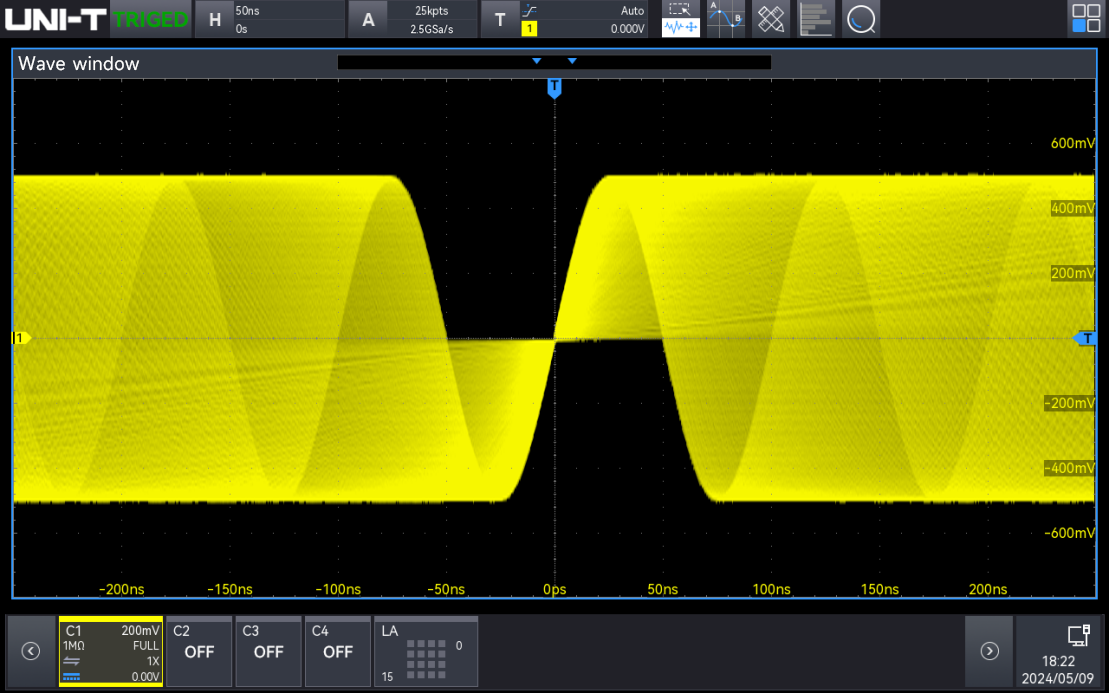 Ultra Phosphor 3.0: 500,000 wfms/s standard, 1,500,000 wfms/s in Sequential Mode.
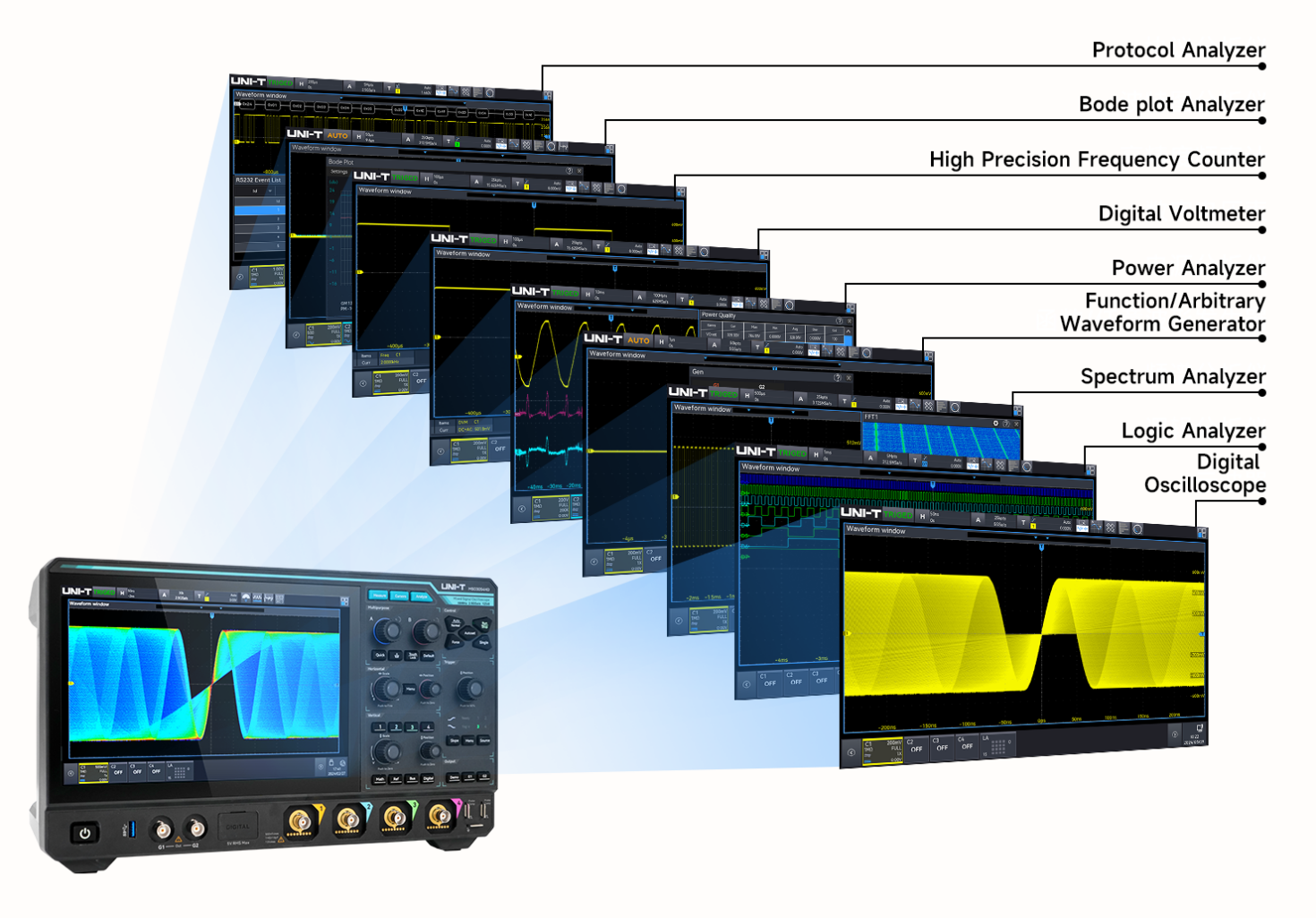
Nine Instruments in One — The HD Workhorse
The MSO3034HD integrates nine instruments in a single chassis — oscilloscope, 16-channel logic analyzer, 50 MHz dual-channel AWG (optional), 4 Mpts FFT spectrum analyzer, DVM, frequency counter, Bode plot analyzer, protocol analyzer, and power analyzer — with the bandwidth headroom to qualify next-generation switching designs and faster mixed-signal silicon. Bode plots run from the same instrument that captures the loop response, FFT runs on the same channel that captures the time-domain signal, and protocol decoding correlates with the analog rail being measured. The design-validation cycle stays on one bench.
Nine integrated instruments in one bench platform.
Deep Memory — 500 Mpts Per Channel
500 Mpts maximum storage depth per channel is the deepest memory in this product class. On a long-window acquisition, the alternative on shallow-memory scopes is the sample-rate trade-off: extend the time base, lose sample rate, lose the high-frequency content that mattered. The MSO3000HD’s memory budget eliminates that trade for capture windows up to 200 ms at the full 2.5 GSa/s sample rate. Boot-sequence captures on a microcontroller, full power-on transient analysis on a switching converter, multi-frame protocol traces — the memory holds the whole event at full resolution. Selectable depths from 25 kpts up to 500 Mpts let the engineer match memory to workflow without leaving the instrument.
16 Digital Channels with the UT-M15 Logic Probe
16 digital channels are hardware-standard on the MSO3034HD — the acquisition path, channel-to-channel correlation, and trigger system are all built in. Adding the optional UT-M15 logic probe pod activates the digital input front end. The probe pod uses high 8-bit and low 8-bit signal groupings on a 2.54 mm pin header, with 101 kΩ input impedance and 9.0 pF capacitive loading — light enough not to perturb the DUT, fast enough to resolve 800 ps minimum pulse width at the full 1.25 GSa/s digital sample rate. Time-correlated triggering across analog and digital channels turns the MSO3034HD into a full mixed-signal debug instrument for embedded systems where the bug lives at the boundary between the firmware and the analog rail.
12 Protocol Decoders — 3 Standard, 9 Optional
Twelve protocol decoders cover embedded, automotive, audio, and aerospace applications. Three are standard: RS-232/422/485/UART, I²C, and SPI ship with the instrument and decode at no additional cost. Nine are field-upgradable license unlocks: CAN, CAN-FD, LIN, FlexRay, SENT, Audio, MIL-STD-1553B, ARINC 429, and Manchester — one license per protocol family, no expiration, no subscription. Decoded frames overlay the analog waveform with field-level annotation, and the event list and search functions navigate captured traffic without leaving the instrument. Up to four protocols can decode simultaneously; up to 18 bits of parallel-bus decoding combines analog and digital channels for legacy buses.
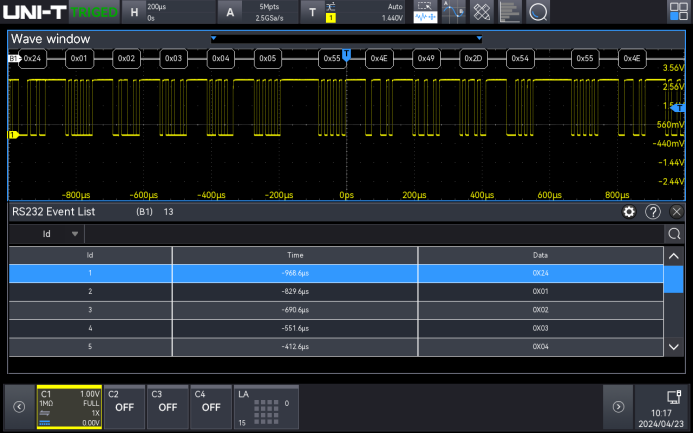 12 protocol decoders — 3 standard, 9 optional. Decoded frames overlay the analog waveform.
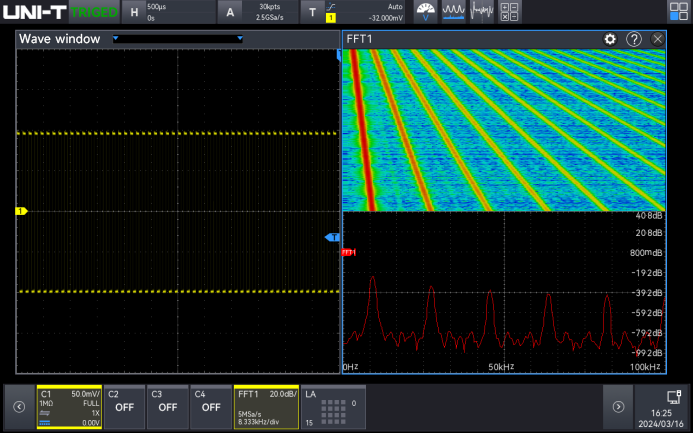
Built-In Spectrum Analyzer — 4 Mpts FFT to 2.5 GHz
An enhanced FFT engine of up to 4 Mpts runs as a dedicated frequency-domain analysis mode on the instrument. Frequency range covers 0 to 2.5 GHz, four traces and four detection types (positive peak, negative peak, sample, average) display simultaneously, and the waterfall view tracks spectral content over time for intermittent emissions. Three marker types (auto, manual, threshold) and a marker-point list support EMI pre-screen, harmonic analysis, signal-purity checks, and switching-noise characterization. The same channel that captures the time-domain trace runs the FFT — no signal transfer, no recapture, no de-synchronized traces between two instruments.
Built-in 4 Mpts FFT spectrum analyzer with waterfall, peak table, and four traces.
Power Analysis — Optional 6-Class Suite
The optional Power Analysis package adds six classes of power-electronics measurement to the MSO3034HD: switching-loss analysis, output ripple, harmonic analysis, slew rate, modulation analysis, and SOA. For mid-bandwidth GaN/SiC validation work where the switching node sits in the 50 to 150 MHz envelope, the MSO3034HD’s 350 MHz bandwidth captures the rising edge and the ringing behavior on the same trace the analysis runs against. Switching-loss integration over the full event window is fast and consistent — no exporting to spreadsheet, no script-driven post-processing.
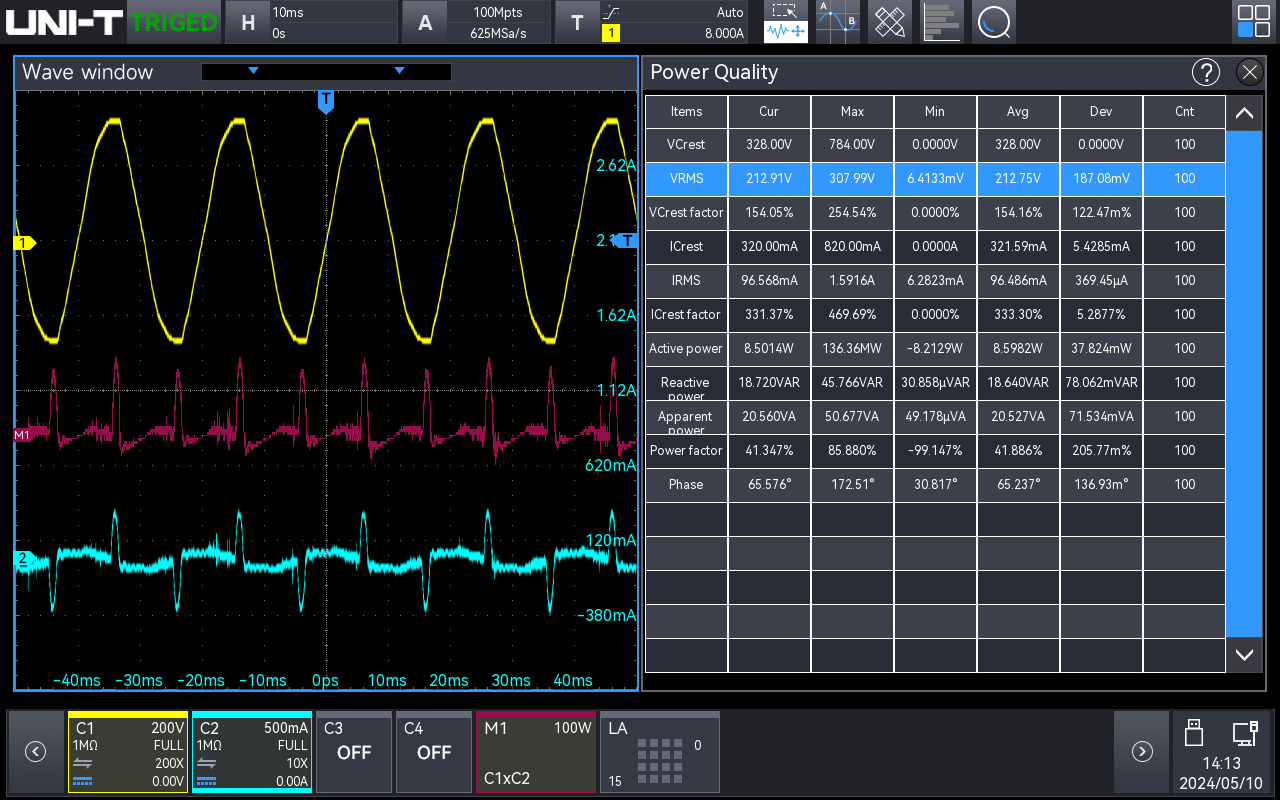 Power Analysis (optional): six measurement classes for power-electronics validation.
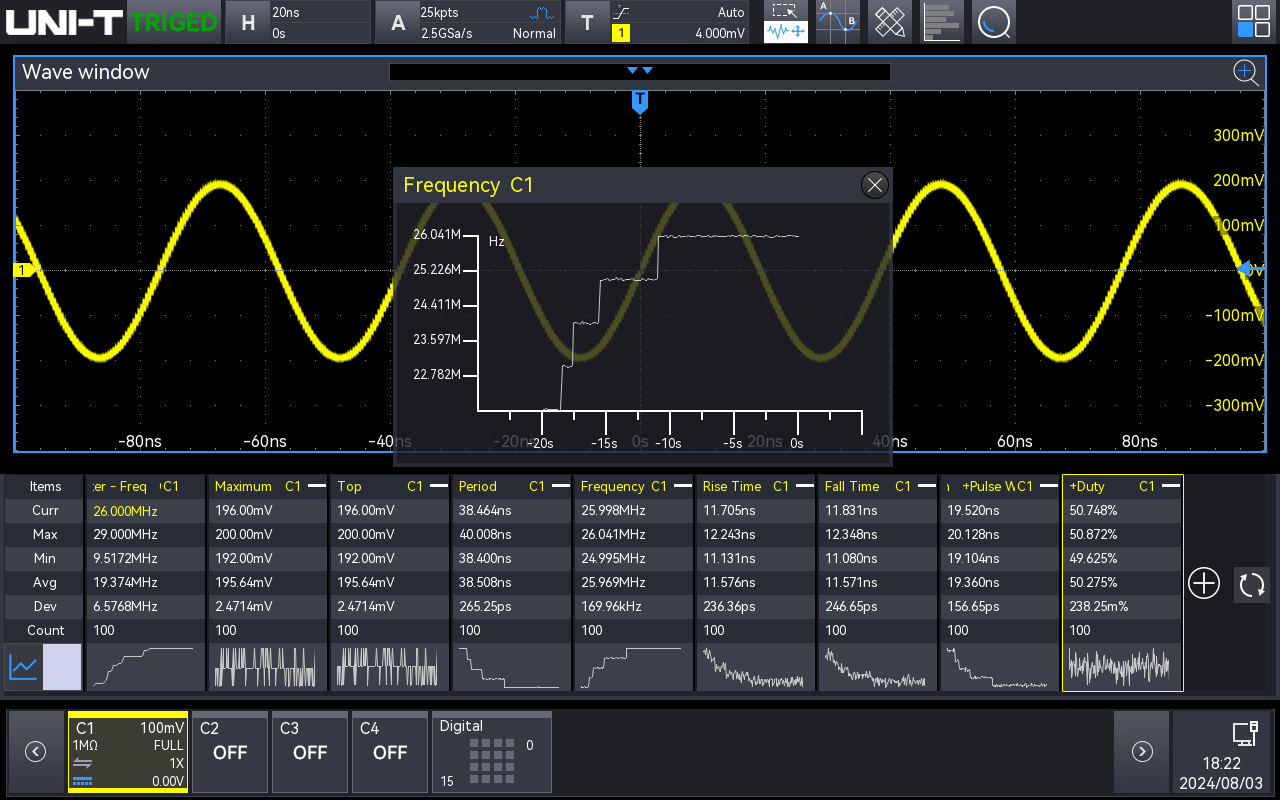
56 Automated Measurements with Statistics
56 automated measurement types cover voltage, time, frequency-domain, and area-under-curve calculations — with up to 27 measurements displayed simultaneously on screen and a 39-item single-channel parameter snapshot for production-style documentation. Histogram and trend-line displays show measurement statistics over time for jitter analysis, drift characterization, and long-window validation runs. Measurements run continuously during acquisition, refresh in real time, and stay correlated with the cursor position when manual analysis takes over.
56 measurement types with histogram and trend-line statistics.
10.1-Inch Touch UI, WebServer, and SCPI Automation
The 10.1-inch capacitive multi-touch display (1280 × 800) supports gesture control — tap, slide, pinch-zoom, drag-and-drop — alongside traditional knob, key, and mouse/keyboard input. The built-in WebServer exposes the instrument over a browser for cross-platform remote access (PC, tablet, phone), with full waveform export and online user-manual browsing built in. SCPI over USB 3.0 and LAN drops the MSO3034HD into automated bench scripts, and HDMI output mirrors the screen to an external display for teaching, presentation, or large-screen analysis. Mask (template) testing accelerates production go/no-go cycles in hardware, and the 7-digit precision Autoset uses fuzzy logic to find the right scale and time base across multi-channel inputs in a single button press.
Applications
R&D and Embedded Engineering
- Mixed-signal validation on faster MCUs and FPGA prototypes — 350 MHz bandwidth and 500 Mpts deep memory capture multi-cycle bus transactions on high-speed parallel buses, while four analog channels follow the supply-rail behavior during the same window.
- Mixed-signal debug across analog and digital domains — with the optional UT-M15 16-channel logic probe pod, the MSO3034HD time-correlates firmware events with analog rails for bug isolation at the boundary.
- Protocol bring-up and bus traffic analysis — standard RS-232/422/485/UART, I²C, and SPI decoding (plus optional CAN, CAN-FD, LIN, FlexRay, etc.) with frame-level annotation on the analog waveform.
- Long-window event capture for intermittent bugs — 500 Mpts memory and 125,000-frame Sequential Mode hold the full event window at full sample rate, so the bug doesn’t have to recur during a manual capture window.
Power Electronics
- Wide-bandgap gate-drive characterization — 350 MHz bandwidth captures GaN and SiC gate-drive edges and ringing behavior on the same trace the optional Power Analysis package integrates, with the 12-bit ADC keeping the µV-scale ripple on the supply rail measurable.
- EMI pre-screen on switching converters — 4 Mpts FFT to 2.5 GHz with waterfall display surfaces conducted-emission spurs before the chamber visit.
- Loop-stability validation with optional Bode plot analysis — with the AWG option enabled, drive small-signal injection and measure the closed-loop response from one instrument across 50 Hz to 50 MHz.
- Multi-rail correlation — four analog channels capture input, output, reference, and feedback signals on a complex switching topology in a single time-aligned acquisition.
Teaching Labs and Curriculum Use
- Multi-station teaching labs and bench scalability — the WebServer browser interface lets an instructor mirror a single bench’s display to a classroom-wide projection, and SCPI scripting prepares advanced courses for automated-measurement curricula.
- Visual demonstration of frequency-domain analysis — the built-in 4 Mpts FFT spectrum analyzer makes time-frequency duality demonstrable on the same instrument students already know.
- Mixed-signal lab work without a separate logic analyzer — with the optional UT-M15 probe pod, students capture analog and digital signals on one screen for embedded-systems coursework.
- Repeatable lab exercises with SCPI automation — instructor-prepared Python scripts drive consistent measurements across student bench stations.
Accessories & In the Box
Included
- MSO3034HD mixed signal oscilloscope
- 4 × UT-P05 100 MHz, 10:1/1:1 passive probes (200 MHz family) or UT-P06 200 MHz, 10:1/1:1 passive probes (350/500 MHz family)
- AC power cord (region-specific)
- USB cable, certificate of conformity, quick start guide
Recommended Accessories
- UT-M15 16-channel logic analyzer probe pod — activates the 16 standard digital channels for mixed-signal debug.
- UT-P series passive, differential, and current probes — matched probes for high-voltage, high-current, and differential measurements.
- Optional protocol decode licenses (CAN, CAN-FD, LIN, FlexRay, SENT, Audio, MIL-STD-1553B, ARINC 429, Manchester) — field-upgradable, no expiration.
- Optional 50 MHz dual-channel AWG license — adds stimulus-response and Bode plot capability to the same instrument.
- Optional Power Analysis package — six-class power-electronics measurement suite.
Family Members
Frequently Asked Questions
What protocols are included standard, and what are optional?
Standard decoders: RS-232/422/485/UART, I²C, and SPI. Optional license unlocks: CAN, CAN-FD, LIN, FlexRay, SENT, Audio, MIL-STD-1553B, ARINC 429, and Manchester. Optional licenses do not expire; firmware updates are free over the product’s lifetime.
What does R12™ mean in practice?
R12™ is UNI-T’s native 12-bit ADC architecture — 4,096 vertical quantization levels, sixteen times the resolution of an 8-bit ADC, held at the full bandwidth and sample rate with no ERES averaging required. ERES is available as an enhancement on top of R12 (up to 16-bit effective resolution); on competing scopes, ERES is required to claim 12-bit at all and trades bandwidth or sample rate to do it.
Can I add the AWG and logic-analyzer capabilities later?
Yes. The 16-channel logic analyzer is hardware-standard; activating it requires the optional UT-M15 logic probe pod. The 50 MHz dual-channel AWG (with Bode plot) is a license unlock. Both are field-upgradable on instruments already in service. License unlocks do not expire.
What’s the difference between the standard 500,000 wfms/s and Sequential Mode’s 1,500,000 wfms/s?
500,000 wfms/s is the continuous capture rate the instrument sustains across normal operation. Sequential Mode is a segmented-memory acquisition mode that conditions captures on a trigger event and uses the memory budget to record up to 125,000 frames of trigger-aligned waveforms back-to-back; the 1,500,000 wfms/s figure is the effective capture rate during Sequential Mode operation. Sequential Mode is the right tool for hunting rare or intermittent events; the standard mode is the right tool for continuous monitoring.
When should I choose the MSO3034HD over the MSO3024HD or MSO3054HD?
The MSO3034HD is the mid-tier of the family. Choose it over the MSO3024HD when your work involves GaN/SiC switching nodes, faster MCU silicon, or higher-speed mixed-signal validation that needs the 350 MHz envelope. Choose it over the MSO3054HD when 500 MHz is more headroom than your application requires — the MSO3034HD hits the same noise floor and the same 12-bit native resolution as the flagship at lower bandwidth, with budget redirected toward probes, software, or a second instrument.
Warranty
This instrument is backed by UNI-T's 3+2 Year Warranty — 3 years of standard coverage, plus 2 additional years free when you register your product. That's 5 years of total protection at no extra cost.
The warranty covers manufacturing defects and component failures under normal use conditions. UNI-T instruments are built for professional daily use, and our warranty reflects that commitment to long-term reliability.
| Analog Bandwidth | 350MHz |
|---|---|
| Channels | 4Ch+16D (opt) |
| Sample Rate | 2.5GSa/s |
| Memory Depth | 500Mpts |
| Vertical Resolution | 12 bits |
| Built-in Signal Generator | Optional |
| Digital Channels | Optional |
| Touch Screen | ✓ |
| Instrument Type | HD MSO |
Features
- Frequency Counter
- Digital Voltmeter
Full specifications (22)
| Details | |||||
|---|---|---|---|---|---|
| Waveform Capture Rate |
|
||||
| Input Impedance | 1 MΩ | 50 Ω | ||||
| Vertical Scale (1 MΩ) | 500μV/div to 10V/div | ||||
| Vertical Scale (50 Ω) | 500μV/div to 1V/div | ||||
| Automated Measurements | 56 | ||||
| Bus Protocols (Standard) | RS232|UART|RS422|RS485|I2C|SPI | ||||
| Bus Protocols (Optional) | CAN|CAN-FD|LIN|FlexRay|SENT|Audio|MIL-STD-1553B|ARINC429|Manchester | ||||
| Protocol Decoders | 12 | ||||
| Measurement Parameters | 56 | ||||
| Fft Points | 4Mpts | ||||
| Features | |||||
| Frequency Counter Bits | 7-digit | ||||
| Power Analysis | 6 | ||||
| Dvm Bits | 4-digit | ||||
| AWG Channels | 2 | ||||
| AWG Frequency | 50 MHz | ||||
| General Information | |||||
| Display Size | 10.1in | ||||
| Display Type | TFT LCD | ||||
| Interface | USB 3.0|LAN|AUX|Gen Out x 2|10MHz In/Out|HDMI | ||||
| Dimensions (W×H×D) | 364 × 209 × 106 mm | ||||
| Weight | 3.83 kg | ||||
| Warranty | 3+2 years | ||||
| Certifications | CE|cETLus | ||||
Data Sheets and Manuals
Older firmware versions (1)
Check your instrument’s hardware revision before updating firmware — different hardware revisions take different builds.
Authentic UNI-T accessories are an affordable way to extend the functionality of your instrument.
MSO3000HD Options 16
Need to add specific functionality to your UNI-T instrument? Here are our options for specific applications and measurement types. Have a question? Contact us at 888-668-UniT (8648).

MSO3000HD-ARINC429 Aerospace ARINC429 Serial Bus Trigger and Analysis
$279.00
MSO3000HD-AUDIO Serial Bus Trigger and Analysis Option (I2S, LJ, RJ, TDM)
$279.00
MSO3000HD-AUTO Serial Bus Trigger and Decode Bundle (CAN, CAN-FD, LIN, FlexRay, SENT)
$689.00
MSO3000HD-AWG Arbitrary Waveform Generator option
$279.00
MSO3000HD-BND Serial Bus Trigger and Decode Bundle (incl. AUTO, AUDIO, MIL-STD, ARINC429, MANCH)
$1,109.00
MSO3000HD-BW2MT3M5 350MHz Bandwidth Upgrade
$499.00
MSO3000HD-BW2MT5M 500MHz Bandwidth Upgrade
$1,599.00
MSO3000HD-BW3M5T5M 500MHz Bandwidth Upgrade
$1,099.00
MSO3000HD-CAN Automotive CAN Serial Bus Trigger and Analysis
$279.00
MSO3000HD-CANFD Automotive CAN-FD Serial Bus Trigger and Analysis
$279.00
MSO3000HD-FLEX Automotive FlexRay Serial Bus Trigger and Analysis
$279.00
MSO3000HD-LIN Automotive LIN Serial Bus Trigger and Analysis
$279.00
MSO3000HD-MANCH Manchester Serial Bus Trigger and Analysis Option
$279.00
MSO3000HD-MIL1553 MIL-STD-1553 Serial Bus Trigger and Analysis Option
$279.00
MSO3000HD-PWR Power Analysis Option
$829.00
MSO3000HD-SENT Automotive SENT Sensor Bus Trigger and Analysis
$279.00Passive Probes 11

UT-P01 25 MHz 10:1 General Purpose Oscilloscope Probe
$15.99
UT-P03 60 MHz 10:1 General Purpose Oscilloscope Probe
$18.99
UT-P04 100 MHz 10:1 General Purpose Oscilloscope Probe
$15.99
UT-P05 200 MHz 10:1 General Purpose Oscilloscope Probe
$20.99
UT-P06 300 MHz 10:1 General Purpose Oscilloscope Probe
$37.99
UT-P07A 500 MHz 10:1 General Purpose Oscilloscope Probe
$51.99UT-P07B 500 MHz 10:1 General Purpose Oscilloscope Probe
$119.00
UT-P08A 350 MHz 10:1 General Purpose Oscilloscope Probe
$51.99
UT-P20 250 MHz 100:1 High Voltage Oscilloscope Probe
$56.99
UT-P21 50 MHz 1000:1 High Voltage Oscilloscope Probe
$430.00
UT-V23 High Voltage Scope Probe
$25.00Current Probes 6

UT-P40 DC-100 kHz 60A AC/DC Current Probe
$452.00
UT-P41 DC-100 kHz 100A AC/DC Current Probe
$595.00
UT-P4150 12 MHz High-Frequency DC/AC Current Probe
$2,529.00
UT-P42 150 kHz 200A AC/DC Current Probe
$459.00
UT-P43 DC-25 MHz 20A 100mV/A Current Probe
$956.00
UT-P44 DC-50 MHz 40A 50mV/A Current Probe
$1,695.00Differential Probes 6

UT-P30 100 MHz 10:1/100:1 Differential Oscilloscope Probe
$399.00
UT-P31 100 MHz 100:1/1000:1 Differential Oscilloscope Probe
$699.00
UT-P32 50 MHz 100:1/1000:1 Differential Oscilloscope Probe
$860.00
UT-P33 120 MHz 100:1/1000:1 Differential Oscilloscope Probe
$1,465.00
UT-P35 50 MHz 50:1/500:1 Differential Oscilloscope Probe
$395.00


