


UNI-T UTG2082X 80 MHz 2Ch Arbitrary Waveform Generator: 16-Bit Dual-Channel Bench Function Generator with Touch Display
Overview
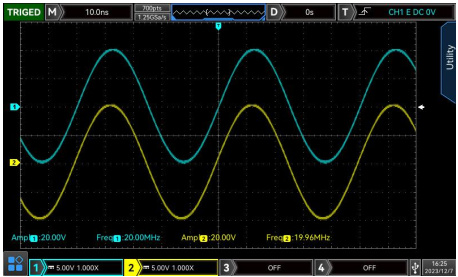
The UNI-T UTG2082X is a 80 MHz dual-channel arbitrary waveform generator built around a 16-bit DAC and a 625 MSa/s sample rate — effectively 1.25 GSa/s with 2× interpolation. A 64 Mpts arbitrary-waveform memory depth supports long-form custom stimulus, and a 4.3-inch capacitive touch display replaces the menu-driven UI of earlier-generation generators with direct parameter manipulation. Equal-performance dual channels deliver full-amplitude 20 Vpp output on both channels simultaneously up to 20 MHz.
40 MHz square / pulse output, 1 µHz frequency resolution across the full 80 MHz output range, harmonic distortion below 0.07% (DC to 20 kHz, 1 Vpp), and a 7-digit hardware frequency counter (100 mHz to 200 MHz). Fifteen analog and digital modulation types — including 3FSK, 4FSK, QAM, and the full BPSK / QPSK / OSK set. Linear, logarithmic, and stepwise sweep. Three burst modes (N-cycle, gated, infinite). 200 built-in arbitrary waveforms.
Key Features
- 80 MHz sine / 40 MHz square & pulse — dual-channel output with 1 µHz frequency resolution.
- 625 MSa/s sample rate (1.25 GSa/s with 2× interpolation) — high sample rate restores fine signal detail across the upper output range.
- 16-bit DAC, 64 Mpts arbitrary memory — extended memory holds long-form protocol streams and complex physiological waveforms.
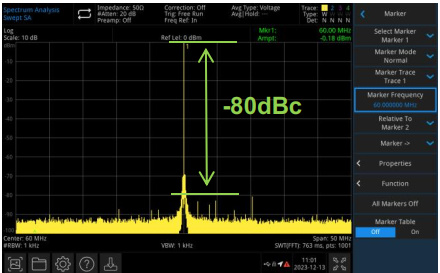
- Harmonic distortion below 0.07% — low harmonic distortion in this output class; −80 dBc spurious-free dynamic range.
- Equal-performance dual channel — both channels deliver full 20 Vpp output simultaneously up to 20 MHz. No amplitude derating from second-channel use.
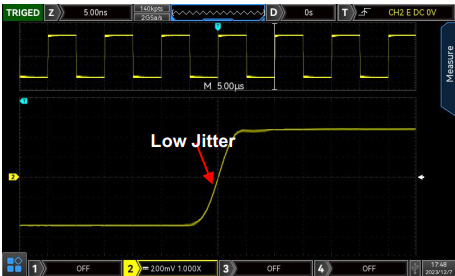
- Ultra-low jitter square wave to 50 MHz — jitter below 200 ps above 5 MHz; pure square output beyond the cost-class envelope.
- 15 modulation types — AM, FM, PM, DSB-AM, ASK, FSK, PSK, 3FSK, 4FSK, BPSK, QPSK, OSK, SUM, QAM, PWM — covers analog and digital modulation across communications-class stimulus.
- Three sweep modes — Linear, Logarithmic, Stepwise. Three trigger sources: Internal, External, Manual.
- Channel Merge, Channel Follow, Channel Stacking — dual-tone, multi-frequency, and signal-plus-noise generation from one instrument.
- 4.3-inch capacitive touch display — direct parameter manipulation; replaces traditional menu navigation.
- LAN, USB-Device, USB-Host, SCPI — full ATE integration. Built-in instrument manager for remote control.
UNI-T UTG2082X Details
Equal-Performance Dual Channel with 1.25 GSa/s Sampling
Both channels deliver the full 80 MHz output range with equal performance — no amplitude derating, no specification compromise on the second channel. Full 20 Vpp output amplitude (high-Z) is maintained simultaneously on both channels up to 20 MHz. 625 MSa/s native sample rate with 2× interpolation produces 1.25 GSa/s effective output, restoring fine detail across the higher-frequency end of the 80 MHz output range.
Low Harmonic Distortion (THD < 0.07%)
Harmonic distortion below 0.07% from DC to 20 kHz at 1 Vpp — 3× lower than the 0.2% typical of Advanced-tier function generators. Spurious-free dynamic range reaches −80 dBc. The cleaner sine output is meaningful when characterizing op-amp distortion, ADC noise floors, audio-band frequency response, and any work where the stimulus must be quieter than the device under test.
Ultra-Low Jitter Square Wave
The UTG2082X produces square waves up to 40 MHz with jitter below 200 ps above 5 MHz. Below 5 MHz, jitter floor is 2 ppm + 200 ps. The clean edge translates into reliable clock-recovery, deterministic protocol triggering, and characterization-quality stimulus for digital-clock-input circuit testing. Rise / fall time is below 6 ns typical at 1 Vpp into 50 Ω (1 kHz).
Wide-Dynamic Pulse with Adjustable Edge
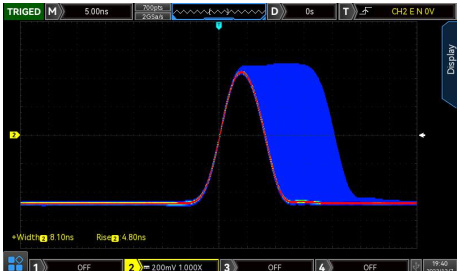
The wide-dynamic pulse output reaches 40 MHz with a minimum pulse width of 8 ns. Edge time is finely adjustable in 100 ps steps — rare in this price tier — allowing characterization of edge-rate sensitivity in receivers, ESD protection circuits, and high-speed digital input stages. The UTG2082X can also generate higher-harmonic-content pulses than typical fixed-edge generators.
High SNR Output
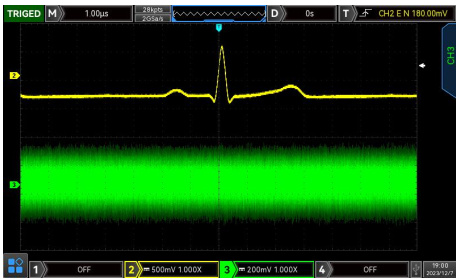
Small signals superimposed on large DC offsets are produced with low output noise — small-signal SNR remains high across the full DC offset range. The result is meaningful when generating low-level AC perturbations on a precision DC bias for power-supply ripple testing, sensor-conditioning input stimulus, or precision-current-source modulation.
15 Modulation Types + Three Sweep Modes
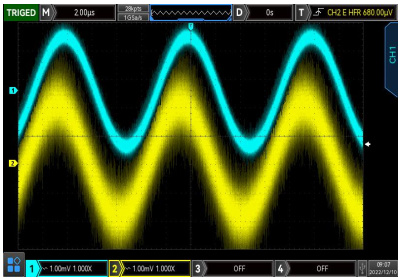
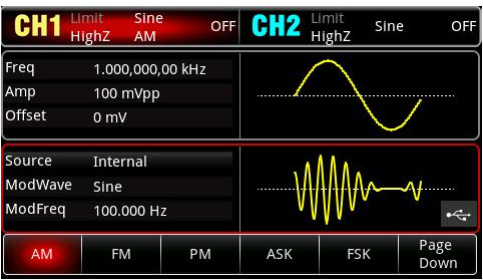
AM, FM, PM, DSB-AM, ASK, FSK, PSK, 3FSK, 4FSK, BPSK, QPSK, OSK, SUM, QAM, PWM — 3FSK and 4FSK cover multi-state digital stimulus. Modulating source is internal (sine, square, ramp, noise, arbitrary) or external. Frequency sweep supports Linear, Logarithmic, and Stepwise modes with Internal, External, or Manual trigger sources. Three burst modes round out the stimulus envelope: N-cycle, gated, and infinite.
Channel Merge, Channel Follow, Channel Stacking
Three dual-channel coordination modes. Channel Merge sums the two outputs for dual-tone, multi-frequency, or signal-plus-noise stimulus. Channel Follow ties phase, amplitude, or frequency parametrically — change one channel and the other auto-adjusts by the configured relationship. Channel Stacking overlays one channel onto the other for signal-on-signal composite waveforms. Together they support differential-circuit stimulus, multi-carrier generation, and signal-fidelity tests that need controlled noise-plus-signal envelopes.
4.3-Inch Capacitive Touch Display & Remote Control
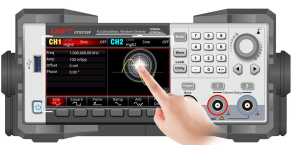
The capacitive touch display replaces traditional menu-button navigation with direct parameter manipulation — tap a numeric field to edit, swipe through modulation modes, drag amplitude or offset on the waveform preview. The UTG2082X also supports remote control over USB or LAN; UNI-T's instrument-manager software gives PC-side waveform editing, parameter control, and automated-test orchestration. SCPI command set supports custom ATE integration.
Applications
The Advanced-Series-X envelope — 1.25 GSa/s effective sample rate, 64 Mpts memory, THD < 0.07%, sub-200 ps square-wave jitter, 15-type modulation, capacitive touch UI — targets benchtop work that benefits from low-distortion stimulus, deep arbitrary-waveform support, or wider modulation coverage than entry-tier generators provide.
- Communications-stimulus development — 3FSK, 4FSK, BPSK, QPSK, OSK, QAM digital modulation; SUM and DSB-AM analog modulation. ASK / FSK / PSK with configurable hop rate and depth.
- Audio and instrumentation testing — THD below 0.07% from DC to 20 kHz is meaningful when characterizing op-amp distortion, ADC noise floors, and audio-band frequency response where the stimulus must be quieter than the device under test.
- High-speed digital input stimulus — sub-200 ps square-wave jitter, 100 ps edge-time adjustment, and 8 ns minimum pulse width support characterization of edge-rate sensitivity in receivers and protection circuits.
- Long-form arbitrary playback — 64 Mpts per channel holds extended protocol streams, complex sensor-emulation traces, and physiological waveforms that overflow shorter buffers.
- Differential and multi-tone signal generation — Channel Follow / Merge / Stacking produces phase-tracked output pairs, summed dual-tone stimulus, and signal-on-signal composites from one instrument.
- Automated test (ATE) — LAN-based SCPI control plus instrument-manager software for synchronized multi-instrument benches.
- Power-supply, sensor-conditioning, and precision-bias work — high small-signal SNR on large DC offsets supports ripple testing, sensor-input stimulus, and precision-current-source modulation.
In the Box
- UTG2082X waveform generator
- Power cord (region-appropriate)
- USB 2.0 cable, 1.5 m (USB-A to USB-B)
- BNC-to-BNC cable
- BNC-to-alligator-clip lead (red and black)
- Factory calibration certificate
- Quick-start guide
Accessories and Family Options
Included with Every Unit
- Power cord conforming to destination country standard
- USB cable (UT-D14)
- BNC-BNC cable (UT-L45)
- BNC-to-alligator clip cable (UT-L02)
Recommended Options
- UT-M14 — 10 W external power amplifier option for higher-current loads.
Family Members
The UTG2000X Advanced-Series consists of three SKUs sharing the same chassis, sample rate, DAC, modulation set, and arbitrary-waveform memory depth:
- UTG2062X — 60 MHz sine / 30 MHz square
- UTG2082X — 80 MHz sine / 40 MHz square (this product)
- UTG2122X — 120 MHz sine / 50 MHz square
Frequently Asked Questions
What does “1.25 GSa/s with 2× interpolation” mean in practice?
The native DAC sample rate is 625 MSa/s. A digital interpolation filter inserts an estimated sample between every two native samples, producing an effective output sample rate of 1.25 GSa/s. The reconstruction filter following the DAC sees a higher-rate sample stream, which lets it pass higher-frequency signal content with less alias distortion. The result is finer detail in the upper portion of the 80 MHz output range than the native 625 MSa/s would deliver alone.
What modulation, sweep, and burst envelope does the UTG2000X cover?
Modulation: 15 types — AM, FM, PM, DSB-AM, ASK, FSK, PSK, 3FSK, 4FSK, BPSK, QPSK, OSK, SUM, QAM, PWM. Modulating source is internal (sine, square, ramp, noise, arbitrary) or external. Sweep: Linear, Logarithmic, Stepwise modes with Internal, External, or Manual trigger. Burst: N-cycle, Gated, Infinite. Standard waveform shapes: Sine, Square, Ramp, Pulse, Harmonic, PRBS, Expression, Noise, DC, Arbitrary.
What is PRBS and when would I use it?
Pseudo-Random Binary Sequence — a deterministic but statistically random-looking bit pattern used in communications testing, encryption verification, jitter-tolerance measurement, and digital-receiver characterization. PRBS covers communications-class testing where a known-but-random bit pattern is the required stimulus. PRBS is one of the ten standard waveform shapes available on the UTG2000X.
How does Channel Follow differ from Channel Merge?
Channel Follow ties the parameters of the two channels — phase, amplitude, or frequency — with a configured offset or ratio. Both channels output to their own BNC ports; the second channel auto-tracks changes made to the first. Channel Merge sums the two channel outputs into a single output port, producing dual-tone, multi-frequency, or signal-plus-noise composite stimulus from one BNC. Channel Stacking overlays one channel onto the other on the same port without summing.
Can I run automated tests over LAN?
Yes. LAN connectivity supports SCPI command control, with the full UTG2000X command set documented in the programming manual. UNI-T's instrument-manager software provides PC-side waveform editing, parameter control, and automated-test orchestration. The 10 MHz reference clock In / Out synchronizes the generator to oscilloscopes, signal generators, or atomic-clock timebases in multi-instrument benches.
Full 20 Vpp output on both channels simultaneously up to 20 MHz
×
THD below 0.07% from DC to 20 kHz at 1 Vpp
×
Square-wave jitter below 200 ps above 5 MHz across the 40 MHz output range
×
Pulse output to 40 MHz with 8 ns minimum width and 100 ps edge-time adjustment
×
Small AC signals stay clean on large DC offset
×
AM, FM, PM, DSB-AM, ASK, FSK, PSK, 3FSK, 4FSK, BPSK, QPSK, OSK, SUM, QAM, PWM
×
Channel Merge sums two outputs into one; Channel Follow tracks parametrically; Channel Stacking overlays signals
×
4.3-inch capacitive touch with direct parameter manipulation
Warranty
This instrument is backed by UNI-T's 3+2 Year Warranty — 3 years of standard coverage, plus 2 additional years free when you register your product. That's 5 years of total protection at no extra cost.
The warranty covers manufacturing defects and component failures under normal use conditions. UNI-T instruments are built for professional daily use, and our warranty reflects that commitment to long-term reliability.
| Frequency | 80MHz |
|---|---|
| Sample Rate | 625MSa/s |
| Channels | 2Ch |
| Memory Depth | 64Mpts |
| Instrument Type | Waveform Generator |
Features
- Frequency Counter
- Channel Coupling
- Touch Screen
Full specifications (26)
| Details | |||||||||||||||||
|---|---|---|---|---|---|---|---|---|---|---|---|---|---|---|---|---|---|
| Standard Waveforms | Sine|Square|Ramp|Pulse|Noise|DC|Arbitrary|Harmonic|PRBS|Expression | ||||||||||||||||
| Built-in Arbitrary Waveforms | 200 | ||||||||||||||||
| Arb Memory Depth | 64Mpts | ||||||||||||||||
| Vertical Resolution | 16 bits | ||||||||||||||||
| Square / Pulse Frequency | 40MHz | ||||||||||||||||
| Modulation Types | AM|FM|PM|DSB-AM|ASK|FSK|PSK|3FSK|4FSK|BPSK|QPSK|OSK|SUM|QAM|PWM | ||||||||||||||||
| Sweep Type | Linear|Logarithm|Step | ||||||||||||||||
| Output Impedance | 50Ω / High-Z | ||||||||||||||||
| Harmonic Distortion |
|
||||||||||||||||
| Total Harmonic Distortion | <0.07% | ||||||||||||||||
| Frequency Counter Range | 100mHz - 200MHz | ||||||||||||||||
| Output Amplitude Range |
|
||||||||||||||||
| Rise Time | <6ns | ||||||||||||||||
| Features | |||||||||||||||||
| Frequency Counter Bits | 7-digit | ||||||||||||||||
| Waveform Jitter | 150ps | ||||||||||||||||
| Frequency Range | 1μHz - 80MHz | ||||||||||||||||
| Frequency Resolution | 1μHz | ||||||||||||||||
| Pulse Train | N cycle|Gate|Infinite | ||||||||||||||||
| Amplitude flatness | ±0.4 dB (≤80 MHz) | ||||||||||||||||
| General Information | |||||||||||||||||
| Display Size | 4.3in | ||||||||||||||||
| Display Type | TFT LCD | ||||||||||||||||
| Interface | LAN|USB-Device|USB-Host|10MHz In/Out|Trigger|Mod In | ||||||||||||||||
| Dimensions (W×H×D) | 215 × 103 × 316 mm | ||||||||||||||||
| Weight | 2.5 kg | ||||||||||||||||
| Warranty | 3+2 years | ||||||||||||||||
| Certifications | CE|cETLus | ||||||||||||||||
Data Sheets and Manuals
Check your instrument’s hardware revision before updating firmware — different hardware revisions take different builds.
Authentic UNI-T accessories are an affordable way to extend the functionality of your instrument.
