


UTG2062B
60MHz 2Ch Advanced-Series Arbitrary Waveform Generator
28 in stock
2-channel 60 MHz arbitrary waveform generator. Compact and cost-effective signal source for education, hobbyist, and general lab use.



UNI-T UTG2062B 60 MHz 2Ch Arbitrary Waveform Generator: 16-Bit Dual-Channel Bench Function Generator
Overview
The UNI-T UTG2062B is a 60 MHz dual-channel arbitrary waveform generator built around a 16-bit DAC, 320 MSa/s sample rate, and a 16 Mpts arbitrary-waveform memory depth. The Advanced-Series chassis adds LAN connectivity, a 10 MHz external reference clock input and output, and a wider modulation envelope — 13 analog and digital modulation types including QAM and the full BPSK / QPSK / OSK / DSB-AM set — on top of the Classic-Series feature set.
25 MHz square / pulse output, 1 µHz frequency resolution across the full 60 MHz output range, harmonic distortion below 0.2%, a 6-digit hardware frequency counter (100 mHz to 200 MHz), and 160 built-in arbitrary waveforms. Sine, square, ramp, pulse, harmonic (up to 16th order), expression-defined, noise, DC, and arbitrary waveform shapes — with channel-coupling and channel-combination functions for dual-channel work that needs coordinated frequency, amplitude, or phase relationships.
Key Features
- 60 MHz sine / 25 MHz square & pulse — dual-channel output with 1 µHz frequency resolution.
- 16-bit vertical resolution, 320 MSa/s sample rate — 65,536 amplitude levels; supports clean waveform reconstruction across the full output range.
- 16 Mpts arbitrary waveform memory — 4,000× the depth of typical 4 kpts entry-tier generators. Supports long-form arbitrary playback for protocol-stream emulation and complex stimulus.
- 13 modulation types — AM, FM, PM, ASK, FSK, PSK, BPSK, QPSK, OSK, SUM, DSB-AM, QAM, PWM with internal and external source.
- 160 built-in arbitrary waveforms — common shapes across measurement, communications, and physiological signal families. Custom waveforms editable in upper-computer software.
- Expression output — mathematical expressions across 18 function types (trigonometric, exponential, logarithmic, polynomial, etc.) describe the output waveform directly without a precomputed sample buffer.
- Channel coupling and channel combination — frequency, amplitude, or phase changes on one channel auto-adjust the other; output of both channels can be summed for dual-tone and multi-frequency stimulus.
- Harmonic output — built-in 16th-order generator — harmonic synthesis without external mixer. Useful for power-system harmonic stimulus.
- LAN, USB-Device, USB-Host — SCPI control over LAN or USB, plus direct thumb-drive waveform upload via USB-Host.
UNI-T UTG2062B Details
60 MHz Multi-Waveform Output
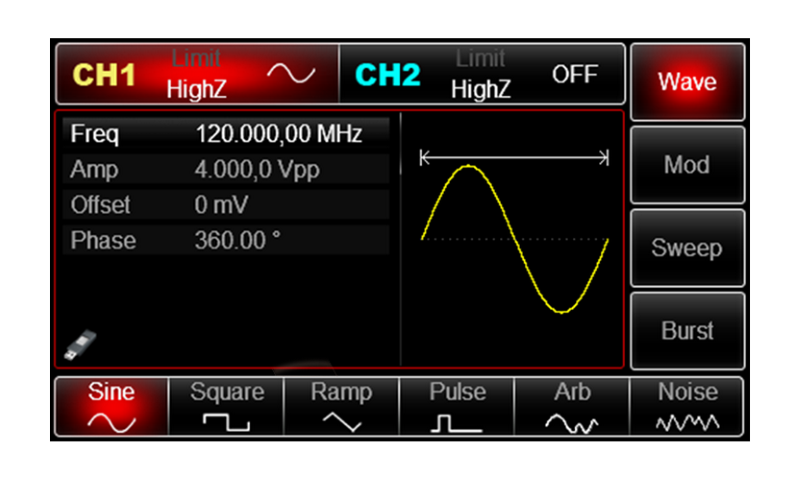
The UTG2062B produces nine waveform shapes at up to 60 MHz top-end on both channels: sine, square, ramp, pulse, harmonic, noise, DC, expression-defined, and arbitrary. Square and pulse output extend to 25 MHz with adjustable rise / fall time (typical 13 ns at 1 Vpp, 50 Ω) and pulse-wave jitter below 150 ps. Output amplitude is 1 mVpp to 10 Vpp into 50 Ω (2 mVpp to 20 Vpp into high-Z) across the full output range.
Expression Output
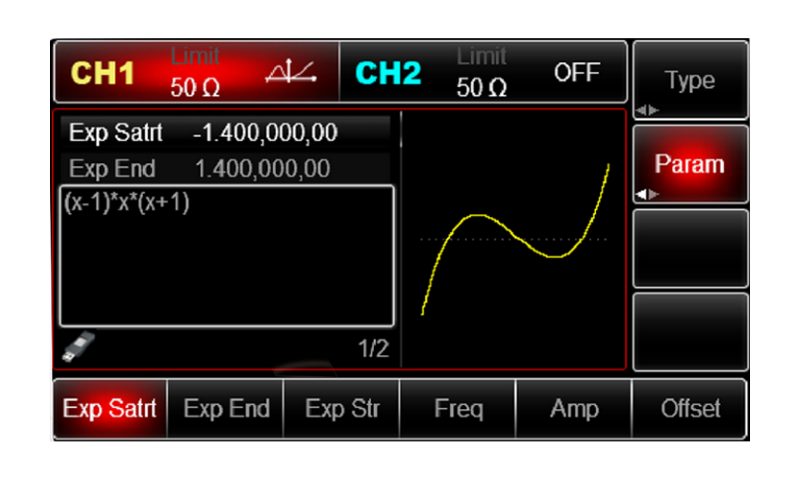
Eighteen function types — trigonometric, exponential, logarithmic, polynomial, absolute-value, and others — can be combined in column-method expressions to define the output waveform directly, without precomputing a sample buffer. The expression engine renders the result at the generator's full sample-rate / vertical-resolution capability. Useful for academic and research work where the waveform definition is the experimental variable.
13 Modulation Types
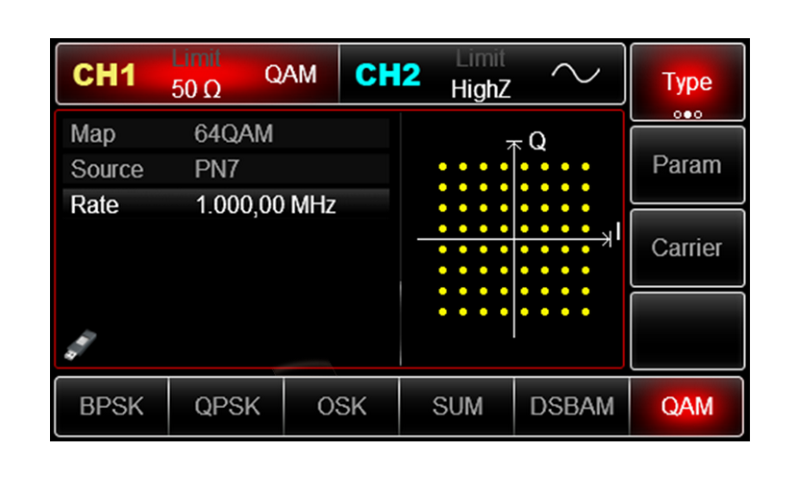
AM, FM, PM, ASK, FSK, PSK, BPSK, QPSK, OSK, SUM, DSB-AM, QAM, and PWM with internal or external source. The full PSK / BPSK / QPSK / OSK set supports communications-class digital-modulation stimulus; SUM and DSB-AM extend into analog double-sideband work; QAM adds quadrature amplitude modulation across configurable constellation depths. Modulating source is internal (sine, square, ramp, noise, arbitrary) or external via the analog modulation input.
160 Built-in Arbitrary Waveforms
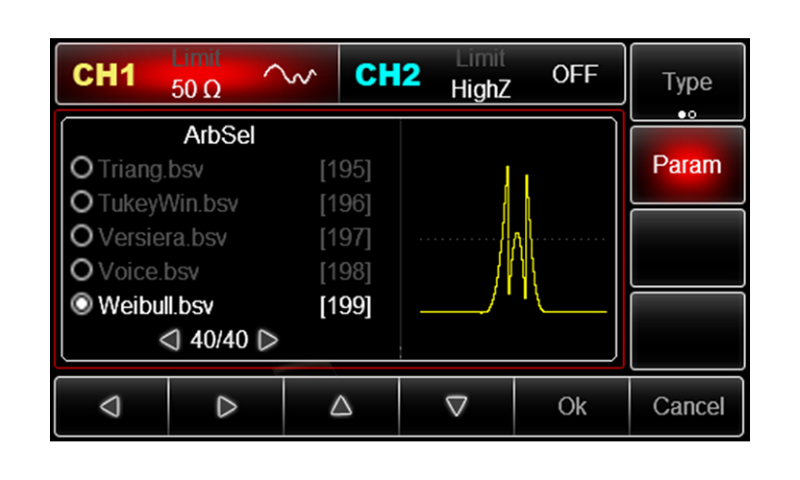
The waveform library covers standard measurement shapes (Sinc, Gaussian, Lorentz, exponential rise / fall, etc.), communications stimulus (PRBS, multi-tone, ramp-modulated), automotive electrical waveforms (ignition, AC ripple, motor-back-EMF), and physiological signals (cardiac, respiratory). Up to 16 Mpts arbitrary-waveform memory per channel supports long-form custom stimulus uploaded via USB-Host or PC software.
Channel Combination & Coupling
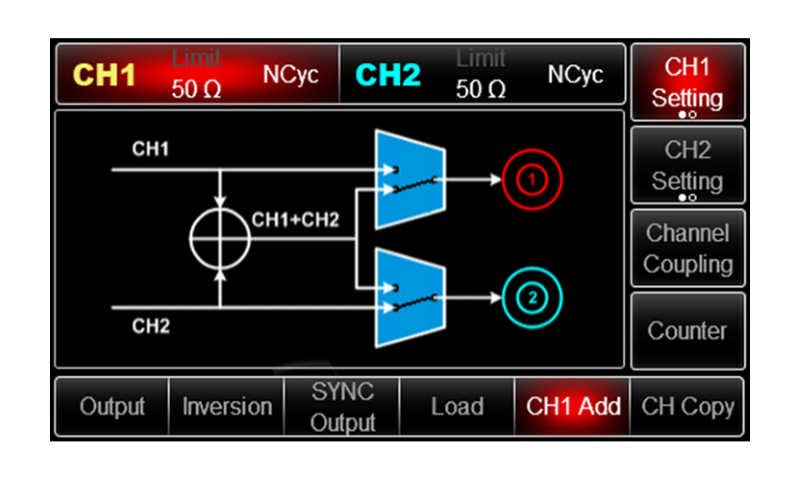
The UTG2062B provides two channel-pairing modes. Channel combination sums the two-channel outputs into a single output port for dual-tone, multi-frequency, or noise-plus-signal stimulus. Channel coupling ties the channels parametrically — when frequency, amplitude, or phase is changed on one channel, the other auto-adjusts by the configured offset or ratio. Useful for differential signal generation and tracked sweep across a defined relationship.
Frequency Sweep & 16th-Order Harmonic Output
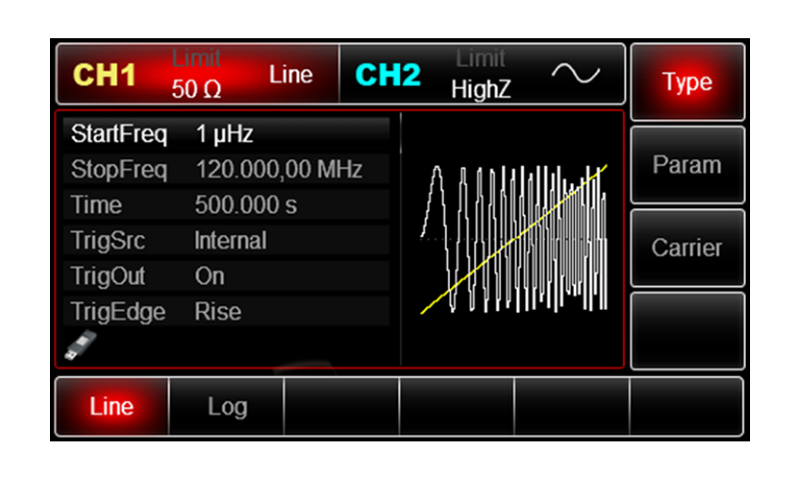
Linear and logarithmic frequency sweep modes cover the full 60 MHz output range with sweep time from 1 ms to 500 s. Internal, external, or manual trigger source. The built-in 16th-order harmonic generator synthesizes the fundamental plus harmonics 2 through 16 with adjustable amplitude and phase per order — useful for power-system harmonic stimulus, filter characterization, and academic harmonic-distortion teaching without an external mixer or summing amplifier.
Applications
The Advanced-Series envelope — 16 Mpts memory, LAN connectivity, 10 MHz reference In / Out, 13 modulation types, channel coupling — positions the UTG2000B family for benchtop work where the entry-tier doesn't reach but the elite-tier is over-specified.
- Communications-stimulus development — BPSK, QPSK, OSK, QAM digital modulation; SUM and DSB-AM analog modulation. ASK / FSK / PSK with configurable hop rate and depth.
- Long-form arbitrary playback — 16 Mpts memory holds extended protocol streams, sensor-emulation traces, and physiological waveforms that overflow a 4 kpts buffer.
- Power-system harmonic testing — 16th-order harmonic generator drives filter, transformer, and meter harmonic-distortion characterization without external mixing.
- Differential signal generation — channel coupling produces phase-tracked, amplitude-tracked, or frequency-tracked output pairs for differential-circuit stimulus.
- Automated test (ATE) — LAN-based SCPI control with 10 MHz reference clock In and Out for synchronized multi-instrument benches.
- Academic and research — expression-defined waveform output supports experimental designs where the waveform mathematics is the experimental variable.
In the Box
- UTG2062B waveform generator
- Power cord (region-appropriate)
- USB 2.0 cable, 1.5 m (USB-A to USB-B)
- BNC-to-BNC cable
- BNC-to-alligator-clip lead (red and black)
- Factory calibration certificate
Accessories and Family Options
Included with Every Unit
- Power cord conforming to destination country standard
- USB cable (UT-D14)
- BNC-BNC cable (UT-L45)
- BNC-to-alligator clip cable (UT-L02)
Family Members
The UTG2000B Advanced-Series consists of three SKUs sharing the same chassis, sample rate, modulation set, burst modes, and 16-bit DAC:
- UTG2062B — 60 MHz sine / 25 MHz square (this product)
- UTG2082B — 80 MHz sine / 25 MHz square
- UTG2122B — 120 MHz sine / 30 MHz square
Frequently Asked Questions
What waveform shapes are available, and how does the expression-output feature work?
Nine standard shapes: sine, square, ramp, pulse, harmonic, noise, DC, expression-defined, and arbitrary. Expression output describes the waveform mathematically — the user enters a function definition combining sine, exponential, logarithmic, polynomial, and other operations across 18 function types, and the UTG2062B renders the result at the full sample-rate / DAC resolution without a precomputed buffer. Useful when the waveform shape is the experimental variable rather than a fixed library entry.
How does channel combination differ from channel coupling?
Channel combination sums the two-channel outputs into a single output port — useful for dual-tone, multi-frequency, or signal-plus-noise stimulus generated within a single waveform generator. Channel coupling ties the channels parametrically: when frequency, amplitude, or phase changes on one channel, the other auto-adjusts by the configured offset or ratio. Coupling preserves two independent output ports but synchronizes their parameters.
What is the harmonic generator and when would I use it?
The harmonic generator synthesizes the fundamental output plus harmonics 2 through 16 (16th-order) with adjustable amplitude and phase per order. The output is a single composite waveform with the configured harmonic content — no external mixer or summing amplifier is needed. Common applications include power-system harmonic-distortion stimulus, filter characterization, and academic teaching of harmonic synthesis. The UTG2062B generates the fundamental anywhere within the 60 MHz output range, with harmonic content capped by the sample-rate and output-bandwidth limits.
Can the UTG2000B series work in a multi-instrument synchronized bench?
Yes. The 10 MHz reference clock input accepts an external timebase from an oscilloscope, signal generator, or atomic clock; the 10 MHz reference clock output supplies the same to downstream instruments. LAN control via SCPI plus external trigger and modulation inputs round out the ATE integration story. All three SKUs in the series support the same connectivity envelope.
How much arbitrary-waveform memory does the UTG2000B have, and how is it loaded?
16 Mpts per channel of arbitrary waveform memory. Custom waveforms are created in the upper-computer software (drawing tool, mathematical expression, or imported sample file) and uploaded to the instrument via LAN, USB-Device, or USB-Host. USB-Host accepts standard USB thumb drives directly — waveforms exported from the upper computer can be loaded into the instrument without a PC connection. 160 built-in waveforms cover the common measurement, communications, automotive, and physiological signal families.
60 MHz top-end sine and 25 MHz square / pulse output across nine waveform shapes
×
18 function types describe the output waveform mathematically — no precomputed sample buffer required
×
AM, FM, PM, ASK, FSK, PSK, BPSK, QPSK, OSK, SUM, DSB-AM, QAM, PWM — internal or external source
×
160 waveform library covering measurement, communications, automotive, and physiological signal families
×
Channel combination sums outputs; channel coupling tracks frequency / amplitude / phase parametrically
×
Linear and logarithmic sweep across 60 MHz plus 16th-order harmonic synthesis
Warranty
This instrument is backed by UNI-T's 3+2 Year Warranty — 3 years of standard coverage, plus 2 additional years free when you register your product. That's 5 years of total protection at no extra cost.
The warranty covers manufacturing defects and component failures under normal use conditions. UNI-T instruments are built for professional daily use, and our warranty reflects that commitment to long-term reliability.
Product Status: Discontinued Replaced By: UTG2062X 60 MHz 2Ch Advanced-Series Arbitrary Waveform Generator
| Frequency | 60MHz |
|---|---|
| Sample Rate | 320MSa/s |
| Channels | 2Ch |
| Memory Depth | 16Mpts |
| Instrument Type | Waveform Generator |
Features
- Frequency Counter
- Channel Coupling
Full specifications (23)
| Details | |
|---|---|
| Standard Waveforms | Sine|Square|Ramp|Burst|Noise|DC|Arbitrary|Harmonic|Expression |
| Built-in Arbitrary Waveforms | 160 |
| Arb Memory Depth | 16Mpts |
| Vertical Resolution | 16 bits |
| Square / Pulse Frequency | 25MHz |
| Modulation Types | AM|FM|PM|ASK|FSK|PSK|BPSK|QPSK|OSK|SUM|DSB-AM|QAM|PWM |
| Sweep Type | Linear|Logarithm |
| Output Impedance | 50Ω / High-Z |
| Harmonic Distortion | <0.2% |
| Frequency Counter Range | 100mHz - 200MHz |
| Rise Time | <4ns |
| Features | |
| Frequency Counter Bits | 6-digit |
| Waveform Jitter | 150ps |
| Frequency Range | 1μHz - 60MHz |
| Frequency Resolution | 1μHz |
| Pulse Train | N cycle|Gate|Infinite |
| General Information | |
| Display Size | 4.3in |
| Display Type | TFT LCD |
| Interface | LAN|USB-Device|USB-Host|10MHz In/Out|Trigger|Mod In |
| Dimensions (W×H×D) | 305 × 230 × 93 mm |
| Weight | 3.1 kg |
| Warranty | 3+2 years |
| Certifications | CE|cETLus |
Data Sheets and Manuals
Check your instrument’s hardware revision before updating firmware — different hardware revisions take different builds.
Authentic UNI-T accessories are an affordable way to extend the functionality of your instrument.
