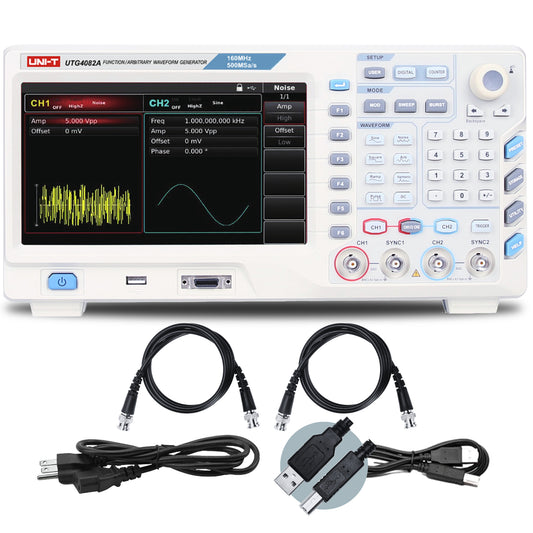
UNI-T UTG4082A 80 MHz 2-Channel Performance-Series Arbitrary Waveform Generator: 16-Bit DDS with 8-Inch Display
Overview
The UNI-T UTG4082A is a 2-channel arbitrary waveform generator with a maximum sine output of 80 MHz, built on Direct Digital Synthesis with a 500 MSa/s sample rate and 16-bit vertical resolution. An 8 pts to 32 Mpts arbitrary-waveform memory with 7 GB of non-volatile storage supports long-form custom stimulus, and an 8-inch TFT display with a structured key-and-knob interface keeps parameter entry direct.
30 MHz square / pulse output, 1 µHz frequency resolution across the full 80 MHz range, and a built-in 100 mHz to 800 MHz hardware frequency counter. Twelve analog and digital modulation types — AM, FM, PM, ASK, FSK, PSK, BPSK, QPSK, OSK, PWM, SUM, QAM. Linear and logarithmic sweep. Three burst modes (N-cycle, gated, infinite). Customizable harmonic generation. 160 built-in arbitrary waveforms with SPI / I²C / UART digital-protocol output.
Choosing Your Model — UTG4000A Performance-Series
Four 2-channel models share one chassis, the same 500 MSa/s sample rate, 16-bit DDS engine, 32 Mpts arbitrary memory, full 12-type modulation set, and the same interface and 8-inch display. They differ in one axis only: maximum output frequency.
| UTG4082A | 80 MHz sine / 30 MHz square & pulse — general-purpose stimulus for embedded, instrumentation, and teaching-lab work. |
| UTG4122A | 120 MHz sine / 40 MHz square & pulse — added headroom for higher-frequency stimulus and modulation carriers. |
| UTG4162A | 160 MHz sine / 50 MHz square & pulse — wider output range for RF-adjacent and faster digital work. |
| UTG4202A | 200 MHz sine / 60 MHz square & pulse — the widest output envelope in the series. |
This page describes the UTG4082A. Channel architecture, modulation, sweep, burst, harmonic generation, interfaces, and the arbitrary engine below apply to all four models; the Specifications table lists this model's frequency figures.
Key Features
- 80 MHz sine / 30 MHz square & pulse — 2-channel output with 1 µHz frequency resolution.
- Standard dual channels — independent or channel-coupling mode for phase-locked, dual-tone, and tracking signal pairs.
- 500 MSa/s sample rate, 16-bit DDS — stable, precise, low-distortion signal generation across all standard waveforms.
- 32 Mpts arbitrary memory, 7 GB storage — deep custom-waveform depth with a large non-volatile on-instrument library.
- 12 modulation types — AM, FM, PM, ASK, FSK, PSK, BPSK, QPSK, OSK, PWM, SUM, QAM — analog and digital in one instrument.
- Linear and logarithmic sweep — with internal, external, and manual trigger sources.
- Three burst modes — N-cycle, gated, infinite, with configurable cycle count and start phase.
- Customizable harmonic generation — user-defined order, amplitude, and phase per harmonic.
- Built-in 800 MHz frequency counter — 100 mHz to 800 MHz, combined source-and-measure on one bench instrument.
- 8-inch TFT display — WVGA 800 × 480 with structured key-and-knob navigation.
- USB Host/Device, LAN — with 10 MHz reference in/out and external trigger; SPI / I²C / UART digital-protocol output.
- 3+2 year warranty (5 years with registration).
UNI-T UTG4082A Details
Standard Dual Channels with Channel Coupling
Two independent channels operate stand-alone or in channel-coupling mode, where a parameter change on one channel is mirrored on the other by a defined frequency, amplitude, or phase relationship. This produces phase-locked pairs, dual-tone stimulus, and tracking signals from a single instrument without external synchronization.
32 Mpts Arbitrary Waveform Depth, 7 GB Non-Volatile Storage
Direct Digital Synthesis drives an 8 pts to 32 Mpts arbitrary-waveform memory at 16-bit vertical resolution, holding long-form custom stimulus, sensor-emulation traces, and complex composite waveforms. 7 GB of non-volatile storage retains a deep library of saved arbitrary waveforms on the instrument, with 160 standard waveforms built in.
Twelve Modulation Types in One Instrument
Twelve analog and digital modulation schemes are built in: AM, FM, PM, ASK, FSK, PSK, BPSK, QPSK, OSK, PWM, SUM, and QAM. Internal or external modulation sources with configurable depth and rate cover communications-stimulus development, receiver characterization, and mixed-signal test from a single channel.
Linear and Logarithmic Frequency Sweep
Linear and logarithmic frequency sweep with internal, external, and manual trigger sources supports frequency-response characterization, filter and amplifier testing, and resonance searching. Start, stop, and sweep-time parameters are independently configurable.
Burst Generation — N-Cycle, Gated, and Infinite
Burst output in N-cycle, gated, and infinite modes produces precisely counted tone bursts and gated stimulus for transient testing, trigger-chain validation, and timing characterization. Cycle count, start phase, and trigger source are user-configurable.
Customizable Harmonic Generation
Dedicated harmonic generation outputs user-defined harmonic content with independently adjustable order, amplitude, and phase per harmonic. This supports power-quality emulation, harmonic-distortion testing, and controlled spectral-content stimulus without building the waveform point-by-point.
Built-In 800 MHz Frequency Counter
An integrated hardware frequency counter measures 100 mHz to 800 MHz, turning the instrument into a combined source-and-measure tool for closed-loop frequency checks, reference verification, and quick bench measurements without a separate counter.
Adjustable Noise and Low-Distortion DDS Output
Direct Digital Synthesis delivers stable, precise, low-distortion signals across all standard waveforms. Adjustable noise output supports signal-plus-noise testing, SNR characterization, and noise-immunity validation of receivers and conditioning circuits.
Applications
The Performance-Series envelope — dual independent channels, 500 MSa/s DDS, 32 Mpts arbitrary memory, 12-type modulation, sweep, burst, and harmonic generation — covers benchtop signal generation from near-DC through the instrument's maximum output frequency.
- Embedded and mixed-signal development — dual-channel clock, data, and stimulus generation with channel coupling for phase-locked pairs.
- Communications-stimulus work — ASK, FSK, PSK, BPSK, QPSK, OSK, QAM digital modulation; AM, FM, PM, DSB analog modulation with configurable rate and depth.
- Frequency-response characterization — linear and logarithmic sweep for filter, amplifier, and resonance testing.
- Transient and timing test — N-cycle and gated burst for trigger-chain validation and counted-tone stimulus.
- Power-quality and harmonic emulation — customizable harmonic generation with per-harmonic order, amplitude, and phase.
- Long-form arbitrary playback — 32 Mpts depth with 7 GB storage for sensor-emulation traces and extended composite waveforms.
- Teaching and instrumentation labs — combined source and 800 MHz counter on one 8-inch-display instrument.
Specifications
| Max sine frequency | 80 MHz |
| Max square / pulse frequency | 30 MHz |
| Max ramp frequency | 2 MHz |
| Max harmonic frequency | 40 MHz |
| Arbitrary frequency range | 1 µHz to 20 MHz |
| Frequency resolution | 1 µHz |
| Channels | 2, independent with channel-coupling output mode |
| Sample rate | 500 MSa/s |
| Vertical resolution | 16 bits |
| Arbitrary memory depth | 8 pts to 32 Mpts |
| Arbitrary storage | 7 GB non-volatile arbitrary-waveform storage |
| Built-in arbitrary waveforms | 160 built-in arbitrary waveforms |
| Standard waveforms | Sine, Square, Ramp, Harmonic, Pulse, Noise, DC, Arbitrary |
| Modulation types | 12 — AM, FM, PM, ASK, FSK, PSK, BPSK, QPSK, OSK, PWM, SUM, QAM |
| Sweep modes | Linear, Logarithmic |
| Burst modes | N-cycle, Gate, Infinite |
| Digital-protocol output | SPI, I²C, UART |
| Frequency counter | 100 mHz to 800 MHz hardware frequency counter, 7-bit |
| Output amplitude (50 Ω) | 1 mVpp to 10 Vpp (50 Ω) |
| Output amplitude (high-Z) | 2 mVpp to 20 Vpp (high-Z) |
| Output impedance | 50 Ω |
| Harmonic distortion | < 0.2% |
| Min rise/fall time | < 7 ns (Typ., 1 Vpp) |
| Jitter | 1 ns + 100 ppm |
| Display | 8-inch TFT LCD, WVGA 800 × 480 |
| Touch screen | No (key/knob navigation) |
| Interface | USB Host, USB Device, LAN, 10 MHz input, 10 MHz output, frequency counter input, FSK trigger input, external modulation input |
| Power supply | 100–240 VAC, 50/60 Hz |
| Dimensions | 336 mm × 164 mm × 108 mm (W × H × D) |
| Weight | 3.5 kg |
| Warranty | 3+2 years (5 years with registration); accessories 1 year |
Accessories and Family Options
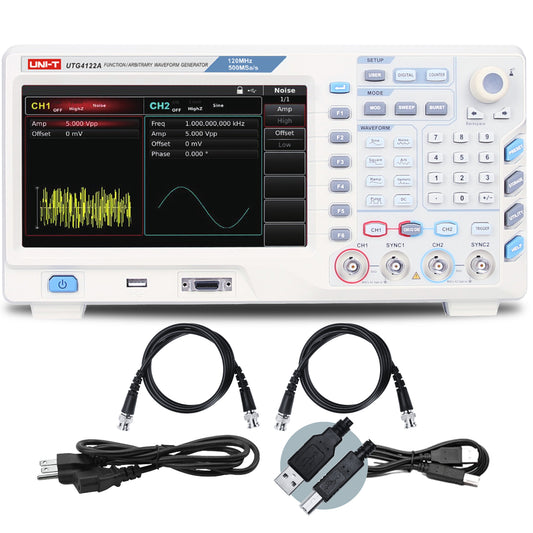
Included with Every Unit
- Power cord conforming to destination country standard
- USB interface cable (UT-D14)
- BNC cable pair (1 m)
Optional Accessories
- UT-U02 — digital interface cable for the optional special digital interface.
Family Members
The UTG4000A Performance-Series consists of four 2-channel SKUs sharing the same chassis, sample rate, DDS engine, modulation set, and arbitrary-waveform memory depth:
- UTG4082A — 80 MHz sine / 30 MHz square (this product)
- UTG4122A — 120 MHz sine / 40 MHz square
- UTG4162A — 160 MHz sine / 50 MHz square
- UTG4202A — 200 MHz sine / 60 MHz square
Frequently Asked Questions
How do the four UTG4000A models differ?
All four are the same 2-channel instrument with the same 500 MSa/s sample rate, 16-bit DDS engine, 32 Mpts memory, 12-type modulation set, sweep, burst, harmonic generation, interfaces, and 8-inch display. They differ only in maximum output frequency: 80 MHz (UTG4082A), 120 MHz (UTG4122A), 160 MHz (UTG4162A), and 200 MHz (UTG4202A) sine, with correspondingly scaled square/pulse, ramp, and harmonic ranges. Choose by the highest output frequency your work requires.
Can both channels run independently at full performance?
Yes. The two channels are independent and can output different waveforms, frequencies, and amplitudes simultaneously, or be linked in channel-coupling mode where one channel tracks the other by a defined frequency, amplitude, or phase relationship.
What is channel coupling used for?
Channel coupling locks the two outputs by a configurable ratio or offset in frequency, amplitude, or phase — useful for generating phase-locked signal pairs, dual-tone stimulus, and tracking reference signals without external synchronization hardware.
What modulation, sweep, and burst does it cover?
Modulation: 12 types — AM, FM, PM, ASK, FSK, PSK, BPSK, QPSK, OSK, PWM, SUM, QAM. Sweep: linear and logarithmic with internal, external, and manual triggers. Burst: N-cycle, gated, and infinite.
Does it have a built-in frequency counter?
Yes — an integrated hardware frequency counter measuring 100 mHz to 800 MHz, making the instrument a combined source-and-measure tool for closed-loop frequency checks and quick bench measurements.
What is the warranty?
Bench instruments carry a 3+2 year warranty — three years standard, extended to five years with product registration. Probes and accessories carry a one-year warranty.
Standard dual channels with frequency, amplitude, and phase coupling
×
Deep arbitrary-waveform memory with 7 GB non-volatile storage
×
Twelve modulation types — analog and digital — in one instrument
×
Linear and logarithmic frequency sweep for response characterization
×
Burst generation in N-cycle, gated, and infinite modes
×
Customizable harmonic generation with per-harmonic control
×
Built-in hardware frequency counter, 100 mHz to 800 MHz
×
Adjustable noise output and low-distortion DDS signal generation
Data Sheets and Manuals
Software / Firmware Downloads
Authentic UNI-T accessories are an affordable way to extend the functionality of your instrument.