Skip to product information
1 of 4

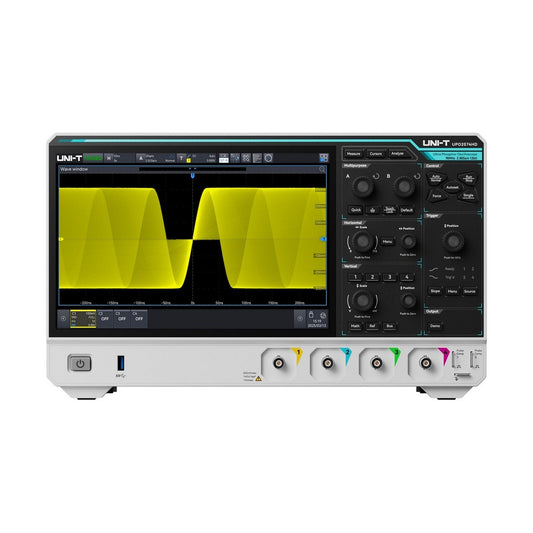
UPO2074HD | 70 MHz 4Ch 12-Bit High-Resolution Oscilloscope

UPO2074HD | 70 MHz 4Ch 12-Bit High-Resolution Oscilloscope

Regular price $949.00
Regular price Sale price $949.00
Sale Contact Us For Lead Time
Shipping calculated at checkout.

59 in stock

Quantity

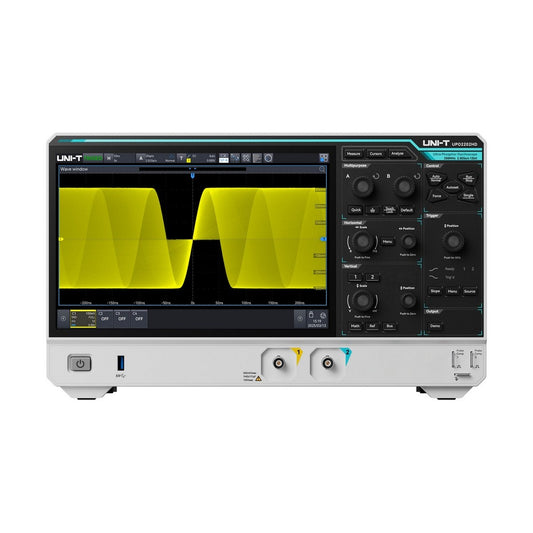
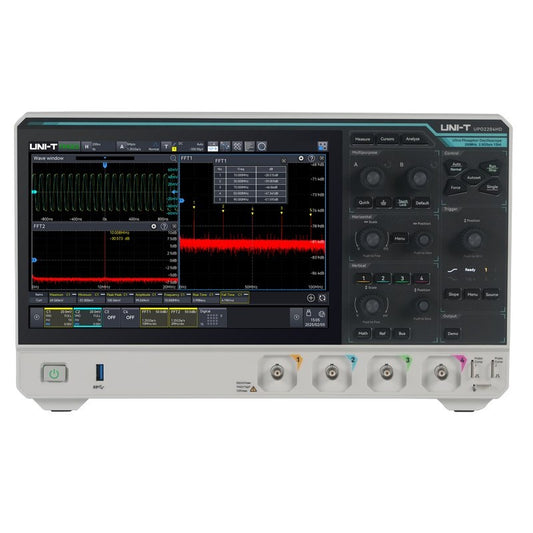
12-bit 70 MHz 4-channel mixed signal oscilloscope with 2.5 GSa/s sample rate, 100 Mpts memory depth. Nine-in-one instrument suited for production, field service, and embedded developers.

View full details

UNI-T UPO2074HD | 70 MHz 4-Channel 12-Bit High-Resolution Oscilloscope

Overview

The UNI-T UPO2074HD is a 70 MHz 4-channel 12-bit high-resolution oscilloscope built around the R12™ native 12-bit ADC. It samples at 2.5 GSa/s with 100 Mpts memory depth standard, and Ultra Phosphor 3.0 acquisition pushes the waveform capture rate to 1,000,000 wfms/s in sequence mode — sixteen times the vertical detail of an 8-bit scope, held at full bandwidth without ERES averaging or sample-rate trade-offs. The 10.1-inch capacitive multi-touch display, on-instrument 4 Mpts FFT, 9 standard protocol decoders, and built-in WebServer round out a six-instrument bench in a single chassis.

The four-channel UPO2074HD adds simultaneous multi-rail observation to the entry-tier 12-bit price point — two analog rails plus a clock plus a control signal, all on screen at once, without compromising the 100 Mpts per-channel memory depth. For curriculum labs where one instrument has to cover everything from intro analog through embedded systems, this is the lift. Backed by the 3+2 warranty.

Key Features

  • R12™ 12-bit native ADC — 4,096 vertical levels held at the full 70 MHz bandwidth. No ERES averaging, no sample-rate trade-off.
  • 70 MHz bandwidth, 4 analog channels — 2.5 GSa/s real-time sample rate, 100 Mpts standard memory depth. Value-tier 12-bit fidelity at a price point typically held by 8-bit instruments.
  • Ultra Phosphor 3.0 — 1,000,000 wfms/s — Sequence-mode capture rate with 256-level grayscale persistence; surfaces intermittent and rare events.
  • 6 instruments in one — Oscilloscope, spectrum analyzer, digital voltmeter, hardware frequency meter, protocol analyzer, and optional power analysis on a single chassis.
  • 9 protocol decoders standard — RS-232/UART, I²C, SPI, CAN, CAN-FD, LIN, FlexRay, SENT, and Audio. No license fees, no time-boxed unlocks.
  • 10.1-inch capacitive touchscreen — 1280×800 multi-touch with pinch, drag, zoom, and rectangle-draw gestures. Mouse and keyboard supported in parallel.
  • 4 Mpts enhanced FFT, 56 automated measurements, hardware mask test, zone trigger, ERES up to 4-bit — standard.
  • 3+2 warranty — five-year coverage when registered, longer than the typical bench-instrument warranty.

Detailed Features

R12™ — Native 12-Bit ADC at Full Bandwidth

R12™ is UNI-T's native 12-bit ADC architecture. It samples at 4,096 quantization levels — sixteen times the vertical detail of a conventional 8-bit oscilloscope — and holds that resolution at the full 70 MHz bandwidth and 2.5 GSa/s sample rate. There is no ERES averaging step, no sample-rate trade, and no asterisk on the spec sheet. For embedded prototyping and curriculum labs at the value tier, this is what makes the UPO2074HD a credible benchtop oscilloscope rather than an 8-bit hobby instrument with 12 bits printed on the front panel.

12-bit resolution
4,096-level quantization holds at full bandwidth
× 12-bit resolution 4,096-level quantization holds at full bandwidth

Ultra Phosphor 3.0 — 1,000,000 wfms/s Acquisition

Ultra Phosphor 3.0 is UNI-T's third-generation acquisition engine. Eight-channel parallel graphics processing at up to 20 Gbps drives a continuous capture rate of 250,000 wfms/s, with sequence mode pushing the rate to 1,000,000 wfms/s for trigger-conditioned events. 256-level grayscale persistence makes intermittent runts, glitches, and jitter visible as density gradients on screen rather than as occasional flashes that the eye misses. The same engine drives the digital trigger system — high sensitivity, low jitter, and zone trigger for isolating non-repeating signals.

Ultra Phosphor 3.0 acquisition
High-speed rendering surfaces fast or infrequent anomalies
× Ultra Phosphor 3.0 acquisition High-speed rendering surfaces fast or infrequent anomalies

6 Instruments in One

The UPO2074HD integrates six instrument functions into a single chassis: high-resolution oscilloscope, FFT spectrum analyzer with 4 Mpts and waterfall display, 4-digit digital voltmeter with DC/AC RMS modes, 7-digit hardware frequency meter, 9-protocol decoder and trigger engine, and the optional 12-parameter power analysis suite. With four analog channels feeding all of them, multi-rail converter validation and multi-bus protocol correlation happen on the same instrument without the cabling and context-switching of separate boxes.

Six instruments in one chassis
Six instrument functions on a single bench chassis
× Six instruments in one chassis Six instrument functions on a single bench chassis

Deep Memory — 100 Mpts Standard

100 Mpts of memory comes standard, not as an upgrade. At 2.5 GSa/s that captures 40 ms of full-rate signal in a single acquisition — long enough to record a complete soft-start sequence, a fault-recovery transient, or a multi-frame burst without re-arming. Combined with hardware-accelerated mask testing, the 4-bit ERES enhanced-resolution mode, and uninterrupted recording of up to 125,000 frames, the deep memory turns long-running events from a sampling problem into a navigation problem.

Deep memory navigation
Zoom across long sequences without losing detail
× Deep memory navigation Zoom across long sequences without losing detail

All Protocols Included Standard

Nine serial-bus protocol decoders are included with every UPO2074HD: RS-232/UART, I²C, SPI, CAN, CAN-FD, LIN, FlexRay, SENT, and Audio. Each protocol supports both triggering and decoding, with event-list and search functions for navigating long captures. Decoded data appears alongside the analog waveform on the same trace — correlate a misbehaving I²C transaction with the supply-rail glitch that caused it, or align CAN-FD frames with the gate-drive event that triggered the fault recovery. No license fees, no time-boxed unlocks — the protocols are standard.

Standard protocol decoding
Nine serial-bus protocols decoded alongside the analog trace
× Standard protocol decoding Nine serial-bus protocols decoded alongside the analog trace

Power Analysis — Optional 12-Parameter Suite

The optional power-analysis package adds 12 measurement and analysis functions to the UPO2074HD: power quality, harmonic analysis, current harmonics, RDS(on), switching loss, slew rate, safe operating area, modulation analysis, output ripple, startup/shutdown time, transient response, and power efficiency. For value-tier labs and curriculum work introducing students to switching-converter behavior, the analysis runs on the same instrument students already learned to use for time-domain debug.

Power analysis suite
Power quality, switching loss, ripple, and SOA on the same instrument
× Power analysis suite Power quality, switching loss, ripple, and SOA on the same instrument

Built-In Spectrum Analyzer — FFT to 4 Mpts

Standard enhanced FFT analysis runs at up to 4 Mpts across all channels with a frequency range from 0 to 1.25 GHz, four traces, four detection modes, and a waterfall display for tracking spectrum changes over time. Auto, manual, and threshold marker modes locate harmonics, spurs, and EMI sources without switching to a separate spectrum analyzer. For pre-compliance spot checks during board bring-up and switching-noise investigation during converter design, the on-instrument FFT closes a common bench-workflow gap.

Built-in FFT spectrum analyzer
FFT with waterfall and four traces at up to 4 Mpts
× Built-in FFT spectrum analyzer FFT with waterfall and four traces at up to 4 Mpts

56 Automated Measurements with Statistics

56 parameter measurements run continuously on every channel, with up to 27 measurements visible on screen and 39 single-channel parameters in the snapshot view. Statistics, histograms, and trend charts visualize each parameter's distribution over time. The new amplitude calculation strategy with top/bottom and burst-parameter handling makes the numbers correct on signals where naive measurement engines pick the wrong reference levels. No post-processing, no spreadsheet export — the answer is on the screen.

56 automated measurements
Measure, visualize, and track parameter distributions on screen
× 56 automated measurements Measure, visualize, and track parameter distributions on screen

10.1-Inch Touch UI and Full Connectivity

The 10.1-inch 1280×800 capacitive multi-touch display supports pinch, drag, zoom, rectangle-draw, and edit gestures alongside the traditional knobs and one-touch front-panel keys. Mouse and keyboard are supported in parallel. The peripheral set includes USB Host, USB Device, LAN, EXT Trig, AUX Out (Trig Out / Pass-Fail), and HDMI for projector or external-monitor display. SCPI is standard, the built-in WebServer enables browser-based remote control from a PC or mobile device, and firmware updates are free over the product's lifetime. For curriculum stations and shared lab benches, the WebServer lets an instructor mirror student displays to a central monitor via LAN without installing software on each station.

Touch UI and connectivity
Multi-touch gestures with full connectivity and WebServer access
× Touch UI and connectivity Multi-touch gestures with full connectivity and WebServer access

Detailed Specifications

Parameter Specification
Bandwidth 70 MHz
Channels 4 Analog
Sample Rate 2.5 GSa/s
Vertical Resolution 12 bits (R12™ native)
Memory Depth 100 Mpts
Capture Rate 1,000,000 wfms/s (sequence mode)
Display 10.1-inch capacitive touchscreen, 1280×800
Touch Screen Yes
Trigger Modes Edge, pulse width, video, ramp, runt, over-amplitude, delay, timeout, duration, setup/hold, Nth edge, code pattern
Zone Trigger Yes — 2 zones, must-intersect / must-not-intersect
Protocol Decoding (Standard) RS-232/UART, I²C, SPI, CAN, CAN-FD, LIN, FlexRay, SENT, Audio
Built-In FFT Yes — up to 4 Mpts, 0 to 1.25 GHz, 4 traces, waterfall
Built-In Power Analysis Optional — 12 parameters
Built-In Spectrum Analyzer Yes (standard FFT)
Digital Voltmeter 4-digit; DC, AC RMS, AC+DC RMS
Frequency Meter 7-digit hardware
Automated Measurements 56 with statistics, histogram, and trend
ERES (Enhanced Resolution) Up to 4-bit
Mask Testing Hardware-accelerated
Waveform Recording Up to 125,000 frames; USB export
Interface USB Host / USB Device / LAN / EXT Trig / AUX Out / HDMI
Remote Control SCPI standard; built-in WebServer (browser access)
Warranty 3+2 years
RoHS Compliant Yes
Certifications CE, cETLus

Applications

ICP-4 — R&D Engineer (Embedded / Hardware / Analog Design)

  • Embedded Prototyping — MCU-board bring-up, sensor-interface debug, and low-power IoT analog-rail validation at value-tier price. The 12-bit ADC reveals sensor detail that flattens into 8-bit quantization noise.
  • Mixed-Signal Debug — Time-correlated analog and protocol-decode views in the same trace; 9 protocols included standard.
  • Signal-Integrity Spot Checks — On-instrument 4 Mpts FFT identifies harmonics, clock spurs, and EMI sources without switching to a separate spectrum analyzer.
  • Long-Capture Investigation — 100 Mpts memory plus 125,000-frame waveform recording captures complete soft-start, fault-recovery, and burst-mode events without re-arming.

ICP-6 — Education (Teaching Labs, Trade Schools, Community Colleges)

  • Multi-Topic Teaching Stations — Four-channel 12-bit configuration supports advanced curriculum modules — mixed-signal, multi-rail power, protocol-correlated debug — on the same station that runs the introductory time-domain labs.
  • Touchscreen UI Lowers Operator Barrier — Pinch and drag gestures are familiar from consumer devices; students focus on the measurement, not the menu structure.
  • HDMI Output for Classroom Display — Drive a projector or external monitor for waveform demonstration.
  • WebServer Browser Access — Instructor can mirror student stations to a central display via LAN; no software install on the student-side PC.

Accessories & In the Box

Included with the Instrument

  • UPO2074HD oscilloscope
  • 4 × passive probes (1:1 / 10:1 switchable, bandwidth matched to instrument)
  • USB cable (USB-A to USB-B)
  • Power cord (region-appropriate)
  • Quick-start guide
  • Factory calibration certificate

Recommended Accessories

  • UPO2000HD-PWR — optional 12-parameter power-analysis package activation
  • UT-P07A — 500 MHz passive probe for higher-bandwidth applications
  • UT-P20, UT-P21, UT-V23 — high-voltage passive probes
  • UT-P30, UT-P31, UT-P32, UT-P33 — differential probes for floating measurements
  • UT-P40, UT-P41, UT-P42, UT-P43, UT-P44 — current probes for power-stage and switching-loss measurement
  • UT-ISOT — isolation transformer for safe line-powered measurements
  • UT-M13X — oscilloscope demo board for protocol decoding practice and curriculum modules

Need different bandwidth or channel-count? Compare with family-mates: UPO2072HD, UPO2104HD, UPO2102HD.

Frequently Asked Questions

What protocols are included with the UPO2074HD?

RS-232/UART, I²C, SPI, CAN, CAN-FD, LIN, FlexRay, SENT, and Audio decoding are included standard at no additional cost. All nine supported protocols are available out of the box — no optional licenses required, no time-boxed unlocks.

What is the advantage of native 12-bit resolution?

A 12-bit ADC provides 4,096 vertical levels compared to 256 for an 8-bit scope — sixteen times greater detail. This reveals small signals riding on large ones, reduces quantization noise, and improves measurement accuracy on low-amplitude signals like power-supply ripple, sensor outputs, and precision analog circuits. R12™ holds the 12-bit resolution at the full bandwidth and sample rate, with no ERES averaging or sample-rate trade-off.

Can I add power-supply analysis?

Yes. The optional power-analysis package adds 12 measurements: power quality, harmonic analysis, current harmonics, RDS(on), switching loss, slew rate, safe operating area, modulation analysis, output ripple, startup/shutdown time, transient response, and power efficiency. The UPO2000HD-PWR activation unlocks the package on any UPO2000HD-series oscilloscope.

How does the touchscreen handle daily lab use?

The 10.1-inch capacitive multi-touch display supports pinch, drag, zoom, rectangle-draw, and edit gestures alongside the traditional knobs and one-touch front-panel keys. Mouse and keyboard are supported in parallel. For lab settings where students or engineers cycle through the instrument frequently, the gesture set is familiar from consumer devices; for production-style workflows where physical controls are preferred, the front panel still does what front panels do.

How does the UPO2074HD compare to 8-bit oscilloscopes at similar bandwidth?

The 12-bit ADC delivers 16× the vertical resolution of an 8-bit scope at the same bandwidth, with no ERES averaging or sample-rate trade-off. Low-amplitude signals — switching ripple, sensor outputs, precision analog circuits — that 8-bit scopes flatten into quantization noise show up clearly on the 12-bit display. For analog precision work and switching-converter validation, the resolution advantage is structural, not a marketing comparison.

Is the firmware field-upgradable?

Yes. Firmware updates are free over the product's lifetime and install via USB drive or LAN transfer. Optional license unlocks (such as the power-analysis package) have no expiration.

Can the instrument be controlled from a PC or from a browser?

Both. SCPI is supported standard via USB Device or LAN for automated test scripts and PC-side instrument-management software. The built-in WebServer enables direct browser-based control from a PC or mobile device on the same network — no PC-side software install required.

Part of the UPO2000HD oscilloscope series. All models share the R12™ native 12-bit ADC, 2.5 GSa/s sample rate, 100 Mpts memory, Ultra Phosphor 3.0 acquisition, and 9 standard protocol decoders. Bandwidth options span 70 / 100 / 200 MHz; channel options are 2-channel and 4-channel. See the series page to compare configurations.

Warranty

This instrument is backed by UNI-T's 3+2 Year Warranty — 3 years of standard coverage, plus 2 additional years free when you register your product. That's 5 years of total protection at no extra cost.

The warranty covers manufacturing defects and component failures under normal use conditions. UNI-T instruments are built for professional daily use, and our warranty reflects that commitment to long-term reliability.