



UNI-T UTG1022X-PA 20 MHz 2Ch Arbitrary Waveform Generator with 4 W Power Amplifier: Bench Function Generator with Built-In Power Output
Overview
The UNI-T UTG1022X-PA is a 20 MHz dual-channel arbitrary waveform generator built around a 16-bit DAC and 200 MSa/s sample rate, with a built-in 4 W power amplifier integrated into the chassis. The power amplifier output is a dedicated front-panel BNC that drives transducers, coils, audio loads, and other inputs directly — without the workspace impact, signal-chain complexity, or cost of a separate external power amplifier.
Generator specifications are identical to the standard UTG1022X: 7 modulation types (AM, FM, PM, ASK, FSK, PSK, PWM), linear and logarithmic sweep, three pulse-burst modes, 200 built-in arbitrary waveforms, a 7-digit frequency counter (100 mHz to 200 MHz), and USB-Device + USB-Host connectivity. The PA option is for engineers and educators who frequently drive low-impedance or current-hungry loads and want one instrument rather than two on the bench.
Key Features
- Built-in 4 W power amplifier — integrated into the chassis with dedicated front-panel BNC output. 1 µHz to 100 kHz frequency range, > 18 V/µs slew rate (typical). Drives transducers, coils, and audio loads directly without an external amp.
- 20 MHz sine / 10 MHz square & pulse — dual-channel generator output with 1 µHz frequency resolution, 20 Vpp maximum amplitude (high-Z).
- 16-bit vertical resolution — 65,536 amplitude levels. 4× the resolution of typical 14-bit Essential-tier generators.
- 200 MSa/s sample rate — 10 sample points per cycle at maximum sine frequency.
- 200 built-in arbitrary waveforms — comprehensive library; 4 kpts arbitrary waveform length for custom shapes.
- 7 modulation types — AM, FM, PM, ASK, FSK, PSK, PWM — internal and external source.
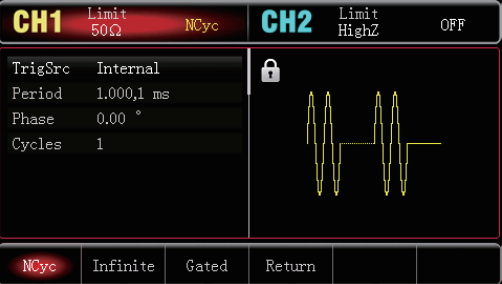
- Pulse burst function — three modes (N-cycle, gated, infinite) with internal or external trigger.
- Built-in 7-digit frequency counter — 100 mHz to 200 MHz input range.
- USB-Device and USB-Host — PC SCPI control plus direct thumb-drive arbitrary waveform upload.
UNI-T UTG1022X-PA Details
Built-In 4 W Power Amplifier
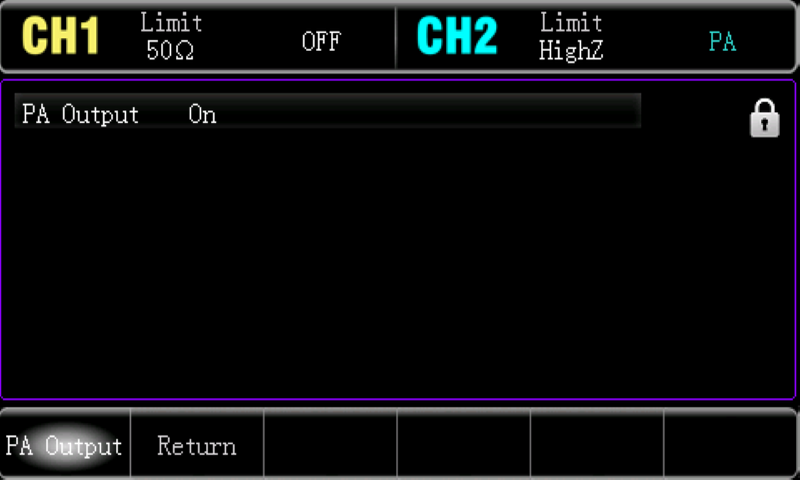
A 4 W power amplifier is integrated into the UTG1022X-PA chassis, with output on a dedicated front-panel BNC. Frequency range covers 1 µHz to 100 kHz, with typical slew rate > 18 V/µs. The PA accepts the standard generator output internally and amplifies it for direct drive of low-impedance or current-hungry loads — piezoelectric transducers, small audio loads, magnetic coils, vibration drivers, and similar inputs where the standard 50 Ω generator output's current capacity is insufficient. For applications that previously required generator-plus-amplifier as a two-instrument signal chain, the UTG1022X-PA collapses the bench footprint to a single unit.
16-Bit Vertical Resolution
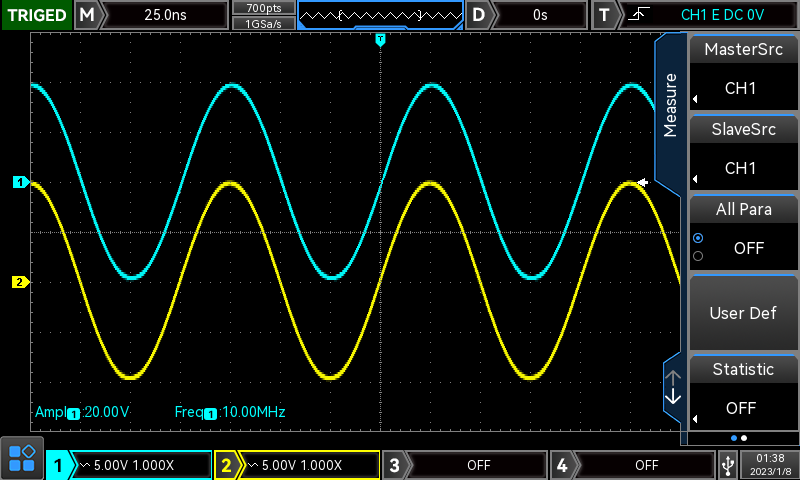
A 16-bit DAC provides 65,536 amplitude levels — 4× the resolution of typical 14-bit Essential-tier generators. This reduces quantization-noise floor and produces measurably cleaner output, particularly on low-amplitude signals. The PA output inherits the DAC's resolution and frequency precision for clean amplified stimulus.
Dual-Channel Output with Same Function
Both channels deliver the full feature set independently, in addition to the PA output. The full 20 Vpp output amplitude (high-Z) is maintained on both standard channels at 10 MHz. The PA output is sourced from one of the two channels (selectable), and the unused channel remains available for triggering, reference, or synchronized stimulus.
7 Modulation Types
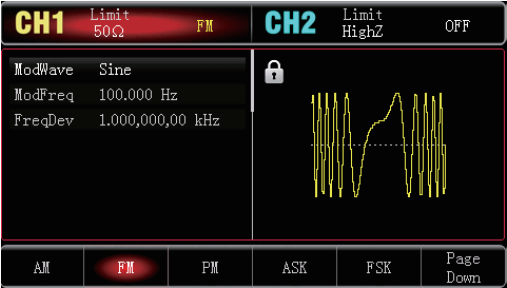
AM, FM, PM, ASK, FSK, PSK, and PWM with internal and external source. All modulation types are available on both standard channels and through the PA output (within the PA's 100 kHz bandwidth limit).
Pulse Burst Function
Three burst modes: N-cycle (1 to 50,000 cycles per trigger), gated, and infinite. Trigger source configurable internal or external, with rising or falling edge selection. The PA output extends burst-mode pulse stimulus to higher-current loads — useful for solenoid testing, relay-coil characterization, and similar workflows where simple voltage-source pulse stimulus is insufficient.
Frequency Sweep
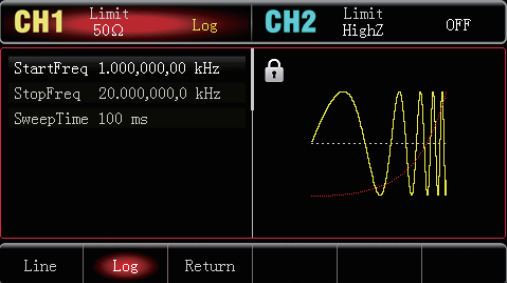
Linear and logarithmic sweep across the full output range. Sweep time 1 ms to 500 s, ±0.1% accuracy. The PA output is particularly valuable for swept stimulus of resonance-prone loads — speaker testing, transducer characterization, and mechanical-resonance identification — where the higher current capability lets the load's actual behavior emerge rather than being masked by source-impedance limits.
Low Jitter
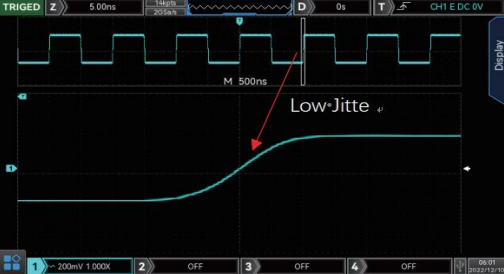
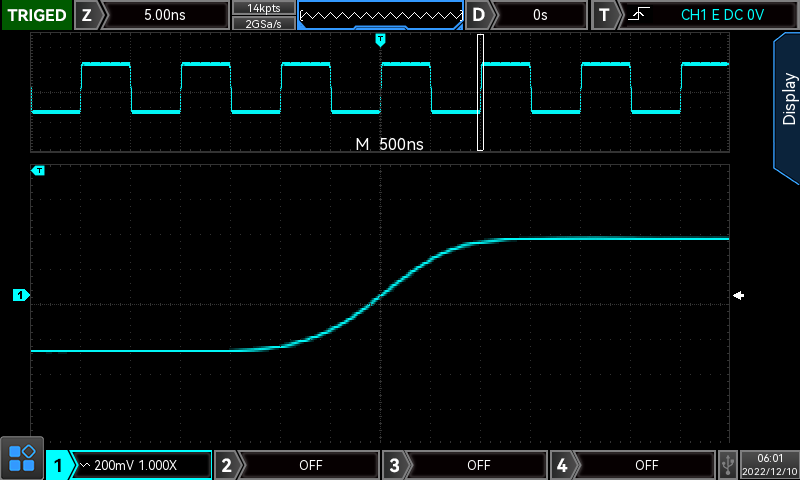
150 ps typical pulse-wave jitter from the digital-sampling architecture. Timing precision carries through to amplified outputs, which matters when the load is sensitive to edge-placement accuracy — magnetic-pickup test, time-domain stimulus characterization.
7-Digit Frequency Counter
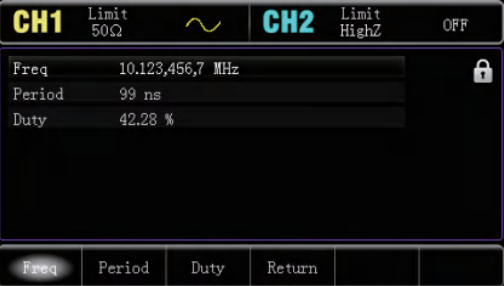
A built-in frequency counter measures external signals from 100 mHz to 200 MHz (TTL compatible). Mounted on the shared front-panel FSK / CNT / Sync BNC, the counter activates when the sync output function is disabled.
Applications
Transducer and Sensor Drive
For piezoelectric transducer drive, magnetic-pickup excitation, and small-coil stimulus, the 4 W PA output delivers current the standard 50 Ω generator output cannot. Typical use: ultrasonic transducer characterization, geophone testing, accelerometer-stand drive, MR-fluid/MR-damper stimulus.
Audio and Vibration Test
For small loudspeaker characterization, vibration table drive, haptic-actuator testing, and audio-amplifier component verification, the built-in PA replaces an external Class-D or Class-AB amplifier in the signal chain. 100 kHz upper limit covers the full audible range plus ultrasonic.
Education and Teaching Labs (Mechatronics, Acoustics)
For curriculum involving real transducer or actuator stimulus — mechatronics labs, acoustics-class instruction, vibration-and-control instruction — the PA option removes the need for a separate amplifier instrument per station. One instrument per student, simpler hookup, lower per-station cost.
Electromechanical Test — Relays, Solenoids, Small Motors
4 W output at moderate-impedance loads drives small solenoids, latching relays, and miniature motors for stimulus testing. Combined with N-cycle and gated burst modes, the UTG1022X-PA replaces a generator-plus-amplifier-plus-pulse-driver chain with one instrument.
SMPS Control-Loop and Feedback-Path Characterization
Frequency-swept stimulus through the PA output characterizes feedback paths and control loops at the higher current levels that reveal nonlinear behavior. The 100 kHz upper limit covers the loop-crossover frequencies of most switching supplies.
In the Box
- UTG1022X-PA waveform generator
- Power cord (region-appropriate)
- USB 2.0 cable, 1.5 m (USB-A to USB-B)
- BNC-to-BNC cable
- BNC-to-alligator-clip lead (red and black)
- Factory calibration certificate
- Quick-start guide
Accessories and Family Options
Included with Every Unit
- Power cord conforming to destination country standard
- USB cable (UT-D04)
- BNC-BNC cable (UT-L45)
- BNC-to-alligator clip cable (UT-L02A)
Family Members
The UTG1000X Essential-Series consists of three SKUs sharing the same chassis, sample rate, modulation set, burst modes, and 16-bit DAC:
- UTG1022X — 20 MHz sine / 10 MHz square (without PA)
- UTG1022X-PA — UTG1022X with built-in 4 W power amplifier (this product)
- UTG1042X — 40 MHz sine / 20 MHz square (without PA)
Step Up — UTG2000B Advanced-Series
For deeper memory, higher sample rate, LAN connectivity, 10 MHz In/Out reference, and a wider modulation envelope — without the built-in PA — the bench-form-factor UTG2025A through UTG2122B Advanced-Series generators cover 25 MHz to 120 MHz sine output. The external UT-M14 10 W power amplifier option pairs with these for amplified-output scenarios at higher generator bandwidths.
Frequently Asked Questions
What loads can the 4 W PA drive directly?
4 W into a typical 8 Ω resistive load works out to about 5.7 V RMS / 17 Vpk — suitable for small audio loads, miniature transducers, magnetic-pickup excitation, and small coil drive. For inductive or capacitive loads with significant reactive component, the > 18 V/µs slew rate matters more than the wattage rating — check the load's impedance vs frequency to verify the PA can sustain the required current.
Can I use the PA output and the standard 50 Ω outputs simultaneously?
Yes. The standard channels remain available for triggering, synchronization, or unrelated stimulus while the PA drives the load. The PA output is sourced from one of the two channels (selectable), and the unused channel is independent.
Why pick the UTG1022X-PA over the UTG1022X plus a separate amplifier?
Three reasons: bench footprint (one instrument vs two), cabling and signal-chain simplicity (no inter-instrument cable, no impedance-match tuning), and cost (the integrated PA is priced below the cost of a separate external amplifier of comparable rating). Trade-off: the PA bandwidth (100 kHz) and rated power (4 W) are fixed — a separate external amplifier can offer more headroom on either axis.
Does the PA output have its own protection circuitry?
Yes. Standard short-circuit protection and overload protection apply to the PA output, the same as the standard generator outputs — an overload disables the output rather than damaging the instrument. Power up and check the output is enabled after clearing a fault condition.
Is the generator side of the UTG1022X-PA identical to the standard UTG1022X?
Yes. All standard generator specifications — frequency range, sample rate, DAC resolution, modulation types, burst modes, sweep, frequency counter, display, USB connectivity — match the standard UTG1022X. The PA option is additive; it does not change any base specifications.
Built-in 4 W power amplifier — 1 µHz to 100 kHz, > 18 V/µs slew rate, dedicated front-panel BNC output
×
16-bit DAC, 65,536 amplitude levels — resolution carries through to the PA output
×
Two standard 50 Ω channels plus the PA output — three output paths on a single instrument
×
7 modulation types across both standard channels and the PA output
×
N-cycle, gated, and infinite burst — available on standard channels and PA output
×
Swept stimulus through the 4 W PA output reveals load resonance behavior
×
150 ps typical pulse-wave jitter — timing precision through the PA output
×
7-digit frequency counter, 100 mHz to 200 MHz
Warranty
This instrument is backed by UNI-T's 3+2 Year Warranty — 3 years of standard coverage, plus 2 additional years free when you register your product. That's 5 years of total protection at no extra cost.
The warranty covers manufacturing defects and component failures under normal use conditions. UNI-T instruments are built for professional daily use, and our warranty reflects that commitment to long-term reliability.
| Frequency | 20MHz |
|---|---|
| Sample Rate | 200MSa/s |
| Channels | 2Ch |
| Memory Depth | 4kpts |
| Instrument Type | Waveform Generator |
Features
- Frequency Counter
- Power Amplifier
Full specifications (30)
| Details | |||||||
|---|---|---|---|---|---|---|---|
| Standard Waveforms | Sine|Square|Ramp|Pulse|Noise|DC|Arbitrary | ||||||
| Built-in Arbitrary Waveforms | 200 | ||||||
| Arb Memory Depth | 4kpts | ||||||
| Vertical Resolution | 16 bits | ||||||
| Square / Pulse Frequency | 10MHz | ||||||
| Modulation Types | AM|FM|PM|ASK|FSK|PSK|PWM | ||||||
| Sweep Type | Linear|Logarithm | ||||||
| Output Impedance | 50Ω | ||||||
| Harmonic Distortion |
|
||||||
| Total Harmonic Distortion | <0.2% | ||||||
| Frequency Counter Range | 100mHz - 200MHz | ||||||
| Output Amplitude Range |
|
||||||
| Rise Time | <16ns | ||||||
| Features | |||||||
| Frequency Counter Bits | 7-digit | ||||||
| Waveform Jitter | 150ps | ||||||
| Phase Noise | ≤-125dBc/Hz | ||||||
| Frequency Range | 1μHz - 20MHz | ||||||
| Frequency Resolution | 1μHz | ||||||
| Storage Temperature | -20°C to +60°C | ||||||
| Pulse Train | N cycle|Gate|Infinite | ||||||
| Amplitude flatness | ±0.3 dB (≤20 MHz) | ||||||
| General Information | |||||||
| Display Size | 4.3in | ||||||
| Display Type | TFT LCD | ||||||
| Display Resolution | 480×272 | ||||||
| Interface | USB-Device|USB-Host|Sync|Cnt|Mod In|Power Out | ||||||
| Operating Temperature | +10°C to +40°C | ||||||
| Dimensions (W×H×D) | 215 × 103 × 316 mm | ||||||
| Weight | 2.2 kg | ||||||
| Warranty | 3+2 years | ||||||
| Certifications | CE|cETLus | ||||||
Data Sheets and Manuals
Older firmware versions (1)
Check your instrument’s hardware revision before updating firmware — different hardware revisions take different builds.
Authentic UNI-T accessories are an affordable way to extend the functionality of your instrument.
