



UNI-T UTG1022X 20 MHz 2Ch Arbitrary Waveform Generator: 16-Bit Dual-Channel Bench Function Generator
Overview
The UNI-T UTG1022X is a 20 MHz dual-channel arbitrary waveform generator built around a 16-bit DAC and 200 MSa/s sample rate. The Essential-Series brings 16-bit signal fidelity to the entry-bench price tier — 65,536 amplitude levels deliver cleaner low-amplitude output and lower quantization noise than the 14-bit DACs typical at this price point.
7 modulation types (AM, FM, PM, ASK, FSK, PSK, PWM), linear and logarithmic sweep, three pulse-burst modes (N-cycle, gated, infinite), and 200 built-in arbitrary waveforms cover the full range of bench signal-generation tasks. A built-in 7-digit frequency counter (100 mHz to 200 MHz) and USB-Host support for thumb-drive arbitrary waveform upload round out a feature set that competes directly with mid-tier generators at significantly higher price points.
Key Features
- 20 MHz sine / 10 MHz square & pulse — dual-channel output with 1 µHz frequency resolution, 20 Vpp maximum amplitude (high-Z), full amplitude maintained at maximum frequency.
- 16-bit vertical resolution — 65,536 amplitude levels. 4× the resolution of the 14-bit DACs typical at this price point, reducing quantization noise and improving signal purity.
- 200 MSa/s sample rate — 10 sample points per cycle at maximum sine frequency, supporting accurate waveform reconstruction without staircasing.
- 200 built-in arbitrary waveforms — comprehensive library of standard, mathematical, medical, and engineering waveform shapes. 4 kpts arbitrary waveform length for custom shapes.
- 7 modulation types — AM, FM, PM, ASK, FSK, PSK, PWM — internal and external source. Adds digital-modulation capability beyond what the UTG900E Classic-Series provides.
- Pulse burst function — three modes (N-cycle, gated, infinite) with internal or external trigger, rising or falling edge.
- Built-in 7-digit frequency counter — 100 mHz to 200 MHz input range.
- Low jitter, low harmonic distortion — 150 ps typical pulse-wave jitter; THD < 0.2% (DC to 20 kHz, 1 Vpp).
- USB-Device and USB-Host — PC SCPI control plus direct thumb-drive arbitrary waveform upload, without computer-tethering.
UNI-T UTG1022X Details
16-Bit Vertical Resolution
A 16-bit DAC provides 65,536 amplitude levels — 4× the resolution of typical 14-bit Essential-tier generators. This reduces quantization-noise floor and produces measurably cleaner output, particularly on low-amplitude signals where 14-bit step error becomes audible or visible. For applications like ADC linearity testing, audio characterization, and sensor-front-end stimulus, the extra DAC bits translate directly into lower SNR-floor measurement results.
Dual-Channel Output with Same Function
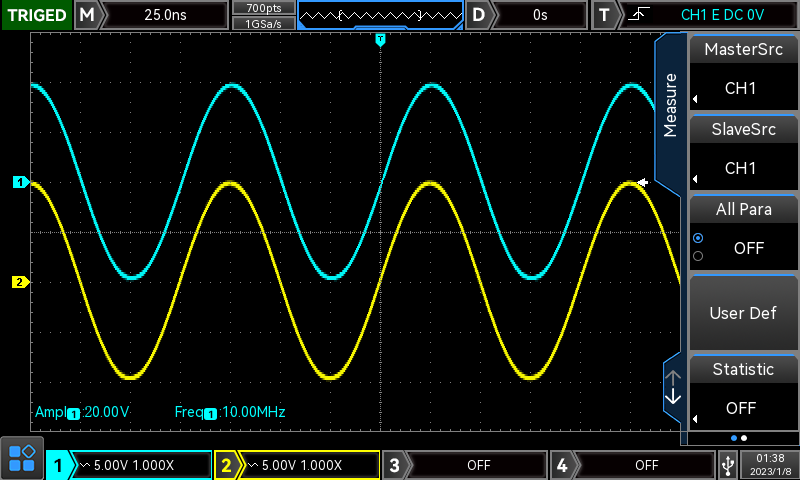
Both channels deliver the full feature set independently: same waveforms, same modulation, same burst and sweep. The full 20 Vpp output amplitude (high-Z) is maintained on both channels at 10 MHz — no derating with channel-count or frequency. For applications requiring synchronized stimulus (differential signals, two-tone testing, phase-locked stimulus), the second channel doesn't cost a capability.
7 Modulation Types
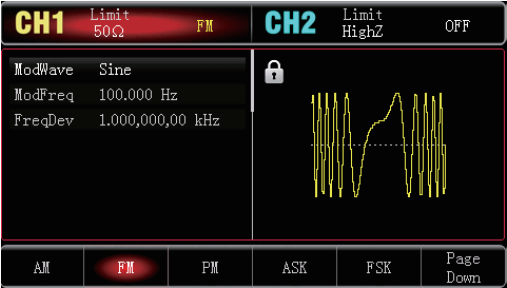
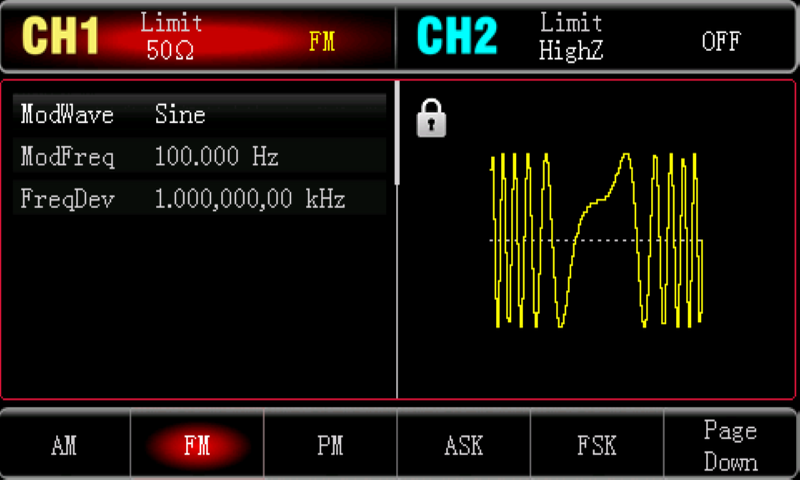
AM, FM, PM, ASK, FSK, PSK, and PWM with internal and external source. The digital modulation types (ASK, FSK, PSK) cover communications testing scenarios that analog-only generators cannot. Modulation source is configurable internal or external for ASK/FSK/PSK; PWM accepts external modulation input. Modulation frequency range extends to 1 MHz on AM/FM/PM/PWM.
Pulse Burst Function
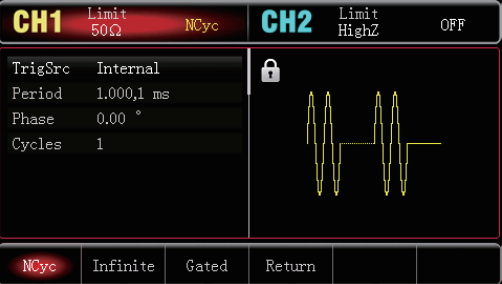
Three burst modes: N-cycle (output 1 to 50,000 cycles per trigger), gated (output while gate is asserted), and infinite (continuous after trigger). Trigger source is configurable internal or external, with rising or falling edge selection. For pulse-train stimulus — relay activation, motor-drive testing, microcontroller interrupt simulation — burst output replaces a manual pulse generator in the workflow.
Frequency Sweep
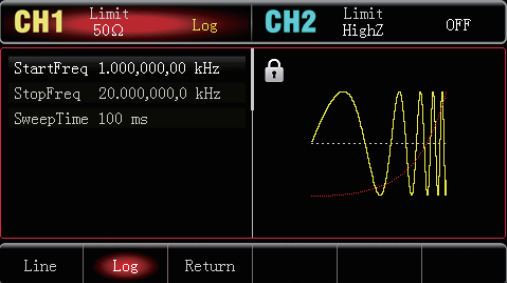
Linear and logarithmic sweep modes for component characterization. Sweep time spans 1 ms to 500 s with ±0.1% accuracy — fast enough for sweep-and-trigger work, long enough for filter Bode plots and resonance characterization. Carrier waveforms include sine, square, ramp, and arbitrary, so sweeps can use any of the standard output shapes.
High SNR on Low-Amplitude Outputs
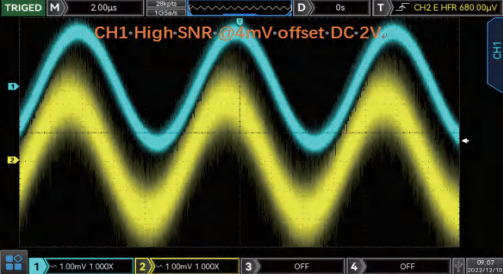
When small AC signals ride on top of a large DC offset (a typical bias configuration for op-amp characterization or sensor simulation), the UTG1022X maintains output cleanliness without the noise pickup that scales-down to compensate. Combined with the 16-bit DAC, this means low-amplitude work on a DC pedestal stays usable down to the millivolt range.
Low Jitter
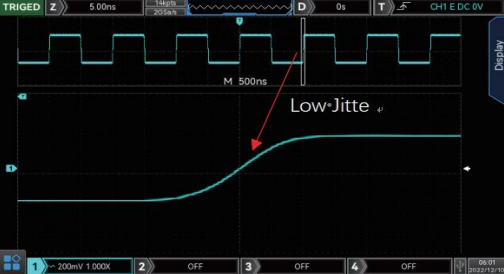
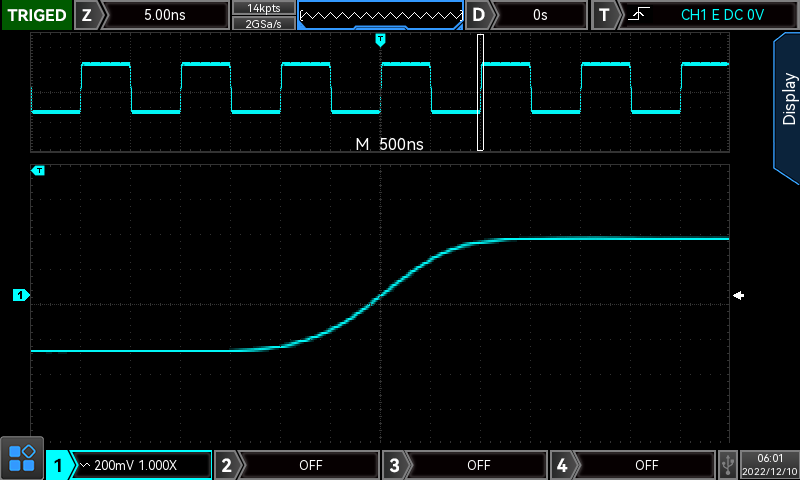
150 ps typical pulse-wave jitter from the digital-sampling architecture. For applications that depend on timing precision — serial-bus stimulus, clock-edge characterization, time-domain reflectometry probes — the jitter floor matters more than the bandwidth headline. Below 5 MHz square output, jitter is specified as 2 ppm + 200 ps; above 5 MHz, the floor is 200 ps.
7-Digit Frequency Counter
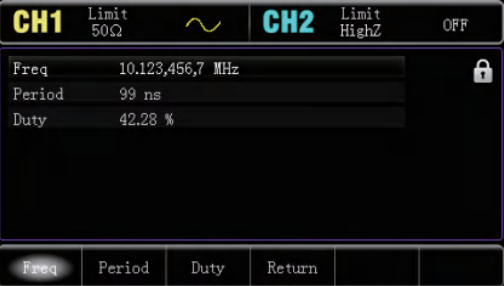
A built-in frequency counter measures external signals from 100 mHz to 200 MHz (TTL compatible). Mounted on the shared front-panel FSK / CNT / Sync BNC, the counter activates when the sync output function is disabled. For bench setups that don't justify a dedicated counter, this means frequency measurement is available alongside the generator without additional hardware.
Arbitrary Waveform Editor
200 built-in arbitrary waveforms cover standard engineering shapes — from sinx-over-x and gaussian to medical-and-biology profiles. The upper-computer software extends this with custom waveform creation: point-by-point drawing, math-expression generation, CSV import. Custom waveforms transfer over USB-Device for SCPI workflows, or via USB-Host from a thumb drive for direct-import scenarios without a connected computer.
Applications
Engineering Bench — Primary Function Generator
For most product-development bench work, the UTG1022X covers the daily-use envelope: dual-channel signal source, modulation across analog and digital scenarios, burst-mode pulse stimulus, and sweep for filter and amplifier characterization. 16-bit DAC keeps the output clean enough for ADC characterization down into the millivolt range.
Education and Teaching Labs (Advanced)
For signals-and-systems labs, communications-class instruction, and digital-systems courses, the UTG1022X covers the curriculum — all four basic analog modulations (AM, FM, PM), the three core digital modulations (ASK, FSK, PSK), and PWM in one instrument. USB-Host arbitrary-waveform upload enables student-designed waveforms without a computer-tethering hassle.
Switching-Mode Power Supply and Filter Characterization
Linear and logarithmic frequency sweep across the 20 MHz output range covers SMPS control-loop characterization, EMI filter response measurement, and crystal-oscillator pull testing. Sweep time configurable 1 ms to 500 s lets the measurement match the dynamics being characterized.
Sensor and Transducer Stimulus
16-bit resolution and 1 µHz frequency resolution support precise stimulus for sensor characterization, ADC linearity testing, and op-amp behavioral testing. Dual independent channels enable differential-input testing without a second instrument.
Production Test and QC Bench
For repeated bench-test scenarios — relay testing, motor-drive stimulus, communications-link verification — the UTG1022X's SCPI command set enables script-based test automation. Burst modes support cycle-counted stimulus that production tests rely on for repeatability.
In the Box
- UTG1022X waveform generator
- Power cord (region-appropriate)
- USB 2.0 cable, 1.5 m (USB-A to USB-B)
- BNC-to-BNC cable
- BNC-to-alligator-clip lead (red and black)
- Factory calibration certificate
- Quick-start guide
Accessories and Family Options
Included with Every Unit
- Power cord conforming to destination country standard
- USB cable (UT-D04)
- BNC-BNC cable (UT-L45)
- BNC-to-alligator clip cable (UT-L02A)
Recommended Options
- UT-M14 — 10 W external power amplifier option
Family Members
The UTG1000X Essential-Series consists of three SKUs sharing the same chassis, sample rate, modulation set, burst modes, and 16-bit DAC:
- UTG1022X — 20 MHz sine / 10 MHz square (this product)
- UTG1022X-PA — UTG1022X with built-in 4 W power amplifier (1 µHz to 100 kHz output, > 18 V/µs slew rate)
- UTG1042X — 40 MHz sine / 20 MHz square
Step Up — UTG2000B Advanced-Series
For deeper memory (16 Mpts vs 4 kpts arbitrary length), higher sample rate (320 MSa/s on UTG2062B), LAN connectivity, 10 MHz In/Out reference, and a wider modulation envelope (1 MHz modulating frequencies on AM/FM/PM up to higher carrier rates), the bench-form-factor UTG2025A, UTG2062B, UTG2082B, and UTG2122B Advanced-Series generators cover 25 MHz, 60 MHz, 80 MHz, and 120 MHz sine output respectively.
Frequently Asked Questions
Why does the 16-bit DAC matter when most generators in this price range use 14-bit?
16-bit gives 65,536 amplitude levels vs 14-bit's 16,384 — a 4× improvement in vertical resolution. The practical effect is a lower quantization-noise floor and cleaner low-amplitude output. For ADC linearity testing, audio characterization, sensor stimulus, and other work where the signal-to-noise floor of the source matters, the extra DAC bits translate directly into more accurate measurement results.
Can I upload arbitrary waveforms without connecting a PC?
Yes. The UTG1022X has both USB-Device and USB-Host. USB-Host accepts standard USB thumb drives — waveforms saved as compatible files can be loaded directly into the 200 arbitrary-waveform stores without a PC connection. Custom waveforms are created in the upper-computer software (point-by-point drawing, math-expression generation, or CSV import) and exported to USB.
What's different between the UTG1022X and the UTG1042X?
Maximum output frequency. The UTG1042X extends sine output to 40 MHz and square / pulse to 20 MHz. All other specifications — chassis, sample rate, DAC, modulation, burst, sweep, frequency counter, display, connectivity — are identical.
What's different about the UTG1022X-PA?
The -PA adds a built-in 4 W power amplifier with 1 µHz to 100 kHz output range and > 18 V/µs slew rate. The PA output sits on a separate front-panel BNC. Useful for driving transducers, audio loads, small coils, and other inputs where the standard 50 Ω output's current drive is insufficient. Generator specifications are otherwise identical to the standard UTG1022X.
Does the UTG1022X support SCPI command control?
Yes. SCPI command set is documented in the UTG1000X Programming Manual; control is over USB-Device. The command subset differs from larger UTG2000B/X and UTG4000A bench generators — scripts written for one series should not be assumed to port directly to another.
16-bit DAC, 65,536 amplitude levels — 4× the resolution of typical 14-bit Essential-tier generators
×
Full 20 Vpp amplitude maintained on both channels even at maximum output frequency
×
7 modulation types — AM, FM, PM, ASK, FSK, PSK, PWM
×
N-cycle, gated, and infinite burst modes with internal or external trigger
×
Linear or logarithmic sweep, 1 ms to 500 s sweep time
×
Small AC signals stay clean even when superimposed on large DC offset
×
150 ps typical pulse-wave jitter — floor of 200 ps above 5 MHz square output
×
7-digit frequency counter, 100 mHz to 200 MHz, shared FSK / CNT / Sync BNC
×
200 built-in arbitrary waveforms + custom upload via USB-Device or USB-Host thumb drive
Warranty
This instrument is backed by UNI-T's 3+2 Year Warranty — 3 years of standard coverage, plus 2 additional years free when you register your product. That's 5 years of total protection at no extra cost.
The warranty covers manufacturing defects and component failures under normal use conditions. UNI-T instruments are built for professional daily use, and our warranty reflects that commitment to long-term reliability.
| Frequency | 20MHz |
|---|---|
| Sample Rate | 200MSa/s |
| Channels | 2Ch |
| Memory Depth | 4kpts |
| Instrument Type | Waveform Generator |
Features
- Frequency Counter
Full specifications (30)
| Details | |||||||
|---|---|---|---|---|---|---|---|
| Standard Waveforms | Sine|Square|Ramp|Pulse|Noise|DC|Arbitrary | ||||||
| Built-in Arbitrary Waveforms | 200 | ||||||
| Arb Memory Depth | 4kpts | ||||||
| Vertical Resolution | 16 bits | ||||||
| Square / Pulse Frequency | 10MHz | ||||||
| Modulation Types | AM|FM|PM|ASK|FSK|PSK|PWM | ||||||
| Sweep Type | Linear|Logarithm | ||||||
| Output Impedance | 50Ω | ||||||
| Harmonic Distortion |
|
||||||
| Total Harmonic Distortion | <0.2% | ||||||
| Frequency Counter Range | 100mHz - 200MHz | ||||||
| Output Amplitude Range |
|
||||||
| Rise Time | <16ns | ||||||
| Features | |||||||
| Frequency Counter Bits | 7-digit | ||||||
| Waveform Jitter | 150ps | ||||||
| Phase Noise | ≤-125dBc/Hz | ||||||
| Frequency Range | 1μHz - 20MHz | ||||||
| Frequency Resolution | 1μHz | ||||||
| Storage Temperature | -20°C to +60°C | ||||||
| Pulse Train | N cycle|Gate|Infinite | ||||||
| Amplitude flatness | ±0.3 dB (≤20 MHz) | ||||||
| General Information | |||||||
| Display Size | 4.3in | ||||||
| Display Type | TFT LCD | ||||||
| Display Resolution | 480×272 | ||||||
| Interface | USB-Device|USB-Host|Sync|Cnt|Mod In | ||||||
| Operating Temperature | +10°C to +40°C | ||||||
| Dimensions (W×H×D) | 215 × 103 × 316 mm | ||||||
| Weight | 2.2 kg | ||||||
| Warranty | 3+2 years | ||||||
| Certifications | CE|cETLus | ||||||
Data Sheets and Manuals
Older firmware versions (1)
Check your instrument’s hardware revision before updating firmware — different hardware revisions take different builds.
Authentic UNI-T accessories are an affordable way to extend the functionality of your instrument.
