
DC Switching Power Supplies
Switching DC power supplies use high-frequency conversion to deliver high power density in compact form factors, the right choice for component validation, motor and battery testing, automotive bench work, and any application where output power matters more than absolute noise floor. The switching line covers three families across 30 SKUs — UDP6700 single-channel units (100–360 W), UDP6900 multi-channel programmable supplies (100–600 W), and UDP5000 single-output supplies spanning 400 W to 2 kW with output classes from 40 V to 800 V.

DC Switching Power Supplies
| Type | Channels | Total Power | Output Voltage | Output Current | Resolution | Connectivity | |
|---|---|---|---|---|---|---|---|
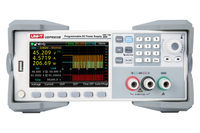
|
Switching | 1 | 600W | 0 - 150V | 0 - 25A | 1mV/0.1mA | USB, LAN, RS232, RS485, I/O |
| UDP6900 Switching Power Supplies | |||||||
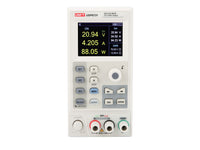
|
Switching | 1 | 360W | 0–80V | 0–30A | 10 mV/1mA | RS232, Sense |
| UDP6700 Switching Power Supplies | |||||||
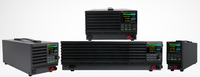
|
— | — | — | — | — | — | — |
| UDP5000 Power Supplies | |||||||
Buying Guide
UNI-T DC Switching Power Supply — Buyer's Guide
Why Switching?
A switching converter chops the input voltage at high frequency and reconstructs the regulated output through a transformer or inductor. The result: high efficiency, light weight, programmable output across a wide V/A envelope, and high power — at the cost of some switching ripple (typically well-filtered) and slightly slower transient response than a comparable linear.
You want switching when the work needs real power (above a few hundred watts), real voltage (above 250 V), constant-power flexibility (one supply covers wide V/I ranges instead of one supply per voltage class), or programmability under SCPI for automated test. If you need sub-millivolt ripple for noise-sensitive analog or RF receivers, switching's tens-of-mV ripple may not work — see DC Linear Power Supplies instead.
What Every UNI-T Switching PSU Shares
Decision 1: Match the Voltage Class to the Work
UNI-T's switching catalog spans 40 V to 800 V output across six voltage classes. Pick the smallest class that comfortably exceeds the maximum voltage your DUT will see.
| Voltage class | Family | Best for |
|---|---|---|
| 40 V | UDP5040, UDP6730 | USB-PD chargers, 12V/24V automotive, low-voltage motors, battery cells under 36V |
| 60 V | UDP6720/6721, UDP6922B/6932B/6942B/6952B | 48V telecom rails, 24V industrial, multi-cell Li-ion (up to 14S), e-bike |
| 80 V | UDP5080, UDP6731 | 72V tractor-traction batteries, mid-voltage motor drives, light-EV testing |
| 150 V | UDP6933B, UDP6953B | 96V battery packs, industrial DC bus simulation, EV auxiliary systems |
| 160 V | UDP5160 | Mid-voltage power electronics, EV traction battery characterization |
| 250 V | UDP5250 | Industrial DC bus, mid-voltage drives, solar microinverter validation |
| 800 V | UDP5800 (within UDP5000 family) | EV traction battery, high-string PV testing, industrial high-voltage DC bus, >250V research |
Decision 2: Match the Power to the Load
UNI-T's switching catalog covers 100 W to 2000 W per chassis. Pick the smallest power class that comfortably exceeds your worst-case continuous load — switching architecture means oversizing has very little efficiency penalty, but undersizing means the supply current-limits and the test stops.
| Power class | Examples | Best for |
|---|---|---|
| 100–200 W | UDP6720, UDP6922B, UDP6932B, UDP6933B | Logic boards, sensor electronics, small DUT validation |
| 360–600 W | UDP6730/6731, UDP6942B/6952B/6953B | Mid-power test, motor controllers, battery formation, telecom rails |
| 400–800 W | UDP5040-40/80, UDP5080-20/40, UDP5160-8/16, UDP5800-2/4 | Higher-power test, fuel-cell test, mid-class EV components, solar inverter input |
| 1200 W | UDP5040-120, UDP5080-60, UDP5160-24, UDP5250-18, UDP5800-6 | Heavy-duty test, EV battery formation, industrial drive characterization |
| 2000 W | UDP5040-200, UDP5080-100, UDP5160-40, UDP5250-30, UDP5800-10 | Production validation, high-voltage PV, traction batteries, industrial DC bus loads |
The Switching Families
UDP5000 Series
UDP6700 Series
UDP6900 Series
Recommended Configurations
EV traction-battery test (> 250 V)
Pick: UDP5800-2 through UDP5800-10 — 800 V output covers 96V, 400V, and 800V EV pack architectures. Pick the power class by your worst-case formation or discharge rate. The 800V tier within the UDP5000 family.
Solar / PV string testing
Pick: UDP5250-30 or UDP5800-6 — 250V single-supply for residential and small-commercial string voltages; 800V UDP5800 for utility-scale string testing. Constant-power architecture covers Vmp/Imp variation across irradiance conditions.
Industrial DC bus simulation
Pick: UDP5160 or UDP5250 — 160V or 250V at 800W–2kW covers most 48V/96V/220V DC bus testing for industrial drives, telecom rails, and DC microgrids.
Programmable bench supply, mid-power
Pick: UDP6900 series or UDP6700 series — compact benchtop chassis, 100–600W, 40V to 150V class. Smaller and lower-cost than the UDP5000 line when you don't need the 2kW envelope or rack format.
Battery formation and cycling
Pick: UDP5040-80, UDP5040-120, or UDP5080-60 — 800–1200W with wide V/I envelope across 40–80V class. Constant-power architecture handles formation profiles where current drops as cell voltage rises.
USB-PD and low-voltage device test
Pick: UDP5040-40 or UDP6720 — 40V/60V class covers the full USB-PD range (5V–48V), automotive 12V/24V test, and small consumer-device validation at modest power.
Why Choose UNI-T Switching PSUs?
Constant-power architecture
Most models deliver rated power across the full V/I envelope, not just at maximum voltage. A UDP5160-40 supplies 2 kW at 80V/25A, 160V/12.5A, or anywhere in between — one chassis covers what would otherwise require multiple fixed-voltage supplies.
Programmable across the line
Every UDP-series switching supply ships with SCPI over USB and at least one of RS-232, LAN, or both. No "programmable variant" upcharge — full automation is standard.
800 V class available
The UDP5800 tier (within UDP5000) is the only practical option in the UNI-T line for EV traction batteries and high-voltage PV. Same chassis architecture, same SCPI, same protections as the rest of the UDP5000 platform — just at a voltage class most competitors cap below.
3+2 year warranty
Three-year base warranty, two additional years on registration. Parts, labor, return shipping included. Longer than typical 1- and 2-year warranties on switching supplies at this power class.
FAQ
How much ripple do these supplies have?
UNI-T switching supplies hold ripple typically below 50 mV peak-to-peak, well-filtered by output stage capacitance and the constant-power topology. That's tens of millivolts in absolute terms — fine for battery, motor, PV, and industrial loads, but higher than linear's sub-millivolt class. If your application is RF receivers or audio gear measuring below −60 dBc, linear is the right choice instead.
What's "constant-power architecture" and why does it matter?
A fixed-voltage supply gives you full current only at maximum voltage. A constant-power supply delivers rated power (Vmax × Imax) at any combination across the V/I envelope. For battery formation where cell voltage rises during charge, or PV testing where Vmp shifts with irradiance, one constant-power supply replaces what would otherwise require multiple fixed-voltage units to span the operating range.
I need both linear-class noise and switching-class power. What do I do?
Two supplies in series. Use a switching supply to bulk-power the load and a linear supply as a post-regulator for the noise-sensitive section of your DUT. This is standard practice in mixed-signal designs — the digital section runs from the switching rail; the analog front-end gets its own linear rail downstream.
Why pick UDP5800 (800V) over the UDP5250 (250V) for an EV battery test?
EV traction packs run at 400V (legacy), 800V (current generation Porsche, Hyundai E-GMP, Audi PPE), and rising. A 250V supply caps before the modern pack's nominal voltage; an 800V supply covers the full nominal-plus-headroom range. UDP5800 is the only tier in the UNI-T catalog that reaches 800V output, making it the de facto choice for current-generation EV traction work.
Can I parallel two supplies for higher current?
UNI-T switching supplies are designed as standalone instruments — no native master/slave pairing. Some users parallel two supplies externally with current sharing controlled by setting one as the CV source and the other as the CC contributor, but this requires care to avoid current-fighting between regulators. If your power requirement exceeds the catalog's 2000W ceiling at your voltage class, contact UNI-T support to discuss higher-power custom or specially configured options.
What's the SCPI command set compatible with?
Standard SCPI 1999 with extensions for list-mode sequencing, captured measurement readback, and protection-event logging. Compatible with LabVIEW (VISA driver), Python (pyvisa), MATLAB Instrument Control Toolbox, and any framework that speaks IEEE 488.2 SCPI.
Match voltage class to your DUT, power class to your worst-case load. UDP5000 (including UDP5800 800V tier) for the heavy work; UDP6700 and UDP6900 for compact bench.

